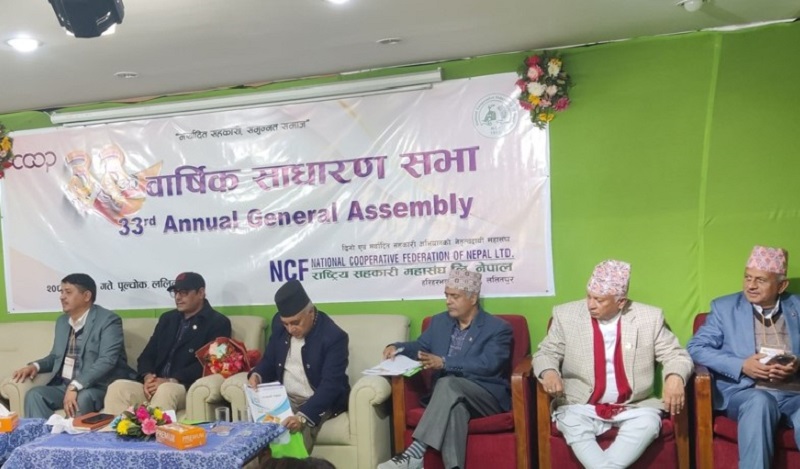
National Cooperative Federation Nepal Concludes 33rd Annual General Meeting

12th January 2026, Kathmandu
The National Cooperative Federation Nepal (NCF) has successfully concluded its 33rd Annual General Meeting in Kathmandu, with a strong emphasis on restoring public trust and strengthening transparency within the cooperative sector.
National Cooperative Federation AGM
The event, held on Sunday, Poush 27, 2082 (January 11, 2026), highlighted the cooperative movement’s role as a key pillar of Nepal’s economy while addressing the systemic challenges currently facing the industry.

Government Emphasizes Cooperative Sector Reform
Inaugurating the general meeting, Madhav Prasad Chaulagain—who currently holds additional portfolios as the Minister for Physical Infrastructure and Transport as well as Forest and Environment—stated that the cooperative movement remains a strong foundation of Nepal’s economic system. He stressed that addressing the liquidity and governance challenges within the cooperative sector is a shared responsibility of the government and all stakeholders.
The minister underscored the need to make cooperatives transparent, accountable, and trustworthy to further reinforce their contribution to national economic prosperity. He noted that without public confidence, the pillar of the “three-pillar economy” (public, private, and cooperative) would struggle to remain stable.
Regulatory Challenges and Public Trust
Speaking at the assembly, Cooperative Department Registrar Sushil Dhakal expressed a firm commitment to working closely with the cooperative movement to resolve existing issues. He noted that regulatory oversight has emerged as the biggest challenge facing the sector today, especially with the rise in problematic cooperatives.
Dhakal emphasized the importance of the following key areas for reform:
- Uniform and clear regulatory mechanisms across all levels of government.
- Effective and proactive monitoring of financial health within cooperatives.
- Policy-level reforms to protect depositors’ interests and maintain public confidence.
He admitted that maintaining people’s trust is inevitable for the survival of the movement and promised that the department would be more proactive in its supervisory duties.
Call for Strong Leadership and Institutional Integrity
During the opening session, a group of distinguished federation advisors—including Keshav Badal, Deepak Prakash Banskota, Khagaraj Adhikari, Devendra Raj Kadel, Lilamani Paudel, Ganesh Shah, and Usha Jha—shared their perspectives on the federation’s path forward.
Advertisement

They highlighted the increasing pressure on the cooperative sector due to the current economic climate, growing trust deficits among depositors, and policy ambiguity. The advisors collectively stated that decisive and strong leadership from the federation is essential at this critical juncture to advocate for the sector and guide primary cooperatives toward better management practices.
Federation Reports and Policy Proposals
The technical session of the AGM was led by Acting President Ramesh Pokharel, who presented the federation’s comprehensive progress report for the fiscal year 2081/82. Vice President Khem Pathak delivered the welcome address, framing the meeting as a turning point for the industry.
Significant administrative steps were taken during the meeting, including:
Statute Amendments: Vice President DB Basnet presented proposals to amend the federation’s statute to better align with current federal laws.
Future Programs: Vice President Indira Pant outlined the federation’s strategic programs and budget for the upcoming fiscal year 2082/83.
Financial Transparency: The federation’s General Manager presented the audited financial report to the assembly for shareholder review and approval.
Conclusion
The 33rd Annual General Meeting of the National Cooperative Federation Nepal concluded with a strong consensus on rebuilding credibility, improving regulatory clarity, and strengthening institutional governance. Participants expressed confidence that coordinated efforts among government agencies, regulators (such as the Department of Cooperatives), and the cooperative institutions themselves will help restore trust.
As the federation moves into its next operational cycle, the focus will remain on ensuring the sustainable growth of Nepal’s cooperative sector, protecting the savings of millions of members, and re-establishing the sector as a reliable engine for local economic development.
For More: National Cooperative Federation AGM