
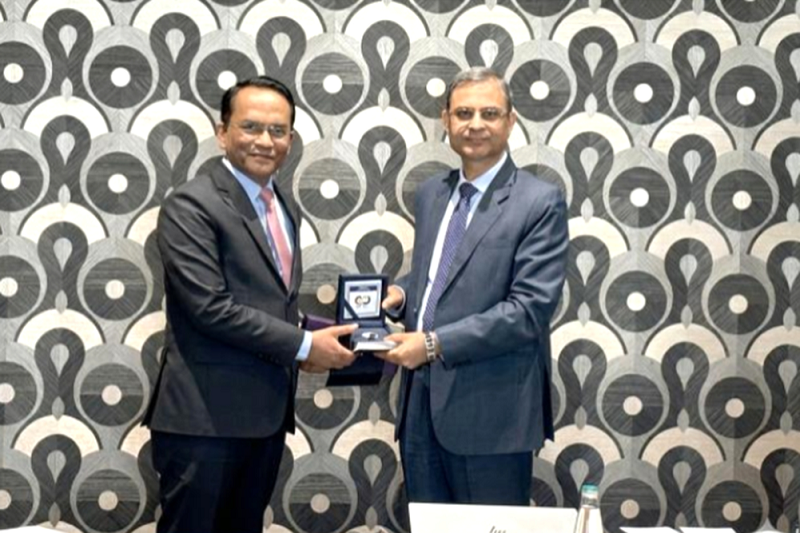
NRB RBI Governors Meeting Enhances Cross-Border Payments

26th January 2026, Kathmandu
The financial relationship between Nepal and India has reached a new milestone following a high-level meeting between the governors of their respective central banks. Nepal Rastra Bank (NRB) Governor Biswo Nath Poudel and Reserve Bank of India (RBI) Governor Sanjay Malhotra met recently to discuss a strategic roadmap for financial integration.
NRB RBI Governors Meeting
This summit, held against the backdrop of rapidly evolving digital economies, focused on making cross-border transactions easier for citizens while enhancing the regulatory frameworks that govern both nations’ financial systems. The discussions highlighted a shared vision for a seamless digital payment corridor that could redefine economic interactions in the South Asian region.

Advancing Digital Payment Integration and QR Facilitation
The most anticipated outcome of the meeting is the formal commitment to facilitate QR code-based payments for Nepali citizens traveling to India. While Indian tourists in Nepal have already begun utilizing UPI-based QR payments at many Nepalese merchants, the reciprocal facility for Nepali travelers in India has been a long-standing demand. Governors Poudel and Malhotra explored the technical and regulatory requirements to bridge this gap.
By integrating Nepal’s National Payments Interface (NPI) with India’s Unified Payments Interface (UPI), the two central banks aim to allow Nepali travelers to pay for goods and services in India using their local mobile banking apps. This move is expected to:
- Eliminate the need for carrying large amounts of physical cash.
- Reduce the reliance on currency exchange counters.
- Provide a secure, real-time transaction record for both consumers and businesses.
- Lower transaction costs associated with traditional cross-border fund transfers.
- Strategic Coordination on Monetary and Supervisory Policies
Beyond the consumer-facing digital payments, the governors engaged in deep discussions regarding monetary policy coordination. Given the pegged exchange rate between the Nepalese Rupee and the Indian Rupee, maintaining a synchronized approach to liquidity management and inflation control is vital for economic stability. The meeting served as a platform to share insights on how both central banks are navigating global economic shifts and domestic price pressures.
Furthermore, the summit highlighted the importance of modernizing financial supervision. Both governors expressed a keen interest in deploying Artificial Intelligence (AI) and Machine Learning (ML) for real-time monitoring of banking activities. These emerging technologies are seen as essential tools for:
Advertisement

- Identifying fraudulent patterns in cross-border remittances.
- Automating risk assessments for commercial banks.
- Enhancing the efficiency of regulatory reporting.
- Ensuring the integrity of the bilateral financial system against cyber threats.
- Deepening Institutional Cooperation and Technical Exchange
The presence of executive directors from key departments—including Foreign Exchange Management and Bank Supervision—underscored the technical depth of the meeting. The two central banks agreed to establish a continuous coordination mechanism to share best practices and conduct capacity-building programs for their staff. This institutional exchange is intended to harmonize regulatory standards, making it easier for financial institutions in both countries to operate across borders.
This collaborative spirit extends to the management of foreign exchange reserves. Governor Poudel and Governor Malhotra discussed safe and profitable avenues for reserve investment, including potential cooperation in gold purchases and other global financial instruments. Such initiatives are designed to strengthen the external sector stability of both nations, ensuring they remain resilient to international market volatility.
Economic and Social Impact of Financial Integration
The implications of this governors’ meeting are far-reaching. For the millions of Nepali citizens who visit India for medical treatment, education, or employment, the ease of digital payments represents a significant improvement in quality of life. Economically, the move toward a cashless cross-border corridor is expected to bring more transactions into the formal banking sector, thereby increasing transparency and reducing the scope for informal “Hundi” channels.
As digital financial literacy grows in the region, the successful implementation of these agreements will serve as a model for regional cooperation within the SAARC and BIMSTEC frameworks. The partnership between NRB and RBI is not just about technology; it is about building a foundation for sustainable economic growth and financial inclusion that benefits the grassroots population of both countries.
Conclusion
The recent summit between Governor Biswo Nath Poudel and Governor Sanjay Malhotra marks a decisive step toward a more integrated financial future for Nepal and India. By prioritizing QR code payment facilitation, AI-driven supervision, and monetary policy alignment, the two central banks are addressing the needs of a modern, digital-first society. As these initiatives move from discussion to implementation, they are set to transform the way people move money across the border, fostering stronger economic ties and mutual prosperity.
For More: NRB RBI Governors Meeting