Lumbini Bank Supports School: A Heartwarming Step Toward Better Education in Nuwakot

6th April 2026, Kathmandu
In a commendable move that highlights the importance of corporate social responsibility, Lumbini Development Bank CSR initiatives have extended vital support to a local educational institution in Nuwakot.
Lumbini Bank Supports School
This recent contribution reflects how leading financial institutions in Nepal can play a crucial role in uplifting community infrastructure, particularly within the foundational education sector in 2026.
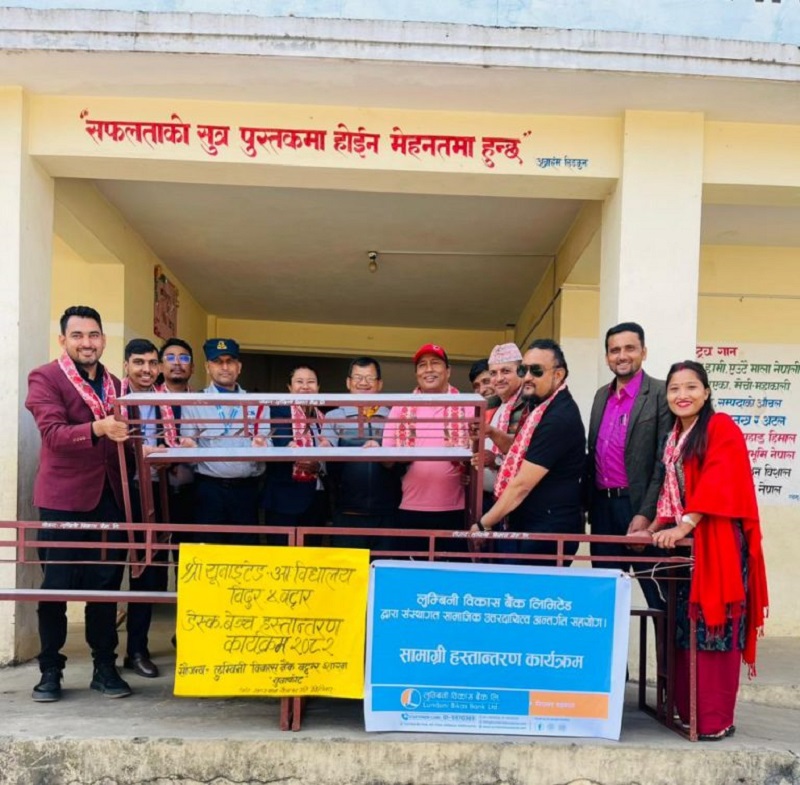
The bank’s Battar branch recently provided essential classroom furniture, including high-quality desks and benches, to United Basic School located in Ward No. 4 of Bidur Municipality. This support is expected to significantly improve the learning environment for students who previously faced challenges due to inadequate seating arrangements.

Strengthening Education Through Corporate Social Responsibility
The contribution was made as part of the bank’s formalized corporate social responsibility program, which targets health, education, and environmental sustainability across Nepal. According to branch chief Ajaya Acharya, the bank is deeply committed to contributing to the development of local communities through meaningful and tangible initiatives.
During the handover ceremony, the desks and benches were officially presented to key local representatives. The event saw the participation of:
Nilam Babu Dhungel: Ward Chairperson of Bidur Municipality-4
Devanarayan Chitrakar: School Management Committee Chairperson
Ramesh Kumar Shrestha: School Principal
Acharya emphasized that the Lumbini Development Bank CSR strategy is built on long-term engagement. He reaffirmed the bank’s dedication to supporting education and community welfare, noting that similar initiatives would continue to roll out across other branches in the future.
Positive Impact on Students and Teachers in Bidur
The donation of desks and benches may seem like a simple logistical upgrade, but it has a profound impact on the daily learning experiences of students in rural and semi-urban areas of Nuwakot. Proper seating is a fundamental requirement for a functional classroom.
Benefits of Improved Classroom Furniture:
Enhanced Focus: Ergonomic seating allows students to sit comfortably for longer periods, reducing physical restlessness.
Improved Discipline: Structured seating arrangements help teachers manage classroom flow and student interaction more effectively.
Advertisement

Better Health: Quality benches prevent postural issues that can arise from sitting on floor mats or broken furniture.
Teacher Morale: A well-equipped classroom provides teachers with a more professional environment to deliver their lessons.
School authorities expressed their heartfelt gratitude for the support. Ward chairperson Nilam Babu Dhungel highlighted how such contributions from the private sector bring immediate relief to the school’s budget and provide long-term benefits for the children of Bidur.
Community Collaboration for Better Infrastructure
This initiative demonstrates how effective collaboration between local government, educational institutions, and private organizations can lead to rapid and tangible improvements. The event was attended by a diverse group of stakeholders, including ward member Chhabi Raj Ojha, local teachers, and bank staff, all of whom acknowledged the significance of the contribution.
Community-driven development is the backbone of sustainable progress in Nepal. When organizations like Lumbini Development Bank step forward with their CSR funds, they provide a spark that often inspires other local businesses and individuals to contribute to their local schools and health posts.
Why School Infrastructure Matters in Nepal
Quality education in the 2080s is not only about digital textbooks and qualified teachers. Physical infrastructure—such as sturdy desks, benches, weather-proof classrooms, and clean sanitation facilities—directly influences learning outcomes. In many parts of Nepal, schools still struggle with inadequate basic resources, which can lead to higher dropout rates.
By addressing these physical gaps, the Lumbini Development Bank CSR program helps create a sanctuary where students can thrive academically without being hindered by their surroundings. Improved infrastructure also encourages higher attendance rates and better overall engagement among young learners.
A Model for Other Financial Institutions
The effort by Lumbini Development Bank sets a strong example for other development banks and corporate entities across the country. Investing in education is widely regarded as one of the most impactful ways a corporation can contribute to national development.
Such initiatives align with the broader national goals of:
- Improving literacy rates in Bagmati Province.
- Reducing educational inequality between private and public institutions.
- Empowering future generations with better resources.
When banks and businesses actively participate in social development, the brand value increases, and the benefits extend far beyond the immediate walls of the school.
Conclusion
The support provided by Lumbini Development Bank to United Basic School in Nuwakot is a meaningful step toward enhancing educational infrastructure at the grassroots level. It underscores the vital importance of corporate involvement in community development and sets a positive precedent for other financial institutions to follow in 2026 and beyond.
As Nepal continues to strive for better educational outcomes and modernized classrooms, collaborations like these will remain essential. With sustained efforts and a shared sense of responsibility between the banking sector and local communities, building a brighter and more comfortable future for students becomes an achievable goal. Residents of Nuwakot and stakeholders of the bank can take pride in this contribution toward the nation’s most valuable asset: its children.
For More: Lumbini Bank Supports School