
International Solidarity For Nepali Workers in Berlin: Global Labor Leaders Rally Against Union Dissolution

18th April 2026, Kathmandu
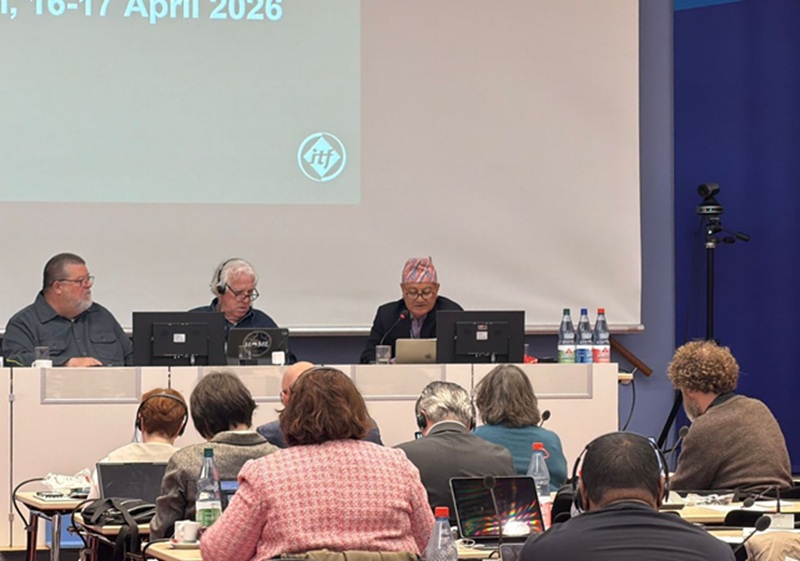
The global labor landscape recently witnessed a powerful moment of unity as the International Transport Workers’ Federation (ITF) concluded its two-day World Executive Board meeting in Berlin, Germany.
Nepali Workers in Berlin
While the summit addressed sweeping global crises, it was the specific plight of Nepali workers in Berlin‘s spotlight that captured the room’s attention.
The gathering of the world’s most influential labor leaders became a platform for a critical defense of democratic rights in Nepal, sending a clear message to the government in Kathmandu: the world is watching.

The ITF: A Global Powerhouse for Labor Rights
To understand the weight of the decisions made in Berlin, one must look at the scale of the ITF. As a global federation, the ITF represents:
-
750+ transport worker unions.
-
Over 20 million workers worldwide.
-
8 key sectors, including maritime, aviation, road, rail, and tourism.
The World Executive Board, consisting of approximately 80 elite labor leaders, meets biannually to steer the direction of international labor policy. When this body speaks, its echoes are felt in the halls of the United Nations and the International Labour Organization (ILO).
Ajay Kumar Rai Champions the Rights of Nepali Workers in Berlin
Representing the voice of the Himalayas was Ajay Kumar Rai, a member of the World Executive Board, General Secretary of the Nepal Trade Union Congress (NTUC), and Chief Advisor to the Nepal Yatayat Mazdoor Sangh.
Rai’s presence ensured that the issues facing Nepali workers in Berlin’s discussions were not just a footnote but a focal point. He raised a formal alarm regarding the proposed dissolution of trade unions in Nepal a move that labor experts describe as a significant regression in democratic values.
The Historical Weight of the Nepali Labor Movement
Rai reminded the international delegates that the trade unions in Nepal are not merely administrative bodies; they are the architects of the nation’s democracy. He cited the vital contributions of workers in:
The 1951 Revolution (2007 BS): Ending the Rana dynasty.
The 1990 Movement (2046 BS): Restoring multiparty democracy.
The 2006/07 People’s Movement (2062/63 BS): Abolishing the monarchy and establishing a republic.
By highlighting these milestones, Rai underscored that attacking unions is an attack on the very foundation of the Nepalese state.
The Legal Argument: Constitutionality and International Law
A major portion of the discourse surrounding Nepali workers in Berlin centered on the legal inconsistency of the government’s proposal. Rai argued that the move to scrap or severely limit union activity contradicts several pillars of law:
The Constitution of Nepal: Which guarantees the right to form and join trade unions.
Advertisement

The Labor Act & Trade Union Act: National laws that provide the framework for collective bargaining.
ILO Conventions: International treaties to which Nepal is a signatory, mandating the protection of workers’ rights to organize.
Rai’s stance was clear: the Nepal Trade Union Congress is not against the government; it is for good governance. He reiterated a commitment to zero tolerance for corruption and called for a resolution through social dialogue rather than executive decree.
A Standing Ovation: Global Solidarity for Nepal
The response from the international community was nothing short of historic. When Paddy Crumlin, President of the ITF, proposed a motion of solidarity with the workers of Nepal, the room erupted.
“The unanimous support and the standing ovation from 80 global labor leaders signify that the struggle of Nepali workers is the struggle of the global transport community,” noted observers at the meeting.
Stephen Cotton, the General Secretary of the ITF, confirmed that the Federation is closely monitoring the situation.
He emphasized that the ITF stands ready to exert international pressure to ensure that the Nepalese government engages in meaningful dialogue rather than suppression.
Contemporary Global Concerns: Beyond Nepal
While the focus on Nepali workers in Berlin was significant, the Executive Board also addressed other pressing issues affecting the global transport network:
US-Iran Tensions: Deep concern was raised regarding the safety of maritime workers navigating volatile waters in the Middle East.
Technological Displacement: Strategies for protecting workers as automation enters the rail and port sectors.
Climate Transition: Ensuring a “Just Transition” for transport workers as the industry moves toward green energy.
The Path Forward: What This Means for Nepal
The conclusion of the ITF meeting in Berlin marks the beginning of a new phase of international advocacy for Nepal. The government now faces a choice: pursue the dissolution of unions and face potential international labor sanctions and reputational damage, or return to the table for social dialogue.
For the Nepalese labor community, the Berlin meeting has provided a much-needed boost in morale. They are no longer fighting in isolation; they have the backing of 20 million workers and a global infrastructure dedicated to protecting the dignity of labor.
Key Takeaways from the Berlin Summit
| Category | Outcome |
| Primary Focus | Defending union rights in Nepal and global maritime safety. |
| Key Representative | Ajay Kumar Rai (NTUC/ITF Board Member). |
| Global Stance | Unanimous solidarity and commitment to monitoring Nepal. |
| Proposed Solution | Immediate social dialogue between the government and unions. |
Conclusion
The presence of Nepali workers in Berlin‘s executive discussions serves as a reminder that in the modern world, labor rights are universal.
As Ajay Kumar Rai and the ITF have demonstrated, the collective voice of workers remains one of the strongest checks against overreach.
The eyes of the global labor movement remain fixed on Nepal, waiting for a commitment to justice, democracy, and the fundamental right to organize.
For more: Nepali Workers in Berlin


