
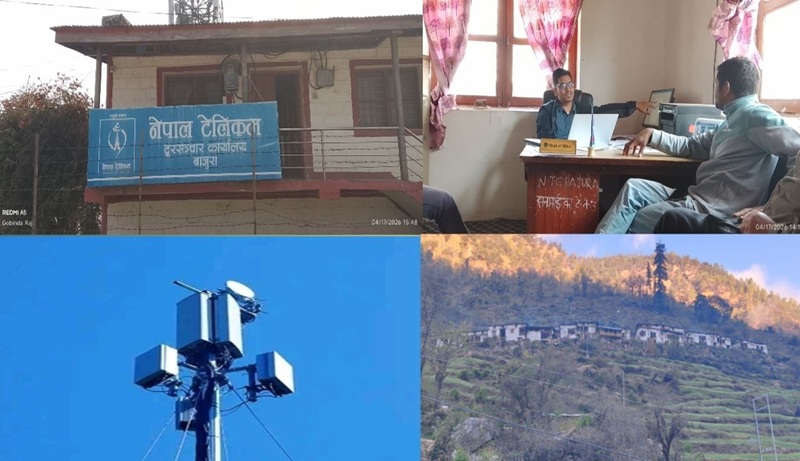
NTC Bajura Network Crisis: Remote Villages Cut Off from the World in 2026

18th April 2026, Kathmandu
The digital divide in Nepal has reached a critical point in the Sudurpaschim Province. The ongoing NTC Bajura Network Crisis has left thousands of residents in all nine local levels struggling with a near-total collapse of communication services.
NTC Bajura Network Crisis
From failed emergency calls to a complete lack of 4G connectivity, the district is facing what locals describe as a “state of digital isolation.”
As of April 2026, Nepal Telecom (NTC) is under immense pressure to modernize an infrastructure that remains heavily reliant on outdated solar power and low-capacity towers.

The Anatomy of the NTC Bajura Network Crisis
The crisis in Bajura is not a sudden outage but a lingering degradation of service that has peaked over the last three months. Residents report that while they may see signal bars on their phones, the actual utility of the network is nonexistent.
Key Symptoms of the Crisis:
Audio Blackouts: Calls frequently connect, but users experience “one-way audio” where neither party can hear the other.
The “Solar Trap”: Over 70% of NTC towers in Bajura operate solely on solar power. During the recent cloudy spells and winter months, these towers shut down completely, leaving entire municipalities without a signal.
4G Ghosting: Although 4G is advertised, users in remote areas like Himali and Swamikartik Khapar find that data speeds are slower than legacy 2G, making digital banking and online education impossible.
Infrastructure Challenges: Why Bajura is Lagging
Ishwor Singh, Chief of Nepal Telecom Bajura, has highlighted that the district’s geography and power deficit are the primary hurdles. Of the 27 towers currently active in the district, only 8 have access to micro-hydroelectricity. The remaining 19 towers are at the mercy of sunlight.
“In places like Bichhya, the network has been erratic since early June 2025. Without a stable power grid connection, the lithium-ion batteries in these remote towers cannot sustain the network through the night or during bad weather,” says a local technical officer.
The 2026 Roadmap: Solutions in Progress
To combat the NTC Bajura Network Crisis, Nepal Telecom has initiated several high-priority projects aimed at restoring communication parity:
1. The 50-Meter “Mega Tower” in Martadi
The 17-meter tower in the district headquarters has long been insufficient for the rising population. NTC has completed the construction of a new 50-meter tower in Martadi. Once fully equipped this month, it is expected to significantly boost signal penetration across the central valley.
Advertisement

2. Survey of 17 New Tower Locations
NTC has finalized the survey for 17 additional towers to fill “blackspots” in the most remote villages. This initiative is part of the government’s 2026 mandate to ensure that no village remains “sanchar-bihin” (communication-less).
3. Power Stabilization Project
Efforts are underway to connect solar-reliant towers to local electricity grids. By prioritizing electricity connections, NTC aims to ensure 24/7 uptime, regardless of weather conditions.
Impact on the Local Community
The network failure has had a ripple effect on the local economy and safety:
Emergency Services: Health posts in rural Bajura struggle to coordinate ambulance services.
Banking: Most local-level payments and government salaries are now processed online, but the network crisis has halted these transactions.
Isolation: For migrant workers abroad, the inability to call home to Bajura has caused significant emotional distress for families.
How to Stay Connected During the Crisis
While NTC works on permanent fixes, experts suggest the following for residents:
Switch to 2G for Calls: If 4G/3G signals are weak, manually switching your phone settings to “2G Only” can sometimes stabilize voice calls.
Monitor Signal Timing: In solar-dependent areas, the network is strongest between 11:00 AM and 3:00 PM when solar panels are at peak efficiency.
Check SIM Compatibility: Ensure you are using a U-SIM by dialing *444# to be ready for the upcoming 4G densification.
Conclusion
The NTC Bajura Network Crisis serves as a stark reminder of the infrastructure gaps in rural Nepal. While the 2026 upgrades offer hope, the immediate need is for consistent maintenance and power stability. For the people of Bajura, a reliable phone call is not just a convenience; it is a lifeline.
For more: NTC Bajura Network Crisis


