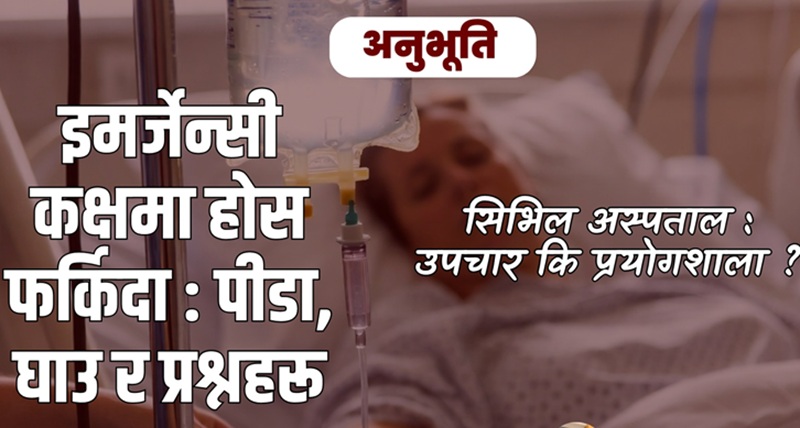
Civil Hospital Nepal Patient Experience: A Traumatic Tale of Treatment or Training?

Civil Hospital Nepal Patient Experience
26th April 2026, Kathmandu
On Baisakh 10, while managing my routine workload at the office, I suddenly collapsed. I have no memory of how it happened. After failing to regain consciousness for a long time, my colleagues rushed me to Civil Hospital in Baneshwor.
Civil Hospital Nepal Patient Experience

Waking Up to Pain and Questions
I regained partial awareness in the Emergency Room (ER). Although my body was paralyzed and unresponsive, my sense of hearing remained active. I could hear the frantic efforts of doctors and nurses trying to revive me. Later, I learned that they had performed repeated chest compressions, similar to CPR.
The real trauma, however, began when a nurse attempted to draw blood and set up an IV drip. I felt her searching for a vein, pricking me repeatedly. Because I was weak, the struggle felt magnified. Then, I heard a senior nurse say to her:
“Didn’t I teach you this the other day? Push the needle deeper.”
In that moment, a chilling thought crossed my semi-conscious mind: Am I a human being receiving treatment, or just a ‘dummy’ for someone’s clinical practice?
Physical Marks of Professional Negligence
Once I was fully conscious and moved from the ‘Red Room’ to the ‘Green Room,’ the physical toll became apparent. Beyond the exhaustion, I felt a sharp, stinging pain near my neck. When I looked in the mirror, I was horrified to see a wound—deep marks that looked like fingernails had been dug into my skin.
My friends confirmed that the nurses were pressing hard on my chest and neck area while trying to wake me up. This leads to a fundamental question: Does CPR require digging fingernails into a patient’s flesh?
Advertisement

The Fever of Trauma
The wound wasn’t just a cosmetic mark; it caused an immediate fever that night. Even three days after being discharged, the pain persists. Every time I look at that scar, I am haunted by the same questions:
-
Is it ethical to use emergency patients for clinical practice by trainees?
-
Should a hospital, a place of trust, feel like a laboratory?
-
Where is the line between life-saving measures and professional insensitivity?
A Call for Accountability in Nepalese Healthcare
My experience is not just a personal grievance; it is a serious indictment of the lack of professionalism and sensitivity in our healthcare system.
Patients are not objects for experimentation. While clinical training is necessary, the Emergency Room is no place for unsupervised trial-and-error that leaves patients physically and mentally scarred.
The state and hospital administrations must ensure that medical practices remain human-centric. Hospitals should be sanctuaries of healing, not training grounds where patients are treated as mere biological specimens.
For more: Civil Hospital Nepal Patient Experience