
Kathmandu University (KU) Launches Google-Funded AI Translation Tool for Nepalese Languages

17th June 2026, Kathmandu
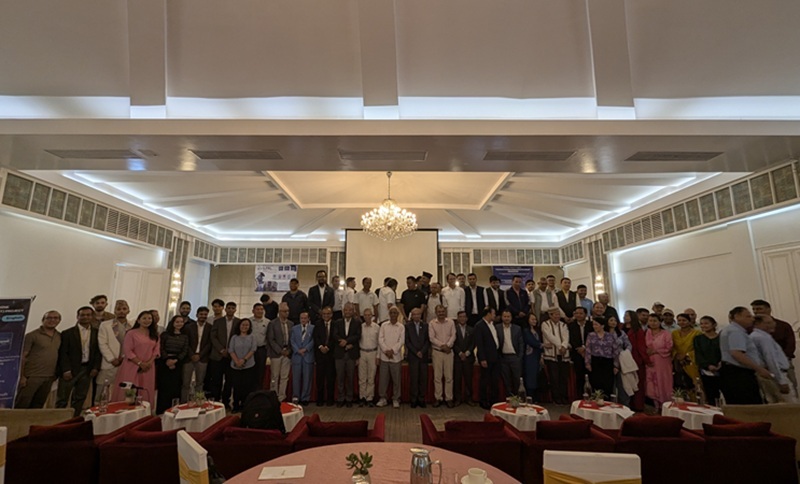
The Information and Language Processing Research Lab (ILPRL) at Kathmandu University formally concluded its groundbreaking Trilingual Machine Translation (TMT) Project today during a closing ceremony held at the Himalaya Hotel, Kupandol, Lalitpur.
KU Google-Funded AI Translation Tool
Funded by the prestigious Google Academic Research Award 2024 under the “Society-Centered AI” initiative, the project marks a historic milestone in bridging Nepal’s digital language divide.
The event brought together over 100 distinguished guests representing a diverse mix of stakeholders from academia, industry, government bodies, non-governmental organizations, and diplomatic missions.
Bridging Languages, Empowering Communities
The TMT System is an AI-powered language tool engineered to automatically translate text between Nepali, Tamang, and English, ensuring underserved language communities gain equal access to information and public services.
Developed in close collaboration with the Central Department of Linguistics at Tribhuvan University and the Tamang Rastriya Pustakalaya (TaRaaPu), the project team spent two years building a 100,000+ parallel sentence “Gold Standard” corpus spanning five vital domains: Agriculture, Education, Health, Culture & Tourism, and General Communication.
The ceremony commenced with a welcome address, seating of guests, and the lighting of the traditional lamp led by Dr. Prakash Poudyal. Following the opening, Prof. Dr. Bal Krishna Bal, the Project’s Principal Investigator, delivered an in-depth project overview and live demonstration.
“Our objective from inception was to establish a scalable, community-driven machine translation mechanism for Nepal’s underserved languages,” said Prof. Dr. Bal Krishna Bal. “By involving the community in design, development, and deployment, we have built a tool that supports local governance, assists schools with multilingual materials, and preserves the Tamang language for future generations.”
Cutting-Edge AI Built Local
The technology powers a working system optimized by fine-tuning Meta AI’s open-source NLLB-200 (No Language Left Behind) model using the team’s custom-built gold-standard dataset. As demonstrated at the event, the publicly accessible platform (tmt.ilprl.ku.edu.np) boasts advanced features, including:
Text Translation: Real-time translation across all three language pairs.
Advertisement

Whole-Page Translation: A game-changer for digital governance, allowing users to input a government portal URL and view the entire page instantly translated.
File-to-File Translation: Support for uploading .docx and .pdf files to download fully translated versions without manual copying.
Community Feedback: A built-in quality rating tool to crowdsource continuous model improvement.
A cornerstone of the project’s success was its intensive community outreach, including beta testing in late 2025, hackathons, and strategic consultative presentations to government entities such as the Bhasha Aayog, the Department of Information Technology (DoIT) under the Office of the PM & Council of Ministers, and the Bagmati Provincial Government.
The academic rigor of the project was further highlighted by the publication and acceptance of multiple research papers in world-class forums, including LREC 2026, SPELL 2025, and EAMT 2026.
Celebrating the Collaboration
The human heart of the project, the linguistic experts and local translators, was celebrated during a dedicated segment on community engagement. Mr. Amrit Yonjan-Tamang, Senior Linguist and Tamang Language Activist, shared insights into the intense corpus development phase alongside lead translator Mr. Indra Tamang and the broader translation team.
Valuable perspectives, reflections, and endorsements were shared by distinguished academic leaders, including Prof. Dr. Manish Pokharel, Prof. Dr. Rajeev Shreshta, and Prof. Dr. Sudhan Jha. The Chief Guest of the ceremony, eminent linguist Prof. Dr. Madhav Pokharel, commended the team’s pioneering efforts in language preservation through state-of-the-art technology.
The Path Ahead
As the ceremony concluded with a vote of thanks from Co-Principal Investigator Prof. Dr. Balaram Prasain and a commemorative group photograph, the ILPRL team outlined future expansions.
Future goals include integrating more indigenous languages, introducing Automatic Speech Recognition (ASR) and Text-to-Speech (TTS) pipelines, and maintaining ongoing communication with Google to potentially integrate the trilingual system into the global Google Translate application.
For more: KU Google-Funded AI Translation Tool


