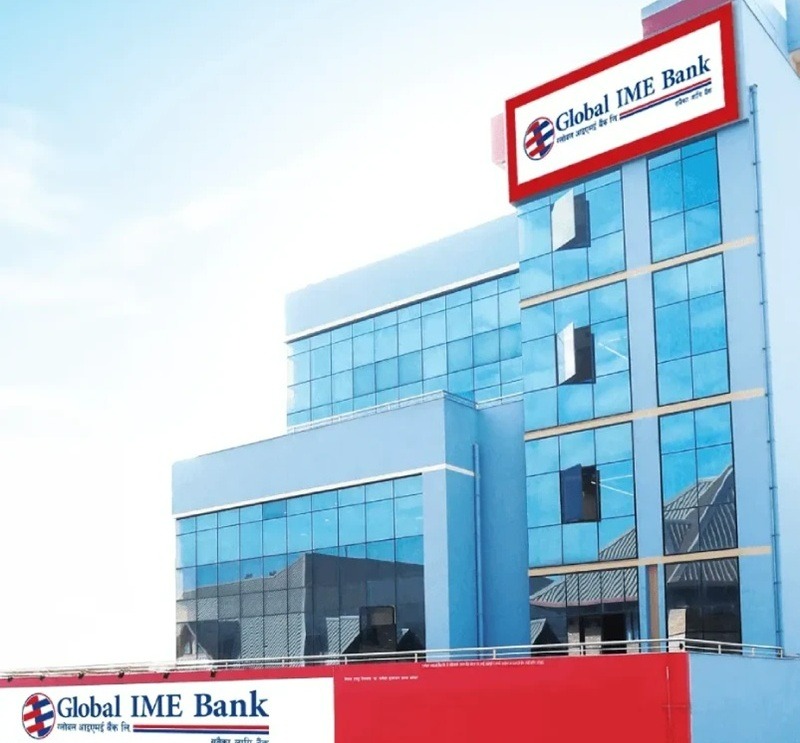
Global IME Bank Announces Revised Deposit And Loan Interest Rates From Shrawan 1 2083

16th July 2026, Kathmandu
Global IME Bank Limited has published revised interest rates effective from Shrawan 1, 2083, which corresponds to July 17, 2026.
Global IME Announces Interest Rate Revision
The updated rate schedule covers a range of deposit products and lending facilities, reflecting the banks latest review of its interest rate framework. Customers can use the revised rates to make informed savings and borrowing decisions.
The financial institution stated that these structured adjustments help align its portfolios with current market liquidity trends while offering competitive avenues for local and international depositors.

KEY HIGHLIGHTS OF GLOBAL IME BANK INTEREST RATE REVISION
The updating of interest structures highlights how the bank manages its cash accumulation against the background of changing national economic indicators. Lenders adjust these frameworks systematically to handle operational costs efficiently.
The updated financial notice breaks down parameters across diverse accounts, focusing on domestic deposits, multi tier fixed structures, and detailed lending lines:
NPR SAVINGS AND TIME DEPOSIT RATES
Global IME Bank Limited has standardized its local currency savings returns across a wide variety of specialized consumer brackets:
- Global Normal Savings, Global Nari Bachat Khata, Global Balbalika Bachat Khata, Global Navaratna Salary Account, Social Security Allowance Account, Global Share Lagani Bachat Khata, Global BLB Saving Account, Global Janmabhumi Bachat Khata, Global Sansthagat Bachat Khata, Global Jestha Nagarik Bachat Khata, Sabai Nepaliko Bachat Khata, and Soche Jastai Bank Khata all provide an annual yield of 2.75 percent.
- The Global Remit Savings Account offers a higher incentive rate of 3.75 percent per annum.
For local currency individual fixed deposits, the returns change depending on the commitment period:
- A tenure of 3 Months to 1 Year offers 2.76 percent.
- A tenure of Above 1 Year to below 2 Years offers 2.80 percent.
- A tenure of Above 2 Years to below 3 Years offers 3.00 percent.
- A tenure of 3 Years to below 5 Years offers 3.50 percent.
- A tenure of 5 Years and above offers the maximum standard individual fixed rate of 4.00 percent.
Remitters Term Deposits for individuals receive an additional 1.00 percent on top of the above slabs. For institutional fixed deposits with a tenure above 1 year, the bank has set a flat interest rate of 2.75 percent. Call deposit accounts yield up to 50 percent of the minimum savings deposit rate.
Advertisement

COMPREHENSIVE FOREIGN CURRENCY PLANS
The bank has set up flexible programs for standard foreign currency savers as well as Non Resident Nepalis seeking fixed or savings channels:
- Standard FCY Saving Deposits provide 2.25 percent for US Dollar, 1.50 percent for Euro, 2.50 percent for Great Britain Pound, 2.50 percent for Australian Dollar, 1.50 percent for Canadian Dollar, 0.50 percent for Japanese Yen, and 0.50 percent for Chinese Yuan.
- Standard FCY Fixed Deposits offer 3.00 percent for US Dollar, 2.50 percent for Euro, 3.50 percent for Great Britain Pound, 3.50 percent for Australian Dollar, 2.25 percent for Canadian Dollar, 1.00 percent for Japanese Yen, and 1.00 percent for Chinese Yuan.
- Global NRN FCYs Fixed Deposits require a minimum balance of 1,000 USD or equivalent and pay 3.75 percent for USD, 3.00 percent for EUR, 4.00 percent for GBP, 4.00 percent for AUD, 2.25 percent for CAD, 1.00 percent for JPY, and 1.00 percent for CNY.
- Global NRN FCYs Saving Deposits yield 3.00 percent for USD, 2.00 percent for EUR, 3.00 percent for GBP, 3.00 percent for AUD, 2.00 percent for CAD, 0.50 percent for JPY, and 0.50 percent for CNY.
LOANS AND ADVANCES PRICING PLANS
Borrowing structures are split cleanly between flexible floating models tied to the base rate and predictable fixed interest rate avenues:
Corporate and Project Financing floating options include Fixed Term Loans at Base Rate plus 0.50 percent to 2.50 percent, and fluctuating working capital options at Base Rate plus 1.00 percent to 3.00 percent. Fixed term variants for corporates can also be locked at fixed rates from 7.99 percent to 9.99 percent up to 10 years.
Small and Medium Enterprise loans feature floating choices like the Small Business Loan at Base Rate plus 2.00 percent to 4.00 percent, or a fixed rate selection from 7.99 percent to 9.99 percent.
Retail and Consumer Financing packages provide Home Loans at Base Rate plus 1.00 percent to 3.00 percent floating, or 8.99 percent to 10.99 percent fixed. Auto Loans match this exact framework. Mortgage Loans carry a premium of 1.50 percent to 3.50 percent over base rate, or a fixed range of 9.99 percent to 11.99 percent. Education and Hire Purchase loans present floating margins of 2.00 percent to 4.00 percent, or fixed ranges of 9.99 percent to 11.99 percent.
PORTFOLIO RESTRUCTURING AND LIQUIDITY REVENUE LOOPS
The publication of this revised pricing format also brought forward news regarding specific portfolio modifications. The bank announced that the Global Sambriddha Awakash Recurring Deposit has been officially discontinued, though existing accounts under the scheme will continue under their original parameters until maturity. Additionally, the minimum balance requirement for the Global Special Current Account has been updated to 5,000 Nepalese Rupees.
By setting up explicit lending margins alongside its fixed choices, Global IME Bank manages its risk profiles carefully. Floating options protect the bank against sudden changes in market conditions, while fixed rate loans allow individuals and companies to build predictable multi year financial plans. This balance is helpful for heavy infrastructure projects, agricultural expansions up to 2 crore rupees, and families looking for long term security through home or education financing.
The inclusion of high yielding remittance savings and NRN specific foreign currency models underscores a strong focus on bringing overseas capital into the formal banking system of Nepal. This mechanism gives the bank stable foreign reserves while helping lower its overall domestic cost of funds. Consequently, this allows the bank to extend credit lines at competitive rates to local businesses, driving financial inclusion and supporting broader economic growth across its countrywide network.