
Hulas Eco Bricks and InnoCSR Plan $60M Carbon Finance Rollout to Transform Nepal’s Brick Kilns


20th November 2026, Kathmandu
Plan to transform brick kilns by providing free technology to operators
Hulas Eco Bricks and InnoCSR aim to mobilise $60 million in carbon finance to provide Nepalese brick kiln operators with $200,000 in free non-fired brick machinery per site across 300 locations, targeting 3 billion eco-friendly bricks and 1.5 million tonnes of annual carbon savings.
Hulas Eco Bricks and climate technology company InnoCSR plan to mobilise $60 million in carbon finance to help Nepal’s existing brick makers adopt a production process that does not require kiln firing.
The companies aim to establish 300 production sites across the country. Hulas Eco Bricks is part of the Diwakar Golchha Organisation, which partnered with InnoCSR in August to expand the technology under the Hulas Good Bricks brand. Their stated approach is to work with existing kiln operators rather than replace them.
Hitesh Golchha, a director of the Diwakar Golchha Organisation, said participating manufacturers would be provided with machinery worth about $200,000 per site without an upfront equipment payment. Ownership of the machines would pass to the operators after 10 years, he said.
The financing has yet to be fully mobilised. Pankaj Pandey, managing director of InnoCSR Nepal, said the companies intend to raise it from international carbon credit buyers, climate funds and financial institutions.
Under the proposed model, emissions avoided by making bricks without firing them would be measured, recorded and verified. Carbon credits generated from those reductions would then be sold to help finance the rollout.
Whether the programme delivers its projected savings will depend on production at the planned sites and the verification of those reductions.
Advertisement

At full capacity, the 300 sites could produce around three billion bricks a year, according to the companies. They estimate that this could avoid about 1.5 million tonnes of carbon dioxide emissions annually compared with conventional fired-brick production. Those figures are projections, not measured reductions from the proposed network.
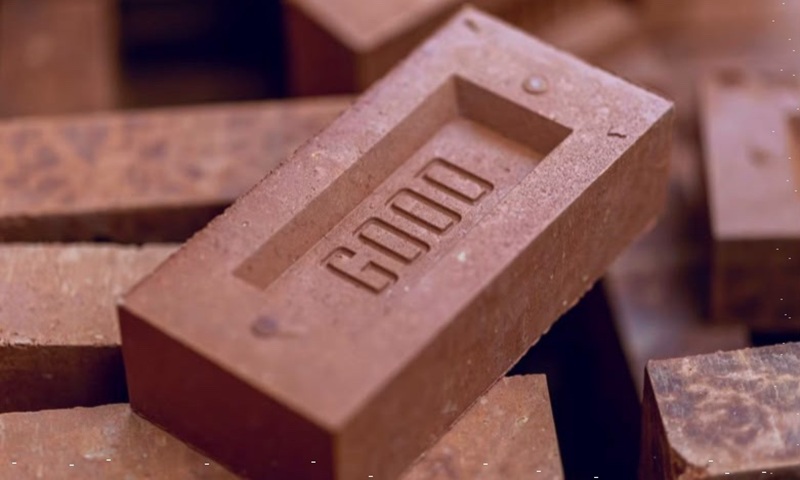
Conventional brick production requires fuel to fire moulded clay in kilns. The Good Bricks process instead combines locally available soil and cement with InnoCSR’s Good Soil Stabilizer, then uses a hydraulic press to form bricks. Removing the firing stage could cut coal use and pollution at production sites.
A full assessment of the environmental benefit would also need to account for emissions from producing cement and other inputs.
Pandey said the companies expect the technology to address some of the difficulties faced by traditional kilns, including seasonal production, labour and fuel requirements, and the need for large areas of land.
InnoCSR will provide the technology and technical support, while Hulas plans to use its network of more than 100 dealers and construction-material partners to expand production.
The technology is already in use in Nepal. InnoCSR says it has established sites in Gorkha, Surkhet and Jajarkot. Two factories in Surkhet and Jajarkot, funded by the Korea International Cooperation Agency and developed with Reserve Carbon, have a combined capacity of about one million bricks a month, according to the company.
The sites are expected to improve local access to building materials, including in areas rebuilding after the 2023 Jajarkot earthquake.
For more: Hulas InnoCSR Plan $60M Carbon Finance


