
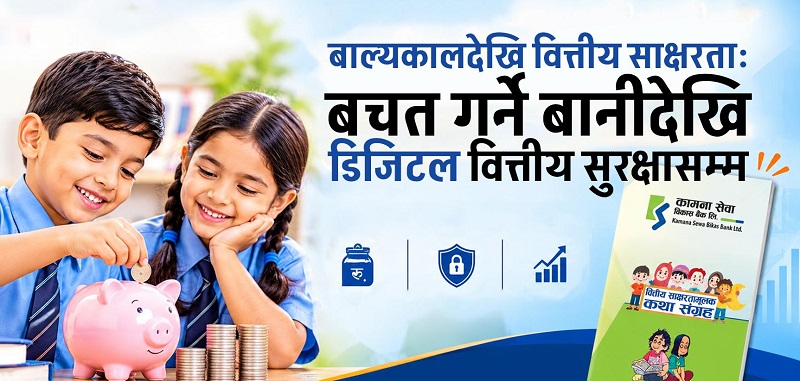
Kamana Sewa Bikas Bank Publishes Financial Literacy Story Collection on Savings and Digital Safety


27th November 2026, Kathmandu
Kamana Sewa Bikas Bank Limited has published a financial literacy story collection aimed at cultivating money management, disciplined saving, responsible budgeting, and digital financial safety habits starting from childhood.
KSBBL Financial Literacy Story Collection
The initiative features 20 stories built around relatable everyday characters and scenarios covering saving, personal budgeting, income, banking services, loans, investing, remittances, hundi risks, and digital fraud prevention.

Key Details of the Financial Literacy Story Collection
The story compilation translates core personal finance principles into accessible narratives for children, families, and newcomers to formal financial services.
Advertisement

- Publishing Institution: Kamana Sewa Bikas Bank Limited.
- Publication / Notice Date: Mangsir 11, 2083 (November 27, 2026) / 2083-8-11.
- Format and Scope: A collection of 20 stories using everyday situations and relatable characters.
Core Thematic Pillars:
- Savings and Emergency Readiness: Illustrated through characters such as Rojal and Rohan—where Rojal saves in a piggy bank and bank account while Rohan spends immediately, proving vital during a medical emergency after an accident—alongside Sita and Sanu’s arithmetic example showing how saving NPR 1,000 per month builds NPR 12,000 in a year.
- Personal Budgeting: Illustrated through characters including Arjun, Binu, and Simu, including Arjun’s sample allocation of 30 percent to savings, 20 percent to study and essential expenses, and 50 percent to daily consumption and entertainment.
- Banking Services and Access: Covers opening accounts, depositing money, earning interest, and using bank lockers through stories involving Sunita, Ram, and Mina.
- Borrowing and Investing: Highlights loan repayment and interest terms through Kajal and Rashmi, and the distinction between saving and investing through Ramesh’s business expansion example.
- Remittance Channels and Digital Safety: Warns against informal hundi transactions via Ranjan and his father, game-based advance-fee scams via Aryan, and unsafe free Wi-Fi, suspicious links, and credential phishing via Manju.
Analytical Evaluation and Operational Context
While storytelling lowers entry barriers for young learners and first-time financial consumers, balanced financial education requires pairing narratives with practical nuance and institutional follow-through.
Key Analytical Takeaways:
- Savings alone cannot solve every financial shock; emergency savings work best alongside appropriate insurance coverage and risk awareness.
- Budget frameworks such as 30/20/50 serve as starting guides rather than rigid rules, since household size, living costs, debt obligations, and income levels vary.
- Formal banking and lending bring important protections and structure, yet users must still review interest rates, fees, deposit protection rules, locker terms, and investment risk-return trade-offs rather than relying on sweeping generalizations.
- Protecting passwords, OTPs, PINs, and banking details, avoiding suspicious links, and reporting disputed transactions promptly are essential as digital payment usage expands.
Scope for Further Refinement and Family Application:
- Several themes in the collection—particularly saving—recur across multiple stories, whereas areas such as insurance mechanics, safe digital payments, grievance redressal, fraud reporting steps, true borrowing costs, and financial privacy can be expanded with more concrete examples.
- Parents can reinforce these lessons at home through household budgeting, shopping priorities, savings goals, and expense tracking, while schools can integrate age-appropriate financial education and practical exercises.
For More: KSBBL Financial Literacy Story Collection


