
Agricultural Development Bank Branches Open Notice

4th March 2026, Kathmandu
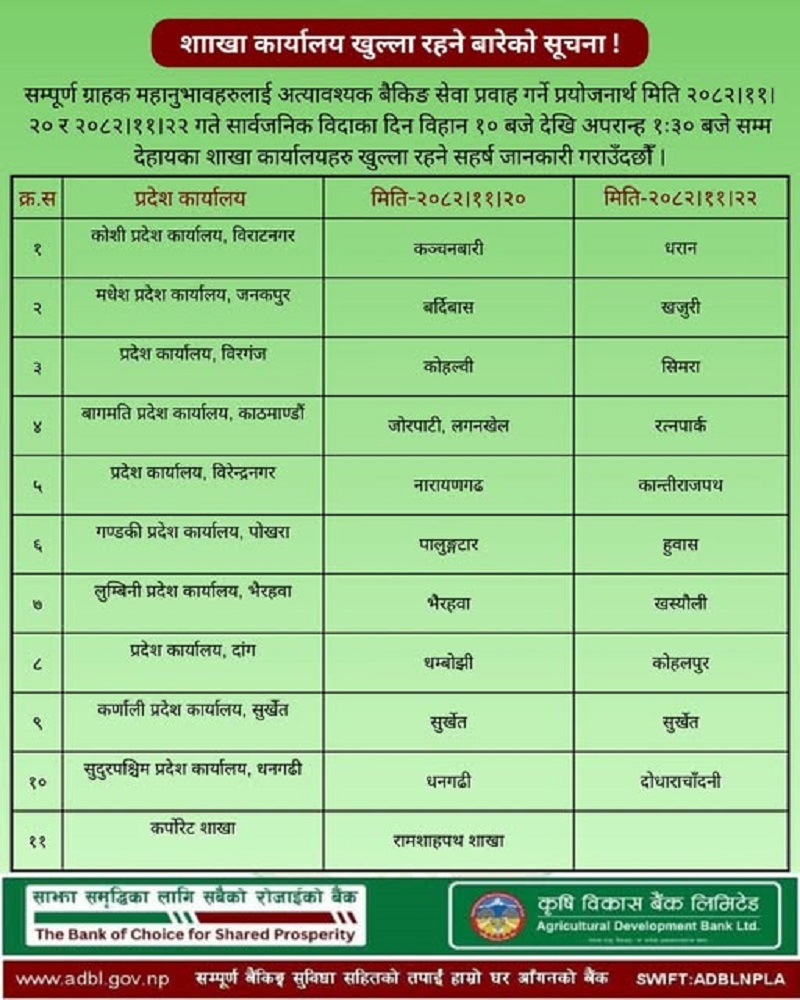
The banking landscape of the Federal Democratic Republic of Nepal is demonstrating a renewed commitment to customer service and financial inclusion as the holiday season of the year 2082 approaches. According to the latest Agricultural Development Bank Branches Open Notice, the state owned institution has decided to operate selected counters during the upcoming public holidays. Specifically, on March 14 and March 15, 2026 (Falgun 30, 2082, and Chaitra 1, 2082), designated provincial and regional offices will remain functional from 10:00 AM to 3:00 PM. This strategic decision by the Agricultural Development Bank Limited (ADBL) is aimed at ensuring that the agricultural community, small scale traders, and general depositors do not face a liquidity crunch during the transition between the months of Falgun and Chaitra. In the year 2082, as the bank continues to be a pillar of the rural economy, the availability of these 5 hour service windows is a vital component of the national financial stability framework.
ADBL Branches Open Notice
The operational logic behind the Agricultural Development Bank Branches Open Notice is rooted in the bank’s unique mandate to serve the agrarian heartland of Nepal. Unlike purely commercial private banks, ADBL carries a significant responsibility for government payment processing and agricultural credit disbursement. By staying open on Falgun 30 and Chaitra 1, the bank allows farmers to deposit their seasonal earnings and access credit for the upcoming planting cycle without waiting for the regular work week to resume. This continuity is essential in a country where the timing of agricultural inputs can determine the success of the entire harvest. Furthermore, for small and medium enterprises (SMEs) in the provincial hubs, the ability to clear cheques and manage cash flow during a public holiday prevents the accumulation of transaction backlogs that can stifle local commerce.
A province wise breakdown of the open branches reveals a highly balanced distribution designed to cover major economic clusters across all seven provinces. In the Koshi Province, the Biratnagar office will coordinate services with the Kanchanpur and Dharan branches on consecutive days. Similarly, in the Madhesh Province, the Janakpur office has designated the Bardibas and Khajuri branches to handle the holiday rush. This targeted approach ensures that the most active trading centers in the Terai region remain financially connected. In the year 2082, as regional autonomy grows, the ability of provincial offices to manage their own holiday schedules reflects a more decentralized and responsive banking culture within the Agricultural Development Bank.
In the Bagmati Province, the focus remains on the capital and its surrounding industrial belts. The Kathmandu province office will keep the Jorpati and Lagankhel branches open on Falgun 30, while the Rukumkot branch will serve as a critical link on Chaitra 1. Additionally, the high volume Corporate Branch and the Ramshahpath Branch in the heart of the city will follow the 10:00 AM to 3:00 PM schedule to accommodate the needs of government contractors and institutional clients. For residents of the Hetauda and Narayangadh corridors, the provincial office in Hetauda has ensured that the Kawasoti and Narayangadh branches remain operational, supporting the vital transport and logistics businesses that operate 24/7 along the East West Highway.
The Gandaki and Lumbini provinces, known for their vibrant tourism and industrial sectors respectively, are also well represented in the Agricultural Development Bank Branches Open Notice. The Pokhara office will mobilize the Walling and Besisahar branches, ensuring that the trekking and hospitality sectors have access to cash and remittance services. In the Lumbini region, the Bhairahawa and Ghorahi branches will operate alongside the Tulsipur and Kohalpur locations under the Dang province office. This coverage is essential for the burgeoning manufacturing plants near the border and the agricultural traders in the Inner Terai. In the year 2082, these branches act as the financial nervous system for the western part of the country, and their holiday operation is a significant boost for local economic morale.
Advertisement


In the geographically remote Karnali and Sudurpashchim provinces, the bank’s presence is often the only link to the formal financial system for many citizens. The Surkhet office will remain open on both days to serve the provincial capital, while the Dhangadhi and Dadeldhura branches will provide a lifeline for the people of the far west. This level of commitment to the remote provinces is what defines the Agricultural Development Bank as a socially responsible institution. By providing a 5 hour window on Falgun 30 and Chaitra 1, the bank facilitates urgent family remittances and small business transactions that are often the only source of liquid capital in these mountain and hill districts.
The technical and operational significance of holiday banking hours in the year 2082 relates to the reduction of digital and physical congestion. When a major bank remains closed for several days, the first working day often sees an overwhelming surge in footfall and a spike in server load for digital banking platforms. By providing an interim service window, ADBL effectively flattens the curve of demand, allowing for a smoother and more efficient banking experience for everyone. Furthermore, it provides an opportunity for the bank to test its disaster recovery and contingency systems in a live but controlled environment. For the bank’s staff, while holiday work requires extra effort, it is often managed through a system of compensatory leave or overtime pay, ensuring that employee morale remains high while serving the public interest.
From a customer’s perspective, the Agricultural Development Bank Branches Open Notice is a call for proactive financial planning. Clients are advised to carry their valid identification and original passbooks or cheque books to avoid any delays at the counter. Since these are limited hour operations, services like new account opening or complex loan processing may be deferred in favor of high priority tasks like cash deposits, withdrawals, and cheque clearances. The bank has also emphasized that its network of ATMs and mobile banking app, ADBL Smart Plus, will remain available 24/7, and customers should use these digital channels for routine inquiries to keep the physical counters free for those who truly need them.
In conclusion, the decision to keep the Agricultural Development Bank Branches open on Falgun 30 and Chaitra 1 is a testament to the bank’s role as a driver of shared prosperity in Nepal. By providing over 1.5 lakh customers with a reliable banking option during the public holiday, the institution is living up to its legacy of rural development and financial empowerment. As the nation moves into the new month of Chaitra in the year 2082, the stability provided by these holiday operations will help in maintaining a positive economic outlook. The Agricultural Development Bank continues to bridge the gap between urban centers and remote villages, proving that even during holidays, the commitment to the Nepali farmer and entrepreneur remains the bank’s highest priority.
For More: ADBL Branches Open Notice


