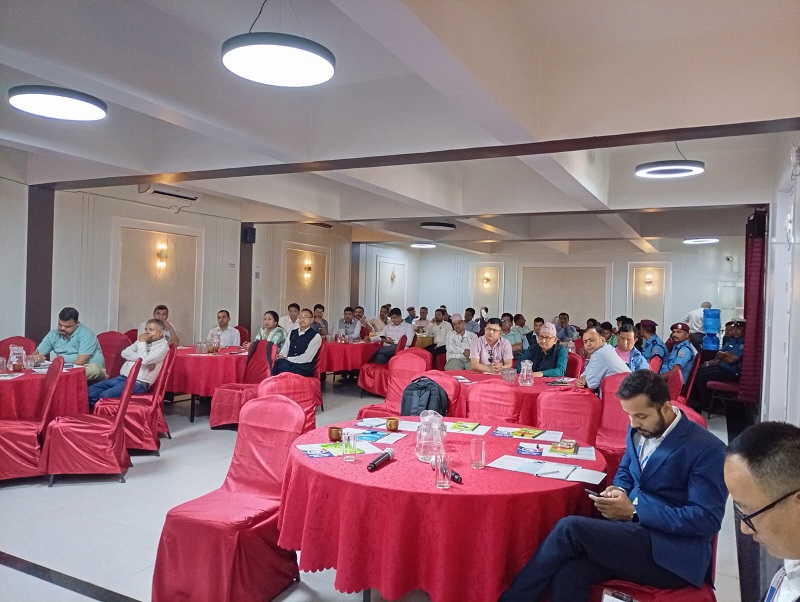
Advancing Emergency Care in Nepal: The Mediciti TOT Program in Retrieval Medicine

27th March 2026, Kathmandu
Nepal has reached a significant milestone in emergency healthcare with the conclusion of the first-ever Advanced Training & Training of Trainers (TOT) Program in Retrieval Medicine.
Advancing Emergency Care in Nepal
Held at Nepal Mediciti Hospital in late March 2026, this landmark initiative is set to redefine helicopter rescue and critical care transport across the country.
Organized in collaboration with Scotland’s Emergency Medical Retrieval Service (EMRS), the program bridges the gap between traditional hospital care and the complex challenges of aeromedical rescue in Nepal’s rugged terrain.
What is the Mediciti TOT Program in Retrieval Medicine?
The Mediciti TOT Program in Retrieval Medicine is an elite training framework designed to build a sustainable network of medical experts. “Retrieval Medicine” refers to the specialized clinical care required to safely move critically ill patients from remote accident sites or smaller clinics to specialized tertiary centers.
By using a Training of Trainers (TOT) model, the program ensures that the knowledge brought by international experts isn’t just used once it is passed down.
The participants are now equipped to mentor the next generation of Nepalese doctors and paramedics, ensuring high-quality care nationwide.
Why Retrieval Medicine Matters for Nepal
With limited road access in rural areas and a high demand for mountaineering rescues, Nepal is often described as a “land of helicopters.” However, flying a patient is only half the battle; providing intensive care at 10,000 feet requires specific expertise.
Key areas covered in the training included:
Aeromedical Transport Principles: Managing patient physiology during high-altitude flights.
Simulation-Based Learning: Practical “mock tests” on positioning and treating patients inside a helicopter.
Advertisement


Pre-Hospital Critical Care: Advanced interventions at the scene of an emergency.
Multidisciplinary Coordination: Enhancing teamwork between pilots, physicians, and ground crews.
A Gateway to International Certification
Under the leadership of Dr. Sanjay Karki, Chief of Emergency and High Altitude Services at Nepal Mediciti, the program was specifically aligned with global standards.
The curriculum prepares Nepalese health professionals for the Diploma in Retrieval and Transfer Medicine (DRTM), a prestigious qualification offered by the Royal College of Surgeons of Edinburgh. This alignment ensures that Nepalese healthcare workers can compete on a global stage while providing world-class service locally.
Nationwide Impact and Collaboration
The program saw participation from approximately 30 specialists from both government and private sectors, including:
Leading Hospitals: Norvic, HAMS, Grande, Vayodha, and Tribhuvan University Teaching Hospital (TUTH).
Security Forces: Nepal Police, Armed Police Force, and the Nepal Army.
Regional Experts: Professionals from Pokhara, Lumbini, and Birgunj.
Supported by the Ministry of Health and Population (MoHP) and international experts from Switzerland, India, and Japan, this initiative represents a unified effort to elevate Nepal’s Emergency Medical Systems (EMS).
Conclusion: A Vision for the Future
The successful completion of the Mediciti TOT Program in Retrieval Medicine is more than just a training event; it is a commitment to saving lives. By investing in the “Golden Hour” of emergency response, Nepal Mediciti is ensuring that no matter how remote the location, international-standard medical care is never out of reach.
For more: Advancing Emergency Care in Nepal