Bhatbhateni-Backed Hospital to Begin Operations with Investment of Over NPR 8.5 Billion

23rd December 2025, Kathmandu
The healthcare landscape in Nepal is set for a major transformation as the Kathmandu International Hospital prepares to begin its operations in the upcoming month of Shrawan. Located in the bustling area of Tinkune in Kathmandu this mega project is being developed with a massive investment exceeding eight point five billion Nepalese rupees. The project has gained significant attention from both the medical community and the business sector particularly due to the involvement of the Bhatbhateni Group which is one of the most successful retail conglomerates in the country.
Bhatbhateni-Backed Hospital Operations
This new multi specialty facility aims to provide world class healthcare services to the citizens of Nepal reducing the need for patients to travel abroad for complex medical treatments.
INVESTMENT DYNAMICS AND RISING PROJECT COSTS
The financial scale of the Kathmandu International Hospital is truly impressive. Originally the construction cost for this ambitious project was estimated at seven point four six billion rupees back in twenty twenty three. However due to various factors including additional land acquisition and the adoption of high level international infrastructure standards the total project cost has been revised upward to approximately eight point four three billion rupees. A significant portion of this investment amounting to five point six five billion rupees is being managed through bank credit facilities while the remaining amount is being covered by equity from the promoting groups.
This increase in cost reflects the commitment of the developers to build a facility that meets the Joint Commission International standards. While the rising costs have introduced certain financial risks and increased the pressure on future cash flows the promoters remain confident in the viability of the project. The involvement of a consortium of leading banks highlights the institutional trust in this venture. The revised budget ensures that the hospital will be equipped with the latest medical technologies and a robust infrastructure that can handle a wide variety of medical emergencies and specialized procedures.
THE STRATEGIC ROLE OF BHATBHATENI GROUP AND MIN BAHADUR GURUNG
One of the most defining features of this project is the participation of the Bhatbhateni Group led by the prominent entrepreneur Min Bahadur Gurung. The group holds a forty five percent ownership stake in the hospital which marks a significant diversification of its business portfolio from retail and supermarkets into the healthcare industry. Min Bahadur Gurung who is well known for his philanthropy and his ability to complete large scale infrastructure projects within tight deadlines brings a wealth of management experience to the table.
Initially the project was conceived and started by a group of investors led by Doctor Harish Chandra Nyaupane of Chitwan Medical College. However as the scope of the project expanded and the capital requirements grew the Bhatbhateni Group was brought in as a strategic partner. This partnership combines the medical expertise of seasoned healthcare professionals with the financial strength and operational efficiency of a top tier corporate group. There is widespread optimism that the involvement of the Bhatbhateni Group will ensure that the final phase of construction is completed swiftly and that the hospital begins serving patients within the revised timeline.
CONSTRUCTION PROGRESS AND REVISED TIMELINES
According to the latest reports the Kathmandu International Hospital project has achieved approximately eighty percent physical progress and seventy percent financial progress. While the project has faced several delays since it was first initiated before twenty twenty one the pace of work has accelerated recently. The core structural works including the basement levels and the main twelve storey building are nearing completion. Currently the focus has shifted toward interior finishing and the installation of technical medical equipment.
Advertisement


The credit rating agency CARE Ratings Nepal recently reaffirmed the rating for the bank loan facilities of the hospital although it did note that the progress has been slower than originally targeted. The repeated extensions of the completion date have led to a shift in the timeline for interest and principal repayments to banks. Despite these challenges the physical presence of the massive building in Tinkune serves as a testament to the fact that the project is in its final stages. The management has confirmed that they plan to bring the first phase of the hospital into operation by Shrawan featuring an initial capacity of one hundred beds.
STATE OF THE ART INFRASTRUCTURE AND SERVICES
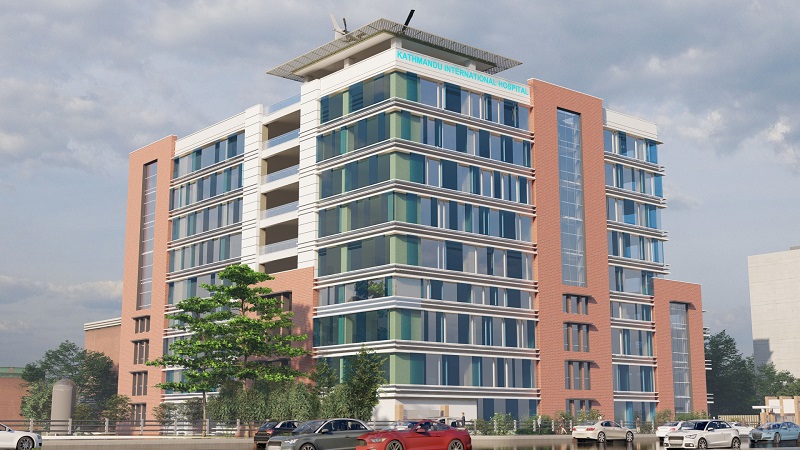
When fully operational the Kathmandu International Hospital will have a total capacity of three hundred beds. The facility is housed in a modern twelve storey building that spans a total built up area of over twenty seven thousand square meters. The structure includes two basement levels for parking and utility services along with a ground floor and eight upper floors dedicated to various medical departments. One of the standout features of the infrastructure is the rooftop helipad which is designed to facilitate rapid air ambulance services for patients coming from outside the Kathmandu Valley.
The hospital is designed to be a multi specialty hub offering services in areas such as cardiology oncology neurology and gastroenterology among others. The focus is on creating a patient centric environment that follows global safety and quality protocols. Although the proximity to the Tribhuvan International Airport may present some regulatory challenges for helicopter operations the inclusion of such advanced infrastructure shows the forward thinking approach of the promoters. By providing a wide range of specialized services under one roof the hospital expects to attract a high volume of patients and establish itself as a leader in the private healthcare sector of Nepal.
MANAGING RISKS AND ENSURING SUSTAINABILITY
Like any large scale infrastructure project the Kathmandu International Hospital is not without its risks. CARE Ratings Nepal has pointed out that the delays in meeting the original timeline have increased the risk of cash flow pressure especially once the loan repayment period begins. The rising cost of construction materials and the high debt to equity ratio are factors that the management must monitor closely. Furthermore the competitive landscape of healthcare in the Kathmandu Valley is intense with several established government and private hospitals already in operation.
To ensure long term sustainability the hospital will need to achieve a high occupancy rate from the early stages of its operation. The management plans to leverage the strong brand name of Bhatbhateni and the medical reputation of its promoters to build trust with the public. Additionally the focus on international accreditation is expected to boost the income profile of the institution by attracting medical tourists and the upper middle class population of Nepal. By balancing high quality care with efficient operational management the hospital aims to overcome its initial financial hurdles and become a profitable and socially impactful venture.
In conclusion the opening of the Kathmandu International Hospital in Shrawan will mark a major milestone for the healthcare industry in Nepal. With an investment of over eight point five billion rupees and the backing of one of the most powerful business groups in the country the facility is poised to set new standards in medical excellence. As the final technical works and equipment installations wrap up the people of Kathmandu look forward to a new destination for advanced and reliable healthcare services.
For More: Bhatbhateni-Backed Hospital Operations