Digital Payments Myths Facts Nepal Explained Clearly

20th March 2026, Kathmandu
The discussion surrounding Digital Payments Myths Facts Nepal is reaching a critical turning point as the nation transitions toward a digital-first economy.
Digital Payments Myths Facts
In coordination with Global Money Week 2026, Nepal Clearing House Limited (NCHL) and various financial institutions are leading a nationwide awareness campaign. The goal is to dismantle the psychological barriers that prevent many citizens from adopting tools like connectIPS, Fonepay, and mobile banking. By addressing the most common “Digital Payments Myths Facts Nepal,” stakeholders aim to build a foundation of trust and security for every user.
Breaking Down the Digital Payments Myths in Nepal
Despite the convenience of smartphones, several persistent misconceptions continue to hinder the growth of a truly cashless society.
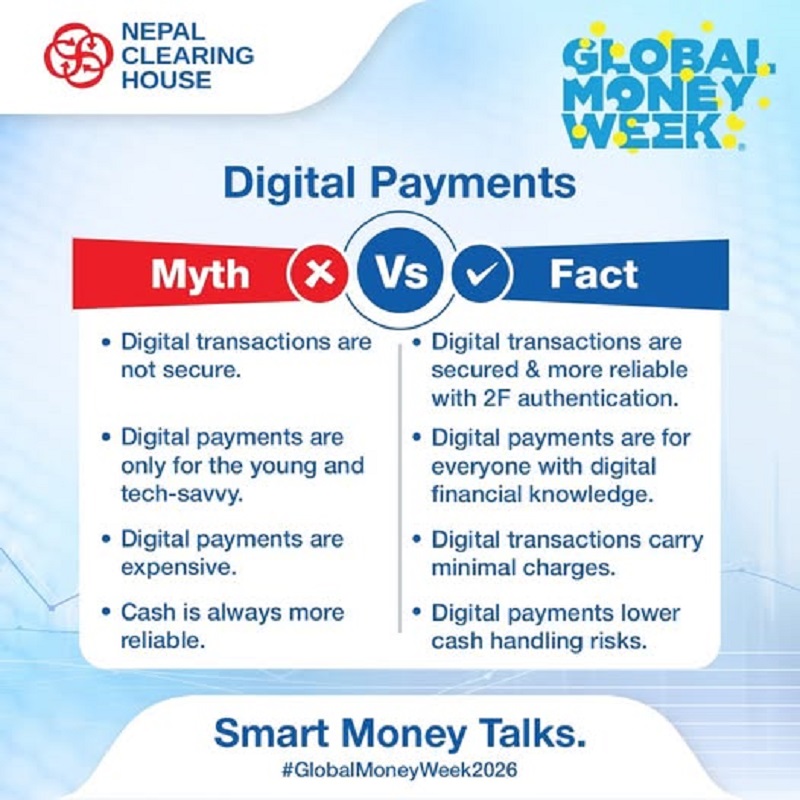
Myth 1: Online transactions are a playground for hackers. Many users fear that once they link their bank account to an app, their entire savings are at risk.
Myth 2: Digital banking is “too complicated” for seniors. There is a widespread belief that digital platforms are designed exclusively for the Gen Z and Millennial demographics.
Myth 3: Hidden fees make digital payments more expensive than cash. Some consumers worry that every “click” results in a deduction that outweighs the convenience.
Myth 4: If a transaction fails, the money is lost forever. The fear of technical glitches often leads people back to the perceived “certainty” of physical currency.
The Reality: Facts That Empower Users
The Digital Payments Myths Facts Nepal initiative provides evidence-based clarity to counter these fears with modern banking realities.
Fact 1: Multi-layered security is standard. Leading Nepali payment gateways utilize Two-Factor Authentication (2FA), biometric encryption (fingerprint/face ID), and end-to-end encryption. These systems are often more secure than carrying physical wallets, which are susceptible to theft or physical loss.
Fact 2: User interfaces are becoming universally accessible. Modern Nepali banking apps now offer Nepali language support and simplified icon-based navigation, making them accessible to users of all ages and educational backgrounds.
Advertisement


Fact 3: Digital is often cheaper than physical. When considering the cost of travel to a bank branch and the time spent in queues, digital transactions are significantly more economical. Furthermore, NCHL and many PSPs offer zero-fee windows for utility payments and low-cost interbank transfers.
Fact 4: Automated reversal systems protect your funds. In the rare event of a “Pending” or “Failed” transaction where money is deducted, Nepal Rastra Bank (NRB) guidelines mandate standardized dispute resolution and automated reversal timelines to ensure user funds are returned promptly.
The Strategic Role of NCHL and connectIPS
As the backbone of Nepal’s payment infrastructure, Nepal Clearing House Limited (NCHL) has been instrumental in normalizing the Digital Payments Myths Facts Nepal discourse. Through platforms like connectIPS, NCHL provides a high-limit, secure environment for large-scale transfers that were previously only possible through physical cheques.
During Global Money Week 2026, NCHL’s “Protect Your Money, Secure Your Future” campaign specifically targets rural and semi-urban populations. By demonstrating live, secure transactions at local workshops, they are proving that the digital ecosystem is robust enough for even the most cautious saver.
Why Shifting to Digital is a National Priority
The move toward digital payments is not just about convenience; it is a pillar of Nepal’s economic modernization.
Financial Traceability: Digital records help in maintaining a transparent economy and reducing the circulation of counterfeit currency.
Instant Liquidity: For small business owners, receiving payments via QR codes means instant access to funds without the need for manual cash counting and bank visits.
Credit Scoring: Consistent digital footprints allow banks to better assess the creditworthiness of individuals, making it easier for them to secure loans in the future.
Conclusion
The Digital Payments Myths Facts Nepal campaign serves as a reminder that the greatest obstacle to a cashless Nepal is not technology, but a lack of information. Digital payments in 2026 are secure, affordable, and inclusive. By separating the myths from the facts, every Nepali citizen can confidently participate in the digital revolution. With the support of regulators and the innovations of NCHL, the journey toward a smarter, safer financial future is already well underway.
For More: Digital Payments Myths Facts