FIU Nepal Annual Report Highlights AML CFT Progress

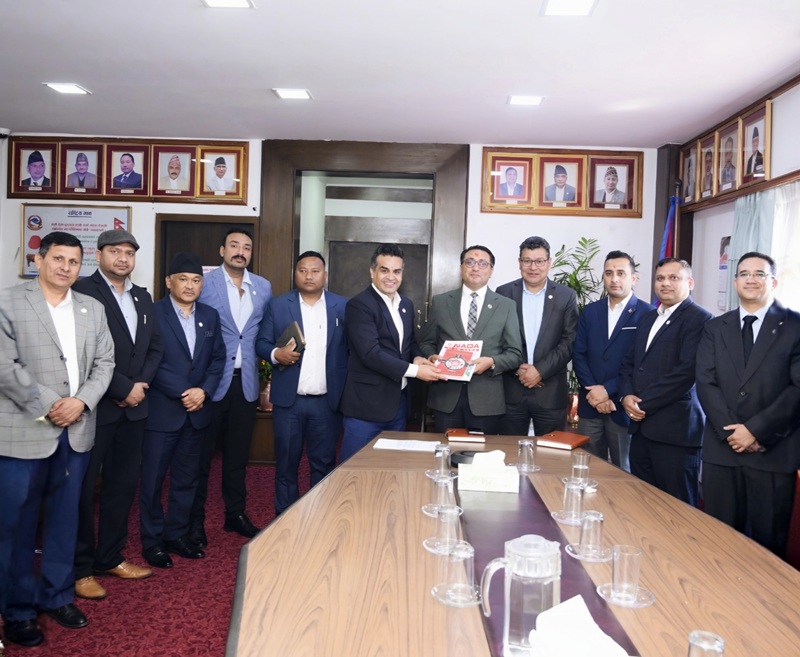
Bashu Dev Bhattarai, Director of the Financial Intelligence Unit (FIU‑Nepal) of Nepal Rastra Bank, hands over the annual report for fiscal year 2024/25 to Governor Biswo Nath Poudel in Kathmandu on Tuesday, January 13, 2026. Photo courtesy: NRB
15th January 2026, Kathmandu
The FIU Nepal annual report for fiscal year 2081/82 provides a detailed overview of Nepal’s progress in combating money laundering, terrorist financing, and proliferation financing. The Financial Information Unit of Nepal officially published its fourteenth edition of the annual report on Wednesday, January 14, 2026 (Poush 30, 2082). The report outlines institutional achievements, operational improvements, and strategic priorities aimed at strengthening the country’s anti-money laundering and counter-financing of terrorism framework.
FIU Nepal Annual Report
According to the FIU Nepal annual report, significant emphasis was placed on enhancing regulatory effectiveness and improving coordination among reporting entities, regulators, and law enforcement agencies. This period was particularly critical as Nepal worked to address strategic deficiencies identified by the Financial Action Task Force (FATF) and the Asia/Pacific Group on Money Laundering (APG) to exit the international grey list. One of the major accomplishments was the issuance of goAML operational guidelines to standardize reporting and improve the quality of financial intelligence.
Expansion of the goAML Platform and Institutional Compliance
The report highlights substantial growth in the use of the goAML platform, a fully integrated software solution developed by the United Nations Office on Drugs and Crime (UNODC). For the first time, 100 percent of Suspicious Transaction Reports (STRs) and Suspicious Activity Reports (SARs) were submitted digitally. The number of reporting entities connected to the system nearly doubled during the fiscal year, reaching a total of 3,487 reporting institutions.
This expansion reflects a significant structural shift in Nepal’s AML data landscape. While commercial banks traditionally dominated reporting, their share of total STRs declined from 84.2 percent to 76.4 percent as other sectors like insurance companies, securities firms, and cooperatives increased their participation. Notable growth was seen in the cooperative sector, where reporting entities increased from 1,010 to 1,766, and among dealers in precious metals and stones.
Surge in Suspicious Transaction and Activity Reporting
A key indicator of progress outlined in the FIU Nepal annual report is the sharp rise in Suspicious Transaction Reports. During FY 2081/82, the FIU received 9,565 STRs and SARs, representing a 30 percent increase compared to the 7,338 reports received in the previous fiscal year. This 30.34 percent growth demonstrates improved detection and a heightened level of vigilance across the financial and non-financial sectors.
The report also provides data on Threshold Transaction Reports (TTRs), which are mandatory reports for transactions exceeding 1 million rupees. The total number of TTRs surged to over 2.23 million, a 31.7 percent increase from the previous year. Remarkably, non-bank entities now account for approximately 50 percent of all TTRs, indicating that the monitoring net is spreading wider than just the traditional banking sector.
Enhanced Analytical Output and Intelligence Dissemination
In addition to higher reporting volumes, the report notes a 39.6 percent increase in analytical work conducted by the FIU. Enhanced analytical capacity allowed the unit to process and interpret financial data more effectively, identifying emerging trends such as cyber-enabled fraud, virtual currency-related crimes, and hundi-related informal value transfers. Based on the analysis of these reports, the FIU disseminated 945 financial intelligence reports to law enforcement agencies and regulatory bodies, the highest annual figure in the unit’s history.
The bulk of this intelligence was absorbed by the Nepal Police, which received 845 disseminations. Other recipients included the Inland Revenue Department and the Department of Revenue Investigation. These reports played a critical role in supporting investigations and prosecutions related to tax evasion, fraud, and corruption. The report acknowledges that while analytical output has increased, the intake of reports is growing faster than current human resources can analyze, suggesting a future need for AI-assisted triage and automated tools.
Advertisement


International Cooperation and Capacity Building
International cooperation remained a strategic priority during FY 2081/82. The report confirms that the FIU exchanged financial intelligence information 64 times with foreign Financial Intelligence Units via the Egmont Group’s secure web.
This cross-border collaboration strengthened Nepal’s ability to track international financial flows and respond to transnational crime.
The FIU Nepal annual report also underscores the importance of capacity building. Throughout the fiscal year, the unit conducted multiple training programs and workshops targeting law enforcement and reporting entities. These sessions focused on risk-based supervision and the identification of new typologies like trade-based money laundering (TBML). The introduction of dedicated reporting fields for TBML for Class-A banks has already resulted in better capture of data related to over-invoicing and phantom shipments.
Strategic Roadmap and Future Priorities
From a strategic standpoint, the FIU Nepal annual report emphasizes the adoption of a risk-based approach as anchored in the National Strategy and Action Plan for 2081/82–2085/86.
The unit is committed to further modernizing its analytical tools, deepening collaboration with domestic stakeholders, and expanding its engagement with international partners to ensure that Nepal meets the 11 immediate outcomes required for a high level of AML/CFT effectiveness.
In conclusion, the FIU Nepal annual report for FY 2081/82 reflects measurable progress in Nepal’s fight against financial crime. With increased digital reporting, stronger analytical output, and expanded international cooperation, the Financial Information Unit has reinforced its role as a key pillar of Nepal’s financial integrity system.
The report serves as both a performance review and a strategic roadmap for advancing the country’s efforts to safeguard its financial system from illicit activities in the years ahead.
For More: FIU Nepal Annual Report