Hyundai’s Industrial Revolution in Nepal: From Importing to Local Manufacturing

16th March 2026, Kathmandu
The landscape of the Nepalese automotive industry is undergoing a historic shift. What was once dismissed as a far-fetched dream—manufacturing four-wheelers within the country has become a tangible reality.
Hyundai’s Industrial Revolution Nepal
At the heart of this transformation is the Hyundai Assembly Plant in Ramgram, Nawalparasi, marking a pivotal moment in Nepal’s journey toward industrial self-reliance.
The Dawn of “Made in Nepal” Cars
For decades, Nepal relied entirely on imported vehicles, leading to high consumer costs and capital flight. In 2024, Laxmi Motor Corporation (LMC), a subsidiary of Laxmi Group and the authorized distributor for Hyundai, changed the narrative by inaugurating the nation’s first sophisticated passenger car assembly plant.
In just two years, the facility has rolled out nearly 2,000 vehicles, proving that local production is not only possible but sustainable.
Key Highlights of the Hyundai Nawalparasi Plant
The assembly plant is more than just a factory; it is a blueprint for the future of the Nepalese automobile industry.
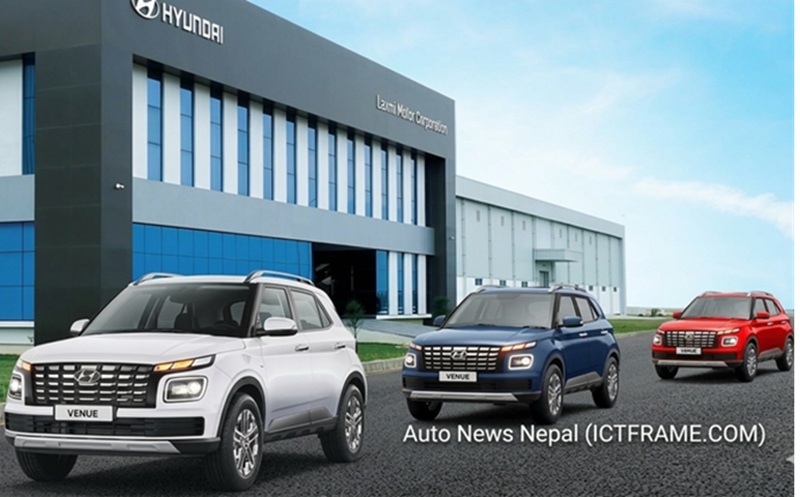
Production Powerhouse: The plant currently focuses on two of Nepal’s most popular SUVs: the Hyundai Venue and the Hyundai Creta. Interestingly, the demand for the Creta has outpaced the Venue, with production numbers for the Creta nearly doubling.
Price Advantage for Consumers: Local assembly has a direct impact on the wallet. By reducing import duties on fully built units (CBU), the Hyundai Venue price in Nepal dropped by approximately 400,000 NPR during its initial local launch phase.
High-Tech Infrastructure: Spread across a massive area in Ramgram, the plant utilizes semi-robotic equipment and adheres to the global quality standards of Hyundai Motor Company (HMC), Korea.
Advertisement


Economic Impact: More Than Just Metal and Tires
The industrial journey in Nawalparasi is driving significant economic benefits for the country:
Job Creation & Skill Transfer: The plant is operated by a 100% Nepalese workforce. Engineers and technicians, previously limited to sales and service, are now experts in precision quality assurance and process engineering.
Import Substitution: By assembling vehicles locally, Nepal is retaining internal resources and reducing the trade deficit.
Ancillary Industry Growth: The success of Hyundai paved the way for potential “backward integration” the future production of local components like batteries, tires, and seats.
2026 Price List: Locally Assembled Hyundai Models
As of March 2026, the “Made in Nepal” variants offer competitive pricing compared to their imported counterparts:
| Model | Variant | Estimated Price (NPR) |
| Hyundai Venue | E (1.2L Petrol) | From 40.96 Lakh |
| Hyundai Venue | SX | From 53.56 Lakh |
| Hyundai Creta | 1.5 E MT (Local) | From 55.56 Lakh |
| Hyundai Creta | 1.5 SX(O) IVT (Local) | From 80.56 Lakh |
The Road Ahead: Nepal as an Auto Hub?
The success of the Nawalparasi plant sends a powerful message to global investors. With the government’s commitment to industrialization and the private sector’s proven capability, Nepal is positioning itself as a budding hub for automobile assembly in South Asia.
As Hyundai continues to expand its local lineup with rumors of electric vehicle (EV) assembly on the horizon, the “Made in Nepal” tag is becoming a badge of national pride and economic progress.
For more: Hyundai’s Industrial Revolution Nepal