
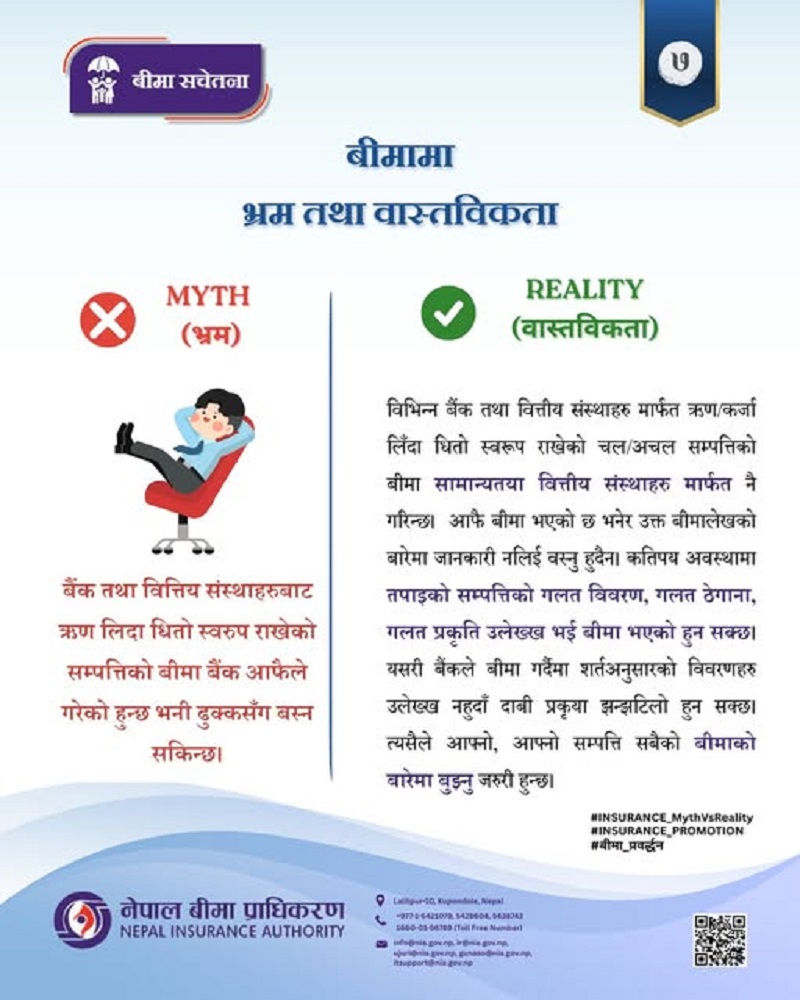
Insurance Myths and Reality Nepal Explained by Authority

8th March 2026, Kathmandu
The insurance sector in the Federal Democratic Republic of Nepal is currently navigating a period of significant regulatory reform and public education, led by the Nepal Insurance Authority (NIA). In the fiscal year 2082-2083 BS (2026 AD), the Authority has prioritized the debunking of systemic misconceptions that have historically hindered the growth of the non-life insurance market. The most prominent of these efforts is the Insurance Myths Reality Nepal campaign, which seeks to clarify the legal and functional relationship between borrowers, banks, and insurance companies. As the national insurance penetration rate reaches 3.72 percent of the Gross Domestic Product, the Authority has identified that a lack of clarity regarding collateral insurance is a major source of friction in the financial ecosystem, often leading to disputes during the claim settlement process after natural disasters or accidents.
Insurance Myths and Reality
At the core of the 2082 awareness initiative is the correction of a long-standing myth: the belief that insurance on a mortgaged property belongs exclusively to the bank. In the traditional mindset of many Nepali borrowers, because the bank mandates the insurance and often collects the premium as part of the loan processing fee, the resulting policy is viewed as a “bank asset.” However, the legal reality under the Insurance Act 2079 (2022 AD) is fundamentally different. The borrower is the “Insured” or the “Policyholder,” while the bank is merely the “Loss Payee” or the “Assignee.” This means that the insurance policy is a contract between the individual property owner and the insurance company, intended to protect the owner’s equity in the asset just as much as the bank’s interest in the loan.
The technical implications of this reality are significant for risk management. When a borrower understands that the policy is in their name, they are more likely to take an active interest in the “Scope of Cover.” For instance, in the aftermath of the 2082 monsoon floods and landslides, many borrowers were surprised to find that their bank-mandated insurance only covered the “Loan Outstanding Amount” rather than the “Full Replacement Value” of the property. The NIA’s campaign emphasizes that borrowers have the right to request a higher sum insured to protect their personal investment beyond what is owed to the bank. By paying a slightly higher premium, a homeowner can ensure that if a total loss occurs, the insurance payout will cover the bank’s debt and provide the owner with the remaining funds to rebuild their life.
Furthermore, the Insurance Myths Reality Nepal campaign addresses the misconception regarding the “Right of Choice.” Many borrowers believe they are legally obligated to purchase insurance from the specific company recommended or partnered with their bank. In 2026, the Nepal Insurance Authority has reinforced the directive that banks cannot practice “Coercive Bundling.” Borrowers have the freedom to choose any licensed non-life insurer in Nepal to cover their collateral, provided the policy meets the bank’s minimum security requirements. This promotes a competitive market where insurers must compete on service quality and claim settlement efficiency rather than just bank tie-ups. The Authority has also introduced a digital “Transparency Dashboard” where policyholders can verify the status of their collateral insurance in real-time using their citizenship number or policy ID.
Advertisement


Another critical myth addressed in 2082 is the idea that insurance claims are impossible to collect if the bank is involved. The reality is that the claim settlement process is a collaborative one. When a loss occurs, the insurance company appoints an independent surveyor to assess the damage. The claim check is typically issued in the name of both the bank and the borrower (jointly), or to the bank with a “No Objection Certificate” (NOC) required from the borrower. This ensures that the funds are used appropriately—either to repair the property, which restores the collateral’s value, or to settle the loan. The NIA’s awareness materials provide a step-by-step guide for borrowers to file their own notice of loss, ensuring they are not solely dependent on the bank’s administrative timeline.
The digital transformation of the insurance sector has played a key role in supporting the Reality side of this campaign. In 2082, the NIA implemented the Digital Insurance Policy Guidelines, which mandate that insurers send an SMS and a digital copy of the policy directly to the borrower’s registered mobile number, even if the policy was facilitated through a bank. This direct communication is a powerful tool against the myth of bank ownership. When a borrower receives a message stating “Dear Policyholder, your home insurance policy has been issued,” it reinforces their status as the primary stakeholder. This transparency is vital for building the trust necessary to expand insurance coverage to the millions of Nepalis currently outside the formal financial net.
From a broader economic perspective, the NIA’s focus on the Myths and Reality of insurance is a prerequisite for the success of the National Insurance Policy 2082. For a nation as vulnerable to climate change and seismic activity as Nepal, insurance is the most effective tool for post-disaster recovery. However, if the public views insurance as a “hidden tax” imposed by banks rather than a protective shield, the voluntary uptake of insurance will remain low. By clarifying that insurance is a personal asset that stays with the borrower even if they switch banks or settle their loan early (through a pro-rata premium refund or policy transfer), the Authority is encouraging a culture of proactive risk management.
In conclusion, the Insurance Myths Reality Nepal initiative of 2026 is a cornerstone of the Nepal Insurance Authority’s mission to protect the rights and interests of the insured. By dismantling the myth of bank-centric insurance, the Authority is empowering borrowers to take ownership of their financial protection. The reality is that an insurance policy is a contract of indemnity designed to return the policyholder to their pre-loss financial position. As borrowers become more educated about their rights to choose their insurer, set their sum insured, and receive direct notifications, the overall credibility of the insurance sector will rise. In 2082, the message from the NIA is clear: the insurance on your property belongs to you, the borrower, and understanding this reality is the first step toward true financial security.
For More: Insurance Myths and Reality