Love Insurance Claim After Decade by Chinese Couple

15th January 2026, Kathmandu
The love insurance claim after a decade has attracted widespread attention after a Chinese woman formally requested a payout from an unusual insurance product she purchased nearly ten years ago.
The case, which went viral in January 2026, has sparked global discussion about unconventional insurance products and the boundaries between emotional commitments and financial contracts.
In 2016, a woman identified by her surname Wu, from Xi’an city in Shaanxi province, purchased a policy popularly known as love insurance for 199 yuan (approximately USD 28).
Love Insurance Claim
The policy was offered by China Life Property and Casualty Insurance Company as a promotional product during a period of high experimentation in the Chinese insurance market.
At the time, the standard price was 299 yuan, but it was made available at a discounted rate for university students and young couples.
The product was essentially a structured wager on the long-term sustainability of a romantic relationship, blending the logic of an insurance rider with a celebration of personal milestones.
How the Love Insurance Policy Functioned
The love insurance policy functioned as a unique financial instrument tied to a specific life event: marriage. Under the original policy terms, if the insured couple married within a period of three to ten years from the date of purchase, they would become eligible to claim a reward.
This time window was mathematically significant, as actuaries likely estimated that most high school or college romances would either lead to marriage or dissolve within the first three years.
The benefits offered upon a successful claim included:
10,000 Roses: A symbolic gesture for wedding celebrations.
0.5 Carat Diamond Ring: A heart-shaped ring to signify the commitment.
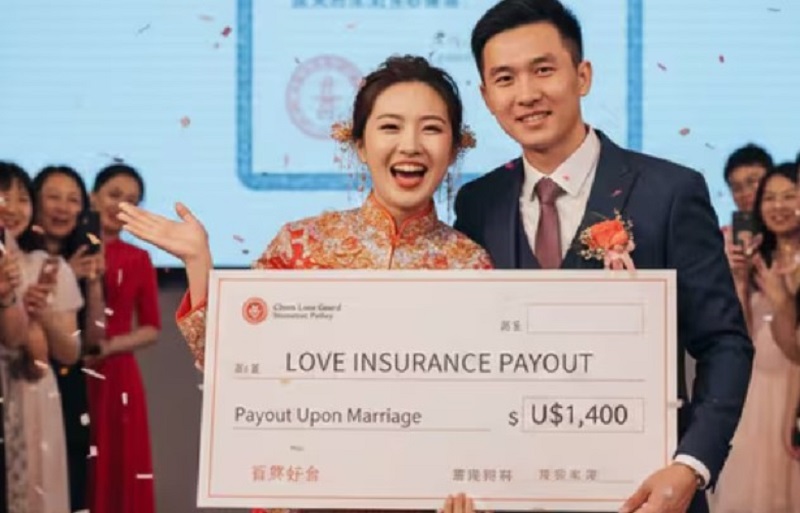
10,000 Yuan Cash Payout: A monetary reward worth approximately USD 1,400 (NPR 185,000).
Wu had purchased the policy as a gift for her boyfriend, Wang, while they were university students. The couple had known each other since secondary school and officially began dating in 2015.
Advertisement


Initially, Wang reportedly doubted the legitimacy of the product and believed it might be a marketing gimmick or even a scam.
The Claim Process and Modern Settlement
Despite the initial skepticism, the couple stayed together through graduation and their early professional lives. They officially registered their marriage in October 2025, reaching the 10-year threshold specified in the contract.
Following their marriage registration, Wu submitted a formal claim to China Life Property and Casualty Insurance Company.
According to reports from January 2026, the couple opted for the cash payout instead of the roses or jewelry. Wu explained that since the wedding ceremony and honeymoon were already completed by the time the claim was processed, receiving 10,000 roses would pose massive logistical challenges and waste.
The monetary option was deemed more practical for their new life together. Wang confirmed that all required documents, including the original policy and the marriage certificate, were submitted, and the insurer moved the process forward within two working days.
Regulatory Intervention and Market Phasing
Although this specific love insurance claim, after nearly ten years, was successful, the product itself has been a thing of the past for nearly a decade.
The discontinuation followed regulatory intervention in 2017 by the former China Banking and Insurance Regulatory Commission (CBIRC). The regulator ordered the suspension of insurance products deemed to lack genuine insurable risk or legal interest.
The regulator’s primary concerns included
Lack of Insurable Interest: Insurance law typically requires that the policyholder suffer a measurable financial loss from the insured event. Romance and marriage were seen as emotional rather than financial risks.
Gimmick-Based Marketing: Products like love insurance, wedding weather insurance, and World Cup heartbreak insurance were classified as promotional tools rather than legitimate risk-transfer mechanisms.
Actuarial Integrity: Regulators questioned whether these products were priced based on sound statistical data or simply as high-stakes bets.
Despite the ban on new sales, the insurer confirmed that policies sold before the 2017 discontinuation remain valid. This ensures that the few remaining couples who bought the policies in 2015 and 2016 can still redeem their romance dividend if they meet the marriage criteria before their policies expire in 2026.
Conclusion
In conclusion, the love insurance claim after a decade serves as a rare and compelling example of how unconventional insurance products can leave lasting impressions long after they exit the market.
As the couple receives their final settlement, their story resonates globally as a symbol of patience, commitment, and the intersection of romance and finance. From a professional standpoint, it underscores the importance of honoring legacy contracts and the power of creative, albeit regulated, financial product design.
For More: Love Insurance Claim