Nepal Myanmar religious reconstruction aid announced

17th February 2026, Kathmandu
The Government of Nepal has officially formalized a significant humanitarian and cultural gesture by pledging 350,000 US dollars for the reconstruction of two vital religious heritage sites in Myanmar. This decision, announced in early 2082 (2026), comes in response to the severe damage caused by a magnitude 7.9 earthquake that struck the region in March 2025. By providing these funds, Nepal aims to support the Republic of the Union of Myanmar in preserving its architectural history while strengthening the long standing cultural and spiritual bonds between the two nations. The assistance is divided into two specific allocations: 300,000 dollars for the Mahamuni Buddhist Pagoda and 50,000 dollars for the Ganga Ghat Hindu Temple, both located in the Mandalay region.
Nepal Myanmar religious reconstruction
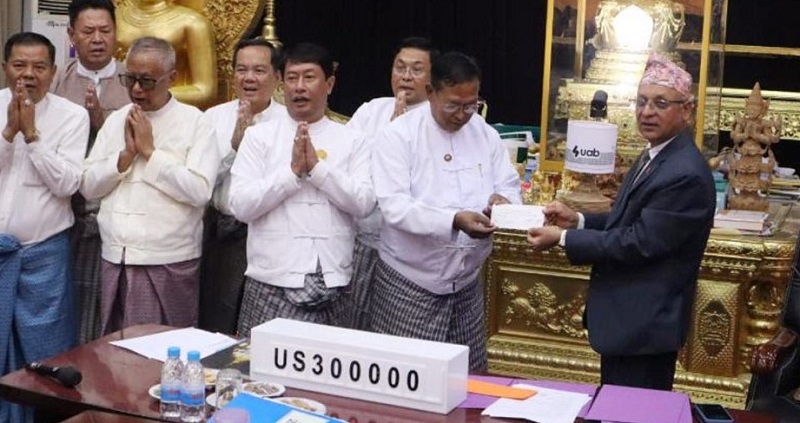
The larger portion of the aid package is dedicated to the Mahamuni Pagoda, which is situated southwest of Mandalay city. Regarded as one of the most sacred Buddhist pilgrimage sites in Myanmar, the pagoda houses the Mahamuni Buddha image, which according to local tradition and ancient texts is one of only five likenesses of the Buddha cast during his lifetime. The earthquake in 2025 caused significant structural damage to the complex, particularly affecting the Stone Inscription House and the surrounding architectural framework. On February 14, 2026, Nepal’s Ambassador to Myanmar, Harishchandra Ghimire, handed over the cheque for 300,000 dollars to Than U, the Secretary General of the Mahamuni Pagoda Trustee, during a formal ceremony held on the temple premises.
Ambassador Ghimire emphasized during the handover ceremony that Nepal and Myanmar have a history of supporting one another during times of natural disaster. He noted that the restoration of the Stone Inscription House is not just a matter of physical rebuilding but a preservation of the shared Buddhist heritage that links the people of Nepal, the birthplace of Lord Buddha, with the devout practitioners in Myanmar. The Mayor of Mandalay, U Kyaw San, expressed his deep gratitude to the Nepali government, noting that the assistance would accelerate the technical restoration efforts required to stabilize the historic site and ensure it remains safe for the thousands of pilgrims who visit daily.
In a separate but equally significant ceremony, Ambassador Ghimire handed over 50,000 dollars to Pawan Bajoria, the Chairman of the Ganga Ghat Hindu Temple Trustee. This temple serves as a central religious and cultural hub for the approximately one million Nepali speaking people, often referred to as Burmese Gurkhas, who reside in Myanmar. The Ganga Ghat temple is particularly important to the diaspora community in Mandalay, providing a space for traditional Hindu rituals, festivals, and community gatherings. The 2025 earthquake disrupted the temple’s operations and damaged its primary structures, making the financial injection from the home country a vital lifeline for the local community.
Advertisement


The Nepali diaspora in Myanmar has a deep and complex history, with many families tracing their roots back to the 19th and early 20th centuries when Gorkha soldiers and workers migrated during the British colonial era. Today, the community remains highly integrated into Myanmar’s society while maintaining a strong connection to their Nepali heritage and language. By specifically allocating funds for the Ganga Ghat temple, the Government of Nepal is demonstrating a commitment to diaspora welfare and the preservation of Nepali cultural identity abroad. Leaders of the local community, including Sagar Ghimire, President of the All Myanmar Gorkha Hindu Religious Association, were present at the handover to welcome the support.
From a diplomatic perspective, this 350,000 dollar aid package is a notable example of soft power and cultural diplomacy. Nepal has developed considerable expertise in post earthquake heritage restoration following its own devastating 7.8 magnitude earthquake in 2015. Over the last decade, Nepali architects and conservationists have successfully restored hundreds of monuments in the Kathmandu Valley, learning valuable lessons in seismic strengthening and traditional masonry. This experience makes Nepal’s contribution to Myanmar both symbolically powerful and technically relevant. It positions Nepal as a proactive regional partner capable of contributing to the protection of global heritage in Southeast Asia.
The March 2025 earthquake in Myanmar was a reminder of the seismic vulnerability of the region’s ancient structures. Beyond the Mahamuni and Ganga Ghat sites, numerous other pagodas and temples, including those in the UNESCO World Heritage site of Bagan, suffered varying degrees of damage. International collaboration is essential for such large scale restoration projects, as they often require specialized materials and historical research to ensure that the character of the monuments is preserved during the rebuilding process. Nepal’s contribution aligns with broader regional efforts to safeguard the spiritual and historical identity of Myanmar during its ongoing recovery phase.
In conclusion, the extension of 350,000 dollars for religious reconstruction in Myanmar marks a high point in Nepal Myanmar bilateral relations. Whether it is through the restoration of the world renowned Mahamuni Pagoda or the community focused Ganga Ghat Hindu Temple, Nepal is playing a vital role in ensuring that these sacred spaces continue to inspire future generations. As construction begins on the damaged Stone Inscription House and the temple facilities, the project will stand as an enduring symbol of friendship and mutual resilience between the two nations. The successful handover of these funds provides a clear path forward for the restoration of cultural ties alongside the physical structures themselves.
For More: Nepal Myanmar religious reconstruction