Nepal Telecom Revenue And Profit Unveiled at 18th Annual General Meeting (AGM)

15th January 2026, Kathmandu
The Nepal Telecom revenue and profit figures for the fiscal year 2081/82 demonstrate the state-owned telecommunications giant’s continued financial strength and strategic importance to Nepal’s digital economy.
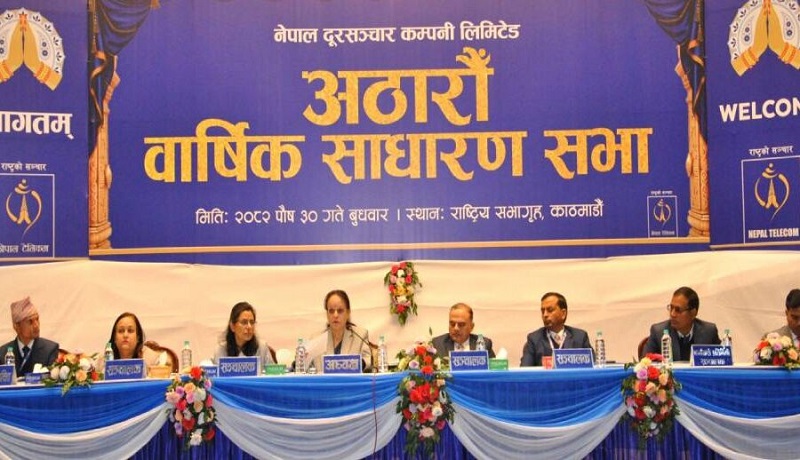
During its 18th Annual General Meeting (AGM) held on Poush 30, 2082 (January 14, 2026) at the Rastriya Sabha Griha in Kathmandu, the company reported a total revenue of NPR 38.19 billion.
While this represents a slight decline compared to previous years due to global shifts in voice traffic, the company maintained a net profit of NPR 6 billion for the review period.
Nepal Telecom Revenue Profit
A significant highlight of the report was the company’s massive contribution to the national exchequer. Nepal Telecom contributed a substantial NPR 18.46 billion to the Government of Nepal in the form of taxes, fees, and other statutory payments.
This underscores the company’s role as one of the highest taxpayers in the country, even as it navigates a highly competitive market environment.
Shareholder Returns and Dividend Approval
The 18th AGM witnessed strong shareholder participation, with approximately 91.56 percent of issued shares represented. During the meeting, shareholders unanimously approved the company’s annual report, audited financial statements, and cash flow details for the fiscal year ending mid-July 2025.
As part of the key resolutions, shareholders endorsed a proposal to distribute a cash dividend of NPR 30 per share from the company’s net profit.
This consistent dividend distribution reflects Nepal Telecom’s stable earnings position despite the increasing pressure from Over The Top (OTT) platforms like WhatsApp and Viber, which have significantly impacted traditional international roaming and voice revenues.
Infrastructure Expansion and 4G Coverage
Nepal Telecom has accelerated its infrastructure development to meet the goals of the Digital Nepal Framework. By the end of Ashwin 2082 (mid-October 2025), advanced 4G LTE services had reached 749 local levels across all 77 districts of Nepal.
This expansion ensures that high-speed mobile broadband is available to over 98 percent of the population’s local administrative units.
In terms of physical infrastructure, the company added 143 new 2G base transceiver stations and 109 new 4G stations during the review period. As of early 2026, Nepal Telecom operates a massive network consisting of:
Advertisement


4,542 2G towers for basic voice connectivity in remote areas.
2,994 3G towers supporting legacy data services.
4,437 4G towers providing the backbone for modern mobile internet.
Furthermore, the Fiber to the Home (FTTH) internet service, branded as NT Fiber, was expanded nationwide, ensuring coverage in all 77 districts by Ashwin 2082. The company also reported expanding its optical fiber network along major highways and district headquarters, reaching a total length of 8,834 kilometers.
Future Outlook and 5G Rollout Plans
Board Chairperson Radhika Aryal noted that Nepal Telecom is preparing to launch commercial 5G services in the near future.
The company has decided to adopt a Standalone (SA) 5G mode, which operates independently of existing 4G infrastructure to deliver ultra-fast speeds and low latency. The initial rollout is expected to focus on Kathmandu and Pokhara before expanding to other major urban centers.
This strategic shift toward 5G is expected to meet the rising consumer demand for high-speed data while supporting emerging digital applications and smart city infrastructure.
Chairperson Aryal emphasized that while generating profit is necessary for sustainability, Nepal Telecom continues to prioritize service delivery in geographically remote and underserved regions where private sector expansion remains limited.
Conclusion
In conclusion, the Nepal Telecom revenue and profit results for FY 2081/82 underline the company’s resilience and public service orientation. With a total income of over NPR 38 billion and a steady net profit, the company remains the cornerstone of Nepal’s telecommunications sector.
As it transitions toward 5G technology and continues to bridge the digital divide through FTTH and 4G expansion, Nepal Telecom is well-positioned to remain a key driver of the country’s digital transformation throughout 2026.
For More: Nepal Telecom Revenue Profit