
Nepal’s Data is Not Safe: World AI Alliance President Ujjwal Roy Calls For Stronger Cyber Laws & AI Investment

3rd December 2025, Kathmandu
As the world rapidly shifts toward an Artificial Intelligence (AI)-centric era, Ujjwal Roy, a New York-based technology entrepreneur and Founder/President of the World AI Alliance, has shared detailed insights into Nepal’s AI potential, the necessary policy reforms, and the urgent need to address critical digital security flaws.
Nepal’s Data is Not Safe
Roy emphasizes that AI is not just a passing trend but a force capable of redefining human civilization and global economies. He uses the example of OpenAI’s rapid ascent toward a trillion-dollar valuation to underscore the speed of the AI revolution, believing that a small country like Nepal, with proper preparation, can compete on the global stage.
Critical Warning on Data Security
Roy issued a stern warning regarding the state of digital security in Nepal.
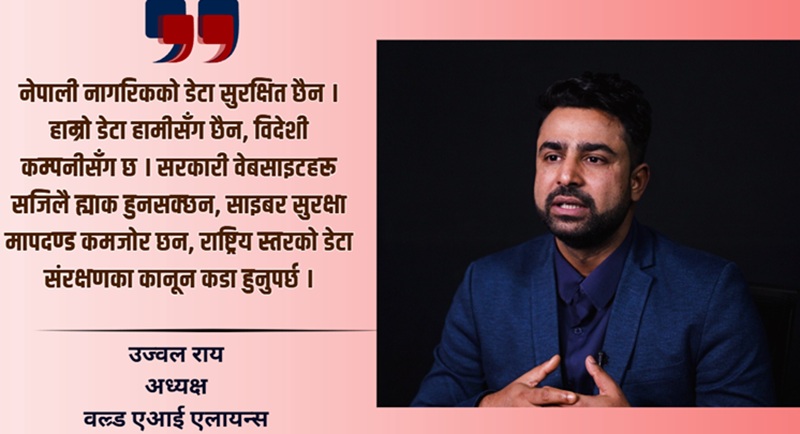
“Nepalese citizens’ data is not safe. Our data is not with us; it is with foreign companies. Government websites can be easily hacked, cyber security standards are weak, and national-level data protection laws must be strengthened.”
He argued that the data of Nepalese citizens is just as important as that of American citizens and advised Nepal to establish its own independent cyber security standards.
Infrastructure and Policy Challenges
According to Roy, the biggest hurdle for AI development in Nepal is the lack of physical computing infrastructure.
Nepal currently lacks the necessary GPU clusters and High-Performance Computing Labs required for developing frontier AI models.
While software access is adequate (platforms like Google AI Studio are available), the lack of physical labs hinders deep AI development.
Advertisement


Roy sees immense potential in building a Nepali Language-based Large Language Model (LLM), which could drastically cut business costs by enabling efficient, multi-lingual AI customer management.
The Skill Gap and Education Reform
Roy noted a severe shortage of qualified personnel for new AI-created roles such as Prompt Engineers, AI Digital Marketers, and AI Video Creators.
He insists on a comprehensive overhaul of the education system to build AI expertise, moving beyond the current limited understanding of AI as just a “ChatGPT tool.”
Implementing an AI curriculum from the school level and developing or importing instructors for practical AI subjects at the university level is crucial.
For Nepal to create global-market AI products, deep specialization is required, not just basic vocational training.
Fostering the Startup Ecosystem
Roy criticized the weak startup ecosystem in Nepal, citing fragile structures for Venture Capital (VC), Angel Investment, and startup incubators.
He urged the government to play a key role in creating an environment conducive to foreign investment, seed funding, and the establishment of incubation hubs.
Roy’s final message to Nepalese youth was to embrace entrepreneurship to solve national socio-economic problems (citing eSewa as an example), moving away from solely seeking government jobs or foreign employment.
For more: Nepal’s Data is Not Safe


