
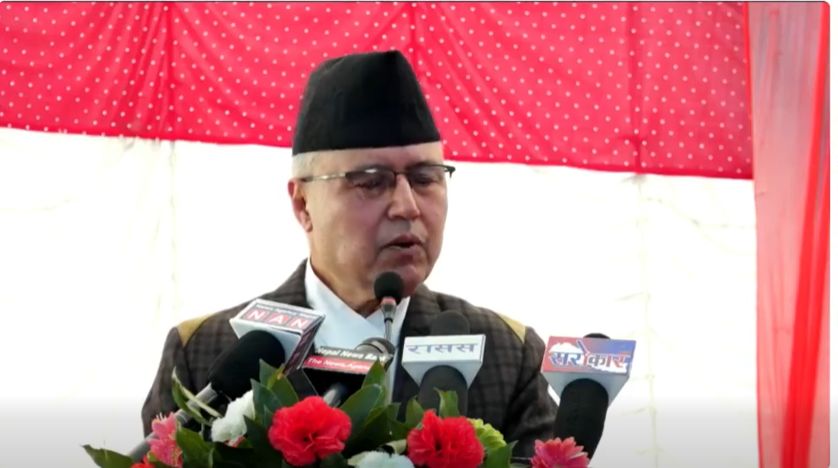
Rameshore Khanal Ends Decisions: Halts Ministerial Process Today

20th March 2026, Kathmandu
In a significant move marking the end of the interim administration, Rameshore Khanal ends decisions at the ministerial level effective today, March 20, 2026 (Chaitra 7, 2082).
Rameshore Khanal Ends Decisions
Serving as both the Finance Minister and the Minister for Federal Affairs and General Administration, Khanal announced his withdrawal from formal decision-making following the Election Commission’s submission of the final 2082 House of Representatives election report to the President. This step clears the path for the Rastriya Swatantra Party (RSP), which secured a clear majority, to form a new government under Article 76(1) of the Constitution of Nepal.
Context of the Transition
The decision for Rameshore Khanal ends decisions comes at a time of political stabilization. Khanal took charge of the Finance Ministry on Bhadra 30, 2082, and the Ministry of Federal Affairs on Ashoj 7, 2082, during a period of intense public movement against systemic corruption. His tenure was defined by an “interim mandate” to maintain fiscal stability and oversee the conduct of national elections.
Government Formation: With the RSP holding a clear majority, the transition of power is expected to be swift.
Constitutional Mandate: The new cabinet will be formed under the leadership of the majority-winning party, ending the term of the interim cabinet led by Sushila Karki.
Integrity and Honesty: Khanal reflected on his term as one marked by transparency, noting that the administration worked under the heavy weight of public expectations for a “clean” government.
Digital Governance: A Statistical Milestone
A standout feature of the period before Rameshore Khanal ends decisions was the rapid shift toward paperless administration. Khanal provided a data-driven breakdown of his ministerial activity to demonstrate the efficiency of his team.
Total Decisions Made: 828 ministerial-level decisions.
Digital vs. Manual: Only 27 decisions were traditional paper-based filings, while 801 were processed through digital governance systems.
Operational Speed: The ministry maintained an average of 6.68 decisions per day, showcasing a high level of administrative productivity during a transition period.
Key Financial Achievements and Election Funding
Managing the national treasury during an election year was the primary challenge cited during the Rameshore Khanal ends decisions announcement. Despite the fiscal pressures of 2082, the ministry achieved several critical goals:
Advertisement


Election Budgeting: Successfully allocated and mobilized funds for the House of Representatives and Provincial elections without disrupting essential services.
Social Relief: Facilitated relief payments to the families of martyrs and covered medical expenses for those injured during the nationwide movements.
Infrastructure Reconstruction: Prioritized the repair of physical infrastructure damaged during civil unrest.
Economic Revival: Launched special initiatives to boost the morale of the private sector in the Kathmandu Valley and other urban hubs, ensuring business continuity despite political shifts.
Future Outlook for Nepal’s Economy
As Rameshore Khanal ends decisions, the focus shifts to the incoming Rastriya Swatantra Party government. The transition period managed by Khanal is seen as a successful “bridge” that maintained the rule of law and prevented economic collapse during a sensitive political vacuum.
Expectations for the new administration include:
Policy Continuity: Sustaining the anti-corruption measures initiated by the Karki-led interim government.
Fiscal Discipline: Managing the national debt while fulfilling the ambitious development promises of the RSP manifesto.
Federalism Strengthening: Continuing the work in the Ministry of Federal Affairs to empower local levels of government.
Conclusion
The announcement that Rameshore Khanal ends decisions marks the formal conclusion of a unique chapter in Nepal’s political history. By halting ministerial processes today, Khanal has signaled a respectful and orderly transfer of power to the democratically elected majority. His legacy will likely be remembered for the successful integration of digital decision-making and the maintenance of fiscal integrity during one of Nepal’s most challenging interim periods.
For More: Rameshore Khanal Ends Decisions