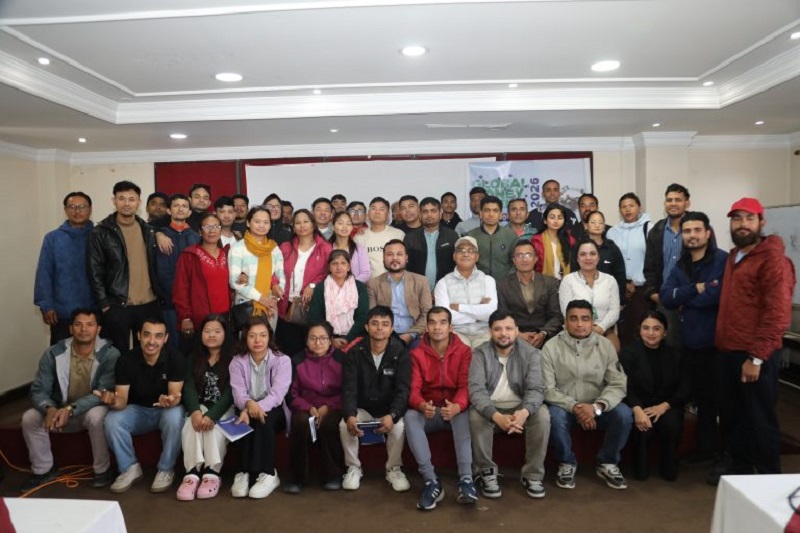
Shangrila Bank Financial Literacy Inclusive Program

24th March 2026, Kathmandu
The Shangrila Development Bank Financial Literacy inclusive initiative has set a new benchmark for corporate social responsibility in Nepal’s banking sector.
Shangrila Bank Financial Literacy
On March 21, 2026 (Chaitra 8, 2082), the bank organized a specialized financial awareness session in Kathmandu specifically designed for the deaf and hard-of-hearing community. Conducted in partnership with the Nepal Deaf Association, the program empowered 40 participants with the tools needed to navigate the modern financial landscape, proving that financial independence should be accessible to every citizen regardless of physical ability.
Pioneering Inclusive Financial Education
The Shangrila Development Bank Financial Literacy drive recognizes that true economic inclusion requires removing communication barriers. By focusing on a demographic often overlooked by standard classroom-style training, the bank addressed a critical gap in Nepal’s National Financial Literacy Strategy.
To ensure the technical content was fully understood, the session utilized professional sign language interpreters Uma Paudel and Prakash Maharjan. This allowed participants to engage directly with expert trainer Binod Narsingh Shrestha, turning a standard lecture into an interactive, two-way dialogue.
Core Curriculum: Specialized Banking Skills
The Shangrila Development Bank Financial Literacy program provided a holistic view of personal finance management. The curriculum was meticulously adapted to be visual and practical, focusing on:
Income vs. Savings: Visualizing the flow of money and the importance of keeping a “safety net.”
Secure Banking Transactions: A step-by-step guide on how to fill out bank forms, use ATMs safely, and understand monthly statements.
Advertisement


Digital Financial Literacy: Demonstrating mobile banking features and the security of QR code payments to reduce the reliance on physical cash.
Smart Money Management: Techniques for prioritizing essential expenses and avoiding high-interest informal debt.
Risk Awareness: Training on how to identify and report financial scams or suspicious digital messages.
Community Impact and Institutional Support
The success of the Shangrila Development Bank Financial Literacy event was echoed by Santosh KC, President of the National Federation of the Deaf Nepal. He noted that such programs are vital for the self-reliance of differently-abled individuals, who frequently face hurdles in accessing formal credit or investment opportunities due to a lack of specialized information.
By fostering this collaboration, Shangrila Development Bank has demonstrated that “inclusive banking” is not just about physical ramps in branches, but about the accessibility of information and the empathy of the service providers.
Strengthening the National Banking Network
With a solid foundation of 109 branches and 30 ATMs nationwide, the Shangrila Development Bank Financial Literacy program is backed by a robust institutional framework. The bank’s commitment to internal controls and risk management ensures that the financial products being taught to the community are safe, reliable, and governed by the highest standards of the Nepal Rastra Bank.
- 109 Branch Offices: Providing a wide physical presence for face-to-face assistance.
- Institutional Governance: Ensuring transparent operations and customer protection.
- Future Growth: A continued roadmap to reach marginalized communities in all seven provinces of Nepal.
Conclusion
The Shangrila Development Bank Financial Literacy inclusive program is a powerful reminder that financial knowledge is a fundamental right. By integrating sign language and specialized training, the bank has not only educated 40 individuals but has also inspired a movement toward more equitable banking in Nepal. As the bank continues to expand its digital and physical reach, its focus on “leaving no one behind” will remain a cornerstone of its contribution to Nepal’s economic resilience.
For More: Shangrila Bank Financial Literacy