Sumeru Hospital to Repay Rs 1 Billion Bank Loan Through Land Sale

2nd January 2026, Kathmandu
In a major move to resolve long standing financial liabilities the management of Sumeru Hospital in Lalitpur has reached an agreement to settle nearly 1 billion rupees in bank loans through the strategic sale of its land holdings. The process took a formal turn recently when Kumari Bank initiated the auction procedure after the hospital promoters failed to maintain regular loan installments.
Sumeru Hospital Bank Loan
This development follows a period of intense financial pressure on the hospital founders, many of whom have been linked to broader cooperative fraud investigations that have rocked the Nepalese financial sector. By liquidating a portion of its prime real estate, the hospital aims to bring its debt back to a manageable level and avoid the total seizure of its assets by the lending institution.

BACKGROUND OF THE DEBT AND COOPERATIVE LINKAGES
Sumeru Hospital was originally established using a significant amount of funds sourced from various cooperatives. Over the years, the promoter group, including individuals such as Dilip Kumar Dangol, Ramesh Maharja,n Binoj Achary, and Bharat Maharjan, among others, borrowed heavily to fund the hospital and related ventures. The total borrowing by the group reached 1.20 billion rupees, spread across entities like Sumeru Housing and Developers, Shankharapur Academy and Asian College for Advanced Studies. However, nearly 1 billion rupees of this total was specifically taken in the name of Sumeru Hospital. The financial stability of the promoters collapsed when the cooperative scandal broke out,t leaving them unable to refund depositors or service their commercial bank loans.
AGREEMENT BETWEEN KUMARI BANK AND HOSPITAL PROMOTERS
The loan was originally issued by Nepal Credit and Commerce Bank which later merged into Kumari Bank. Following the merger Kumari Bank took over the portfolio and began aggressive recovery efforts as the loan became non performing. After extensive negotiations the bank and the promoters agreed on a phased repayment plan centered on the sale of the hospital land assets. On Poush 13 the bank issued a formal 15 day notice for loan repayment which serves as the legal prerequisite for an auction. Both parties have clarified that the auction notice is a procedural step to facilitate the sale of specific land parcels rather than a hostile takeover of the entire property.
STRATEGIC LAND SALE TO REGULARIZE THE LOAN
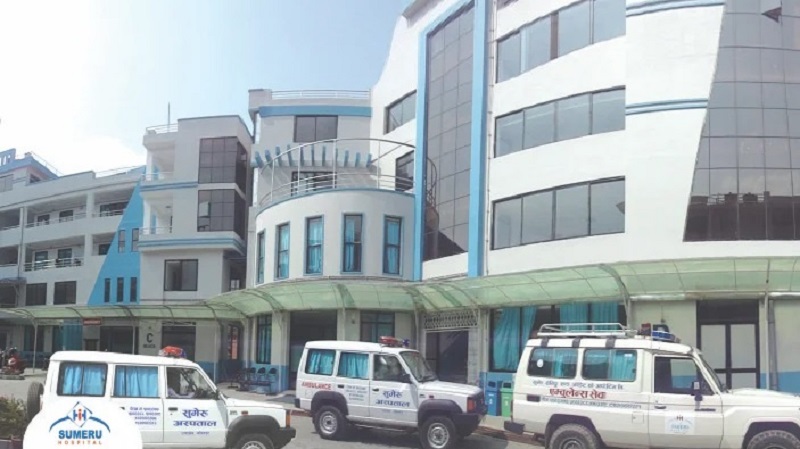
Sumeru Hospital occupies a prime 36 ropani plot in a highly valuable location in Lalitpur. Instead of selling the entire property at a distressed price the current strategy involves selling only 4 to 5 ropanis of land. At current market valuations this small portion is expected to fetch between 120 million and 150 million rupees. This specific amount is calculated to be sufficient to cover the accumulated interest and a portion of the principal bringing the loan out of the defaulted category. This targeted approach allows the promoters to retain the majority of their land while gaining the time needed to stabilize the hospital operations and seek long term investors.
Advertisement

INVESTOR INTEREST AND MARKET DYNAMICS
The news of the land sale has already attracted significant attention from real estate investors and developers in the Kathmandu Valley. Because the land is located in a high demand area preliminary discussions with potential buyers have already taken place. The bank has initiated the auction process with the understanding that there is ready demand for the property. By selling in smaller increments the management believes they can achieve a much higher price per anna compared to a bulk liquidation. This method protects the remaining 30 plus ropanis of land allowing it to be used for future hospital expansion or sold at a later date when the market conditions for large tracts of land are more favorable.
STANCE OF THE BANK LEADERSHIP
Kumari Bank Chief Executive Officer Ram Chandra Khanal has stated that the bank’s primary goal is the recovery of funds and they are willing to support borrowers who demonstrate a genuine intent to repay. By working with the Sumeru promoters to facilitate a controlled sale the bank avoids the lengthy and often complicated process of a full forced auction while ensuring that its balance sheet is cleared of a major non performing asset. This cooperative approach between the lender and the borrower is seen as a pragmatic solution to a complex financial crisis that involves thousands of cooperative depositors and the stability of a major healthcare provider.
IMPLICATIONS FOR THE HEALTHCARE SECTOR
Despite the financial turmoil Sumeru Hospital continues to provide essential healthcare services to the public. The management has emphasized that the land sale is a financial restructuring move and will not impact the day to day clinical operations or the quality of patient care. In fact the settlement of the bank debt is expected to lift a major administrative burden from the hospital allowing the management to refocus on upgrading medical facilities and services. For the residents of Lalitpur the survival of the hospital is crucial as it remains a significant health infrastructure in the region. The successful resolution of this debt could serve as a blueprint for other distressed institutions facing similar cooperative related liquidity issues.
CONCLUSION AND NEXT STEPS FOR THE AUCTION
In conclusion the initiation of the auction process for Sumeru Hospital land marks the beginning of the end of a long standing financial dispute. With a 1 billion rupee loan at stake the sale of 4 to 5 ropanis of prime Lalitpur land represents a calculated and strategic move to preserve the institution. As the 15 day notice period concludes the formal bidding for the land will provide more clarity on the final valuation and the timeline for debt clearance. Stakeholders and depositors of the associated cooperatives will be watching closely as this liquidation provides the first real hope for the recovery of funds.
For More: Sumeru Hospital Bank Loan