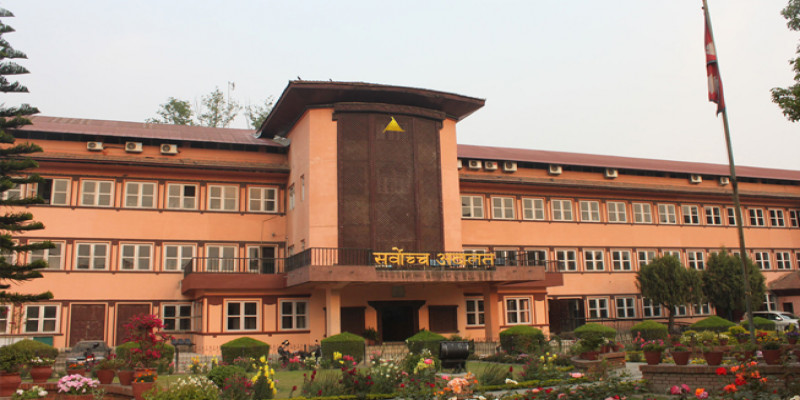
Supreme Court highway tax interim order issued

17th February 2026, Kathmandu
The constitutional and fiscal landscape of Nepal’s federal system has witnessed a landmark judicial intervention following a decisive ruling by the Supreme Court on Magh 28, 2082. In response to a writ petition addressing unauthorized local taxation, a joint bench comprising Justices Mahesh Sharma Paudel and Balkrishna Dhakal issued an interim order prohibiting local governments from collecting road usage fees and taxes from vehicles operating on national, auxiliary, and postal highways. This ruling specifically targets the practice of establishing roadside checkpoints and toll booths on federal infrastructure, a trend that had sparked intense friction between municipal authorities and the national transport sector. By prioritizing the balance of convenience, the court has effectively paused a localized revenue stream that was increasingly seen as a barrier to the free movement of goods and passengers.
Supreme Court highway tax
The legal challenge was initiated by Rajendra Bikram Baniya, the President of the Federation of Nepal Truck Transport Entrepreneurs, who filed the petition on Bhadra 22. The writ named several high level respondents, including the Office of the Prime Minister and Council of Ministers, and highlighted the specific actions of the Jeetpur Simara Sub Metropolitan City. For years, transport entrepreneurs have complained that multiple local governments were imposing overlapping fees on the same journey, often using physical barriers or gates to enforce payment. The Supreme Court’s order notes that such practices on major arteries like the Tribhuvan Highway, Mahendra Highway, and the Hulaki Highway are not permissible under the current legal framework, which designates these routes as national assets under federal jurisdiction.
A key piece of evidence referenced in the court’s decision was a contract agreement dated Asar 30, 2082, involving Jeetpur Simara Sub Metropolitan City. The court observed that while the contract itself stipulated that essential vehicles like ambulances, fire engines, and hearses should be exempt from fees, the broader act of setting up gates and collection desks on national highways violated the uniform regulatory framework. Furthermore, the court pointed to previous correspondence from the District Administration Office in Bara, which had already instructed local bodies to cease these collections. The judicial stay now provides a legal shield for transport operators who have long argued that these local taxes were a form of double taxation that inflated the cost of essential commodities across the country.
The economic implications of this order are significant for Nepal’s logistics and freight industry. According to the Federation of Nepal Truck Transport Entrepreneurs, the removal of these unauthorized tolls will reduce the operational burden on thousands of heavy vehicles that traverse the Terai and hills daily. President Baniya has welcomed the decision as a victory for the rule of law and has issued a stern warning that any local mayor attempting to bypass the interim order will face direct defamation and contempt of court charges. The transport sector has frequently argued that the cost of doing business in Nepal is artificially high due to such fragmented tax policies, and the Supreme Court’s intervention is seen as a step toward harmonizing the national trade corridor.
Advertisement

From a governance perspective, the dispute underscores the ongoing challenges of fiscal federalism in Nepal. While the Local Government Operation Act 2074 grants municipalities certain powers to raise revenue, these powers are often in conflict with the rights of the federal government over national infrastructure. National highways are the lifeblood of the country’s economy, and allowing 753 local levels to independently tax these routes would create a chaotic and unpredictable environment for inter provincial commerce. The Supreme Court’s ruling reinforces the principle that local authority ends where federal infrastructure begins, particularly when it comes to the movement of vehicles on designated national and auxiliary roads.
The interim order will remain in effect until a final verdict is reached in the ongoing case. During this period, all local governments, including those along the Postal Highway (Hulaki Rajmarg) and the auxiliary roads connecting various district headquarters, must dismantle their collection points. The Office of the Attorney General, representing the central government, and advocates for the municipal bodies will likely present further arguments in the coming months regarding the balance between local self governance and federal oversight. For now, the focus shifts to the enforcement of the order, with transport entrepreneurs monitoring the highways closely to ensure compliance by local administrators.
In conclusion, the Supreme Court highway tax interim order of 2082 is a defining moment for road governance in Nepal. It addresses the immediate grievances of the transport community while raising deeper questions about the limits of local government taxation powers. As the nation continues to refine its federal structure, this case will serve as an important precedent for how national assets are managed and how the burden of infrastructure maintenance is shared without disrupting the national economy. For retail consumers and business owners alike, the reduction in unauthorized highway fees promised by this ruling offers a rare moment of fiscal relief in a challenging economic period.
For More: Supreme Court highway tax