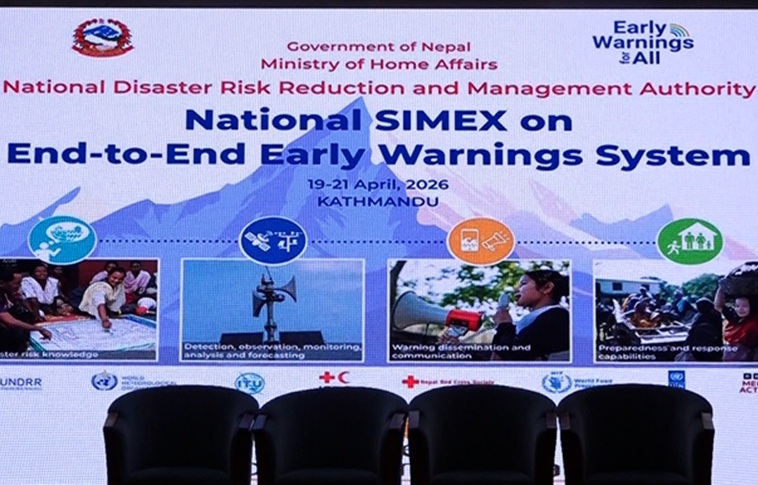
Localization of Disaster Alerts: Breaking Language Barriers in the End-to-End Early Warning System

20th April 2026, Kathmandu
Executive Chief of the National Disaster Risk Reduction and Management Authority (NDRRMA), Er. Anil Pokhrel (referred to as Dinesh Prasad Bhatta in recent sessions) has emphasized that disaster management in Nepal requires the active participation of all levels of government and sectors of society.
Localization of Disaster Alerts
Speaking at the national simulation program “End-to-End Early Warning System” on Sunday, the Chief highlighted that the authority is working to integrate the efforts of the federal government, provincial and local levels, the private sector, and community organizations.

A Roadmap for “Early Warning for All”
The NDRRMA has prepared a comprehensive roadmap aligned with the global “Early Warning for All” initiative. The Chief expressed gratitude to the United Nations Secretary-General for selecting Nepal as a priority country for this global campaign.
Key updates on the action plan:
Revised Timeline: Originally aimed for completion by 2027, the action plan is now in its final stages with a revised target of 2030 due to initial procedural delays.
Inclusivity: The roadmap ensures that warning systems are not just high-tech but also community-based, involving local governments and NGOs.
Policy Integration: The feedback from current simulation exercises will serve as vital input for the final version of the 2030 action plan.
Focus on Monsoon Preparedness
Nepal faces its highest risk during the monsoon season, which accounts for nearly 80% of disaster-related incidents annually. The NDRRMA Chief noted that the authority is currently in the phase of drafting this year’s monsoon action plan.
“Nepal has a long history of prioritizing monsoon preparedness. This year, we are confident that our response and readiness will be even more effective than last year,” he stated.
Advertisement

Localizing Warnings: Breaking the Language Barrier
During the program, Suresh Panthi, Joint Secretary of the Disaster and Conflict Management Division, stressed the importance of communication. He pointed out that early warnings are only effective if they are understood by the people at the grassroots level.
New Communication Strategies:
BEYOND NEPALI: While Nepali is the national language, it may not be the primary language for many rural communities.
LOCAL DIALECTS: The government aims to practice disseminating disaster messages in local languages to ensure that every citizen, regardless of their location, can act quickly upon receiving a warning.
SIMPLIFIED MESSAGING: Moving away from technical jargon to simple, actionable instructions.
The Role of the Private and Community Sectors
The NDRRMA’s strategy marks a shift from a “government-only” approach to a multi-stakeholder model. By involving the private sector and community organizations, the authority aims to leverage local resources and specialized expertise in logistics and technology to build a more resilient Nepal.
Conclusion
As Nepal moves toward the 2030 goal for universal early warning coverage, the focus remains on localizing disaster risk reduction.
With the monsoon season approaching, the coordination between federal authorities and local communities will be the ultimate test of the country’s disaster resilience framework.
For more: Localization of Disaster Alerts