CNI President Pandey Warns New Taxes Amid Economic Slump Could Adversely Impact Market Demand

8th June 2026, Kathmandu
The President of the Confederation of Nepalese Industries (CNI), Birendra Raj Pandey, highlighted that despite banks having sufficient investable liquidity, business owners have been unable to take new loans or expand investments due to a lack of overall market demand.
CNI President Pandey Warns
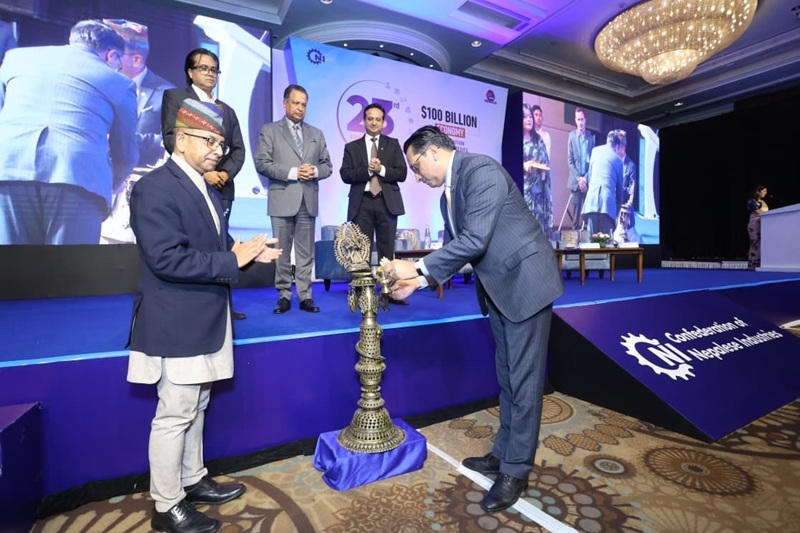
President Pandey made these remarks while delivering his welcome address at the inauguration ceremony of CNI’s 23rd Annual General Meeting.
Speaking before the Chief Guest, the Honorable Finance Minister, alongside other distinguished ministers, parliamentarians, high-ranking government officials, and private sector representatives, President Pandey outlined CNI’s official stance on prevailing economic hurdles, national budget provisions, and future strategic pathways.

‘Ample Liquidity but Flat Investment; NPA and Blacklist Tragedies Worrying’
President Pandey noted positive economic indicators such as robust foreign exchange reserves, a stable balance of payments, inflation controlled at 4.47%, and interest rates dropping to single digits. However, he emphasized that a contraction in demand over the past few years has severely dampened the manufacturing sector.
“More than NPR 10 kharb in investable funds remains idle in the banking system,” Pandey stated. “Due to shrinking market demand, industries have been unable to scale production. Furthermore, banks’ Non-Performing Assets (NPA) have hit 5.60%, and the number of borrowers placed on the blacklist has exceeded 160,000.” He stressed that the upcoming Monetary Policy must directly address these critical challenges. He also urged the government to take effective steps to accelerate capital expenditure, which currently hovers around a mere 31% for the fiscal year.
Welcoming the Budget While Pressing for Effective Execution
CNI welcomed several policy shifts introduced in the budget for the upcoming fiscal year 2081/82. The reduction of customs duties on 273 items to promote domestic manufacturing, the elimination of excise duties on 360 goods, and the decision to hand over the Motipur and Mayurdhap industrial areas to the private sector under Public-Private Partnership (PPP) models were hailed as highly positive steps by Pandey.
However, he expressed reservations regarding certain taxation frameworks. Although CNI had repeatedly suggested implementing a multi-tiered Value Added Tax (VAT) system to simplify compliance, five new taxes were introduced this year. “This will not only increase tax compliance costs and leakage risks but could also drive up commodity prices, further suppressing market demand when industries are already struggling,” Pandey noted.
Advertisement

Demand for Business Security: ‘Clear Line Needed Between Error and Malafide Intent’
Drawing attention to the declining morale of the private sector, President Pandey strongly demanded an end to the practice of detaining business practitioners during initial investigative phases for alleged economic offenses. “Arresting individuals based on complaints without a thorough preliminary verification of facts deeply discourages the private sector,” he asserted. “A clear distinction between an operational error and malafide intent must be established right from the beginning. Corporate laws should be decriminalized, focusing instead on financial penalties for economic offenses.”
‘Nepal@100Bln’: A Decade-Long Roadmap to a USD 100 Billion Economy
Presenting the findings of a comprehensive study conducted by CNI in collaboration with the Investment Board Nepal, President Pandey claimed that Nepal could realistically scale into a USD 100 billion economy (GDP) by the year 2033. The macro-modeling research, executed by over 20 experts over a period of eight months, indicates that this target is achievable if the nation maintains a long-term average economic growth rate of 6%.
To drive this mega-campaign forward, CNI has proposed 100 ‘Growth Pathways’ covering energy, manufacturing, tourism, ICT, agriculture, infrastructure, and institutional reforms. Pandey clarified that this goal is not merely a grand GDP statistic, but a realistic vision to achieve higher state revenue, qualitative infrastructure, massive job creation, and a robust middle class.
Announcement of National Infrastructure Summit
Recognizing sustainable infrastructure development as the backbone of national prosperity, Pandey announced that the 6th edition of the ‘Nepal Infrastructure Summit’ will be hosted in Kathmandu on September 11 and 12.
This year’s summit will center around the core theme: “Infrastructure with Purpose: Building Nepal’s Path to a $100 Billion Economy.”
Concluding his speech, President Pandey reiterated that the private sector stands firmly with the government in its pursuit of nationwide prosperity, urging the state to build a reliable business environment backed by consistent, pro-investment policies.
For more: CNI President Pandey Warns