
AI Frontiers in Science, Farming & Indian Languages: Insights from Google DeepMind


26th November 2026, Kathmandu
How AI Is Transforming Science, Agriculture & India’s Future | Google DeepMind
Discover how AI is revolutionizing nuclear fusion, materials discovery, precision agriculture, and regional languages. Google DeepMind Senior Director Manish Gupta joins Nasscom to explore on-device AI models, culturally aware technology, and India’s growing role in driving global AI innovation for the Global South.
How AI Could Transform Science, Agriculture and Everyday Life in the Years Ahead. Artificial intelligence is moving beyond conventional applications to open up new possibilities in scientific research, healthcare, agriculture, and the way people interact with technology.
From accelerating the development of nuclear fusion to identifying new materials, enabling AI in Indian languages and helping farmers access more granular insights, its potential is increasingly extending into real-world applications.
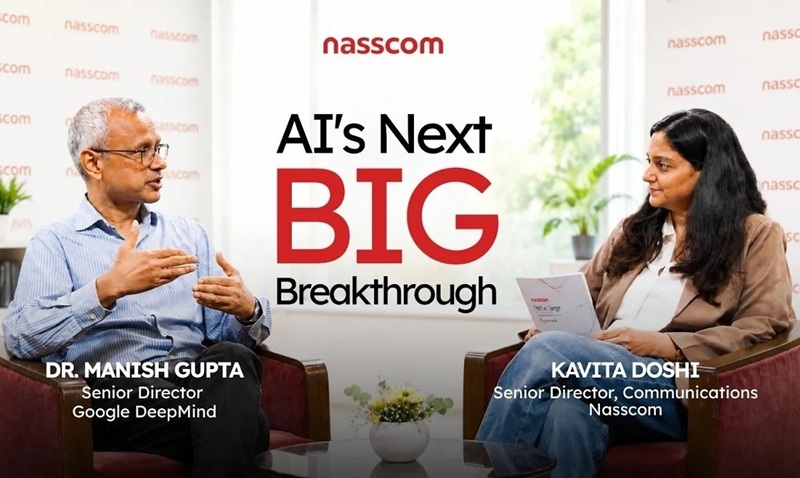
In this episode of #NasscomConversations, Kavita Doshi, Nasscom, speaks with Manish Gupta, Senior Director at Google DeepMind, about the emerging frontiers of AI, its applications in India and the opportunities for the country to contribute to global AI innovation.
AI is opening new frontiers in scientific research
AI is creating opportunities to accelerate research across several scientific disciplines, including energy and materials science.
Manish highlights nuclear fusion as one particularly exciting area. Fusion has the potential to provide an abundant source of clean energy, but one of the key challenges has been getting more energy out of a controlled fusion reaction than is required to initiate it.
Researchers are now using AI, particularly reinforcement learning algorithms, to control the flow of plasma in tokamak reactors. Teams working in this area are optimistic about reaching the energy break-even point in the coming years.
AI is also contributing to materials discovery. Diffusion models, which are used in image and video generation, are being applied to explore and identify new materials, demonstrating how techniques developed in one area can advance research in another.
Bringing powerful AI capabilities to mobile devices
Making AI more accessible across India also means developing models that can work on devices, including in areas with limited connectivity.
Manish points to the progress already being made with models such as Gemma, which can run directly on high-end smartphones and offer significant capabilities in Indian languages.
Gemma and Gemini support over 100 languages, including at least 25 Indian languages. While capabilities can vary across languages, these models are increasingly able to understand widely spoken forms.
As on-device models become more powerful, they can bring AI capabilities closer to users without always depending on cloud connectivity.
Building AI solutions for India and the Global South
India is already serving as a starting point for AI applications that can be adapted and deployed across other parts of the world.
One example is Google’s agricultural landscape understanding model, initially developed for India. Using satellite imagery, it can identify farm boundaries across the country. The model has since been launched in 15 countries, including markets in Africa and Southeast Asia.
Another application, agricultural monitoring and event detection, helps identify crops and farming activities such as harvesting and sowing.
Advertisement

These models are also enabling startups to develop solutions using more granular agricultural insights. What was previously possible largely at an aggregated district or state level can now be analysed at an individual farm level.
Manish sees this as an important foundation for other applications, including carbon credits, farmer loans, crop insurance and more targeted subsidies. Drawing a parallel with the Aadhaar ecosystem, he describes the potential of uniquely identifying farms and building further applications around that foundation.
Why cultural context matters in building AI for India
Developing AI for diverse markets requires more than translating responses from English into local languages. Models also need to understand the cultural context in which people communicate and interact.
Manish discusses the work being done to identify and address sociocultural and regional biases in AI models, including biases related to attributes such as religion and caste in the Indian context.
This involves building deeper cultural understanding into models, as well as using agentic capabilities to research specific cultural contexts when required.
Even the way a model communicates can influence how natural it feels to users. For instance, responding in overly formal or pure Hindi may not reflect how people actually speak. A more natural mix of Hindi and English can often be more appropriate, depending on the context.
The larger point is that language understanding must go beyond vocabulary to reflect how people communicate in everyday life.
AI could accelerate solutions to some of humanity’s biggest challenges
Looking ahead over the next decade, Manish believes AI could help address some of the most complex challenges facing humanity, including finding cures for diseases such as cancer and advancing materials research.
He refers to Amara’s Law, which suggests that we tend to overestimate the impact of technology in the short term and underestimate its impact in the long term.
AI models can explore multiple research hypotheses in parallel, analyse scientific literature and help researchers investigate possibilities at a scale that would be difficult to achieve through human capabilities alone.
Another significant opportunity lies in cross-disciplinary discovery. Many breakthroughs in science have emerged when ideas from one field have been applied to another. With AI models capable of understanding knowledge across different disciplines, this kind of cross-pollination could become much easier to facilitate.
India’s opportunity in shaping global AI innovation
With its large talent base, entrepreneurial ecosystem and diverse societal challenges, India has an opportunity to become a hotbed of AI innovation.
Manish is optimistic about more Indian entrepreneurs, scientists and practitioners using AI to address real-world problems. Solving these challenges can also give India an advantage in applying emerging technologies in meaningful ways.
However, he also emphasises the need for greater investment in basic research and research and development. Indian companies currently spend a relatively smaller share of their revenues on R&D compared with companies in countries such as the US and China.
Strengthening this investment will be important to translating India’s talent and technological capabilities into significant advances.
The opportunity ahead extends beyond adopting AI. It lies in advancing scientific research, developing solutions grounded in local needs, and building technologies that can create an impact well beyond India’s borders.