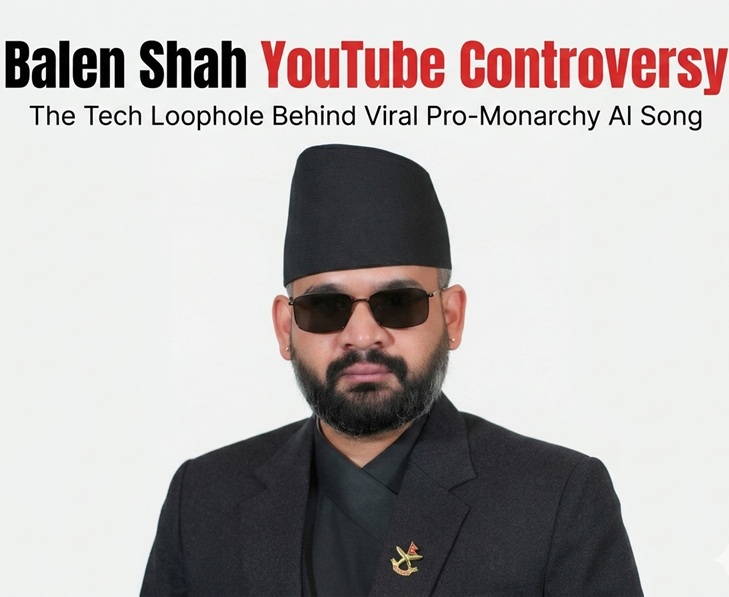
AI Songs Controversy: How a Pro-Monarchy Track Exploited YouTube’s System to Impersonate Balen Shah

26th May 2026, Kathmandu
A major digital storm is brewing across Nepalese social media spaces. A pro-monarchy track supporting former King Gyanendra Shah went viral after mysteriously appearing under the official YouTube channel name of Prime Minister Balen Shah.
AI Songs Controversy
Featuring politically charged lyrics“Shirmathi Nepal Aama Kandhamathi Gyanendra Rajalai” (Mother Nepal on our heads, King Gyanendra on our shoulders) the track quickly polarized public opinion.
While critics slammed Balen for allegedly pivoting toward monarchist sentiments, supporters and tech observers noticed something highly unusual: the track was completely missing from the video upload tab on Balen’s actual YouTube channel page.
The incident has thrust the AI songs controversy back into the spotlight, exposing a significant vulnerability in how global digital music distributors interact with automated streaming systems.

How Did the Track End Up on Balen Shah’s Profile?
Tech experts and music industry insiders familiar with automated publishing protocols point toward a well-known vulnerability in digital music distribution networks.
The track was not manually uploaded by Balen Shah or his team. Instead, it was routed through a third-party digital music distributor, likely platforms like DistroKid.
The Metadata Loophole Explained
DistroKid and similar aggregators make it incredibly easy for independent creators to push music to global platforms like Spotify, Apple Music, and YouTube Music.
For a small annual fee, anyone can upload an audio file, input metadata (the artist’s name, track title, and album art), and distribute it globally.
When a malicious actor or prankster uploads an AI-generated track, they can simply type an established artist’s name in this case, “Balen”—into the primary artist metadata field.
Advertisement

[User Uploads AI Audio File]
          │
          ▼
[Inputs Target Artist Name in Metadata: "Balen"]
          │
          ▼
[Distributor Pushes Track to DSPs]
          │
          ▼
[YouTube Algorithms Automatically Map Song to Official Topic/Artist Channel]
Because digital streaming platforms (DSPs) prioritize automated algorithmic matching, YouTube’s backend system automatically linked the incoming release to Balen Shah’s Verified Artist Profile.
This caused the track to appear in automated feeds and generated auto-generated “Topic” playlists carrying his official branding, giving the illusion of an official release.
A Growing Pattern in the Nepalese Music Industry
This bizarre event is far from an isolated incident. The AI songs controversy has steadily disrupted Nepal’s digital ecosystem over the last few years. Popular Nepalese artists have repeatedly fallen victim to distribution platform flaws and identity hijacking.
| Artist | Impact of Distribution Flaws / Exploitation |
| Sushant KC | Unrelated, unverified ambient tracks automatically linked to his official streaming discography. |
| Samir Shrestha | Faced ghost-releases where third-party uploads temporarily appeared under his verified artist profiles. |
| Swapna Suman | Experienced algorithm mismatch issues that mixed third-party content into official user-facing playlists. |
The Darker Side of Deepfakes and AI Impersonation
The intersection of generative AI tools and open distribution systems has created a unique headache for figures in leadership and entertainment alike. Unscrupulous pages and creators have increasingly turned to AI-generated content to harvest engagement from unsuspecting Nepalese netizens.
From deepfaked voice covers mimicking prominent artists to manipulated, highly emotional AI images designed to trade public sentiment for views, the barrier to digital impersonation has dropped to zero.
Industry Warning: When streaming systems blindly rely on metadata strings rather than biometric voice matching or explicit cryptographic keys from artist teams, public figures remain completely exposed to digital identity hijacking.
Final Takeaway: The Urgency for Stricter Verification
The viral pro-monarchy track incident highlights a critical flaw in modern music tech. While distributors like DistroKid democratize the music industry for independent artists, their lack of rigorous upfront verification allows bad actors to exploit gaps and stir unnecessary political or social unrest.
As streaming platforms slowly upgrade their defense systems to flag unverified AI music submissions, users are urged to double-check official channel uploads before reacting to controversial tracks on automatically generated streaming playlists.
For more: AI Songs Controversy