
Cybersecurity Beyond Core Banking in Nepal: Securing the Entire Digital Ecosystem

23rd October 2026, Kathmandu
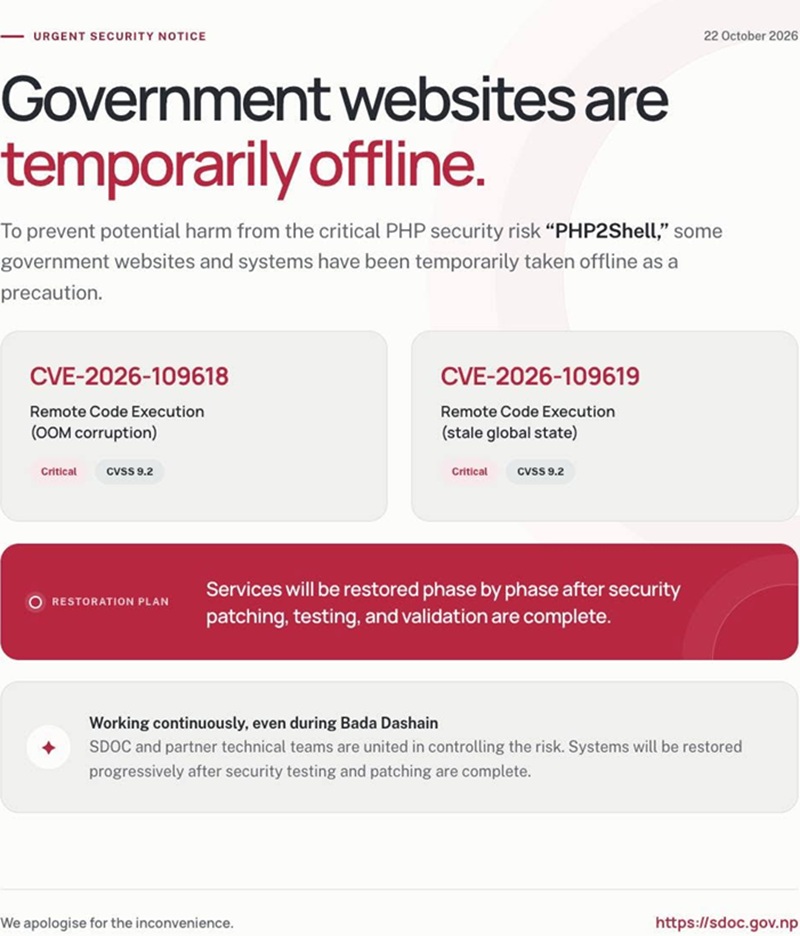
The recent PHP2Shell vulnerability serves as an urgent wake-up call for financial institutions. For years, the primary focus of cybersecurity for core banking in Nepal has revolved around securing mission-critical transaction engines, internal database architectures, and high-traffic customer platforms like mobile banking apps. However, modern cyber threats rarely target the front door directly; they exploit forgotten side entrances.
In today’s hyper-connected environment, a bank’s perimeter extends far beyond its Central Banking System (CBS). Non-core web applications, marketing microsites, customer portals, third-party software integrations, and vendor-managed infrastructure frequently present low-hanging fruit for malicious actors.
To achieve true cyber resilience, banking leaders in Nepal must shift their paradigm: A bank’s security is only as strong as its least-protected digital entry point.
The Misconception Surrounding Core Banking in Nepal
Historically, risk management strategies and IT budgets for core banking in Nepal have prioritized core infrastructure. Regulatory compliance frameworks, audits, and penetration tests naturally zero in on transaction-processing systems to prevent financial fraud and immediate monetary losses.
While safeguarding the central core is indispensable, over-indexing on core security creates a false sense of safety. Cybercriminals recognize that while a bank’s CBS might be shielded behind multi-layered firewalls, intrusion detection systems, and stringent access controls, auxiliary systems often lack equivalent security posture:
Marketing & Public Web Portals: Frequently hosted on open-source Content Management Systems (CMS) or custom PHP stacks that receive infrequent updates.
Third-Party & Vendor Infrastructure: API connectors, loan application portals, and credit scoring platforms integrated into the main network without end-to-end security audits.
Support & Ticketing Systems: Vendor-managed customer support desks that maintain active connections or routes into internal bank networks.
When an attacker successfully executes a remote code execution (RCE) exploit such as the PHP2Shell vulnerability on a seemingly minor web server, that compromised asset becomes an internal operational bridge. From there, bad actors pivot laterally across the internal network until they reach critical assets, including core databases.

Critical Questions for Nepalese Bank Leaders & CISOs
As financial institutions across Nepal accelerate digital transformation and adopt open banking standards, executive leadership and Chief Information Security Officers (CISOs) must evaluate their broader exposure by asking three vital questions:
Advertisement

1. Are we securing our entire digital ecosystem, or just our core systems?
Focusing security investments solely on core banking in Nepal leaves edge applications vulnerable. Every digital touchpoint—regardless of how non-essential it seems requires continuous vulnerability assessment, secure coding reviews, and strict access management.
2. Do we have complete visibility into third-party applications and vendor supply chains?
Banks increasingly rely on external software vendors, fintech partners, and IT contractors. Without comprehensive supply-chain risk management, strict service level agreements (SLAs) for patching, and regular third-party audits, external partner vulnerabilities directly expose the bank.
3. Can we identify and contain a breach before it spreads laterally?
Perimeter defense alone is no longer sufficient. Implementing robust network segmentation, Zero Trust Architecture (ZTA), and Endpoint Detection and Response (EDR) solutions ensures that if a non-core web application is breached, the compromise is isolated immediately before it reaches central banking networks.
Key Strategies to Secure Nepal’s Banking Digital Ecosystem
To move beyond traditional core-focused defenses, Nepalese financial institutions should adopt a comprehensive, ecosystem-wide security strategy:
1. Implement Zero Trust Architecture (ZTA)
Never trust, always verify. Ensure that auxiliary systems, public portals, and third-party vendors operating within or outside the network are granted only the minimum necessary privileges (Least Privilege Principle). Network segmentation should strictly restrict non-core servers from communicating with core databases.
2. Mandate Continuous Vulnerability Management & Patching
Threat actors actively scan for known vulnerabilities like PHP2Shell across public IP ranges. Banks must maintain a real-time inventory of all digital assets and enforce automated, rapid patching protocols across all web servers, subdomains, and staging environments.
3. Strengthen Vendor & Third-Party Risk Management (TPRM)
Establish clear cybersecurity standards for software vendors and technology partners in Nepal. Require routine third-party penetration testing reports, source code audits, and immediate disclosure protocols for supply-chain vulnerabilities.
4. Continuous Threat Monitoring & Incident Response
Deploy centralized Security Information and Event Management (SIEM) and Security Orchestration, Automation, and Response (SOAR) capabilities. Comprehensive logging and automated threat containment allow security teams to detect anomalous behavior on auxiliary web servers instantly.
Conclusion: Think Beyond Core Systems
Cybersecurity is not merely about protecting what matters most; it is about ensuring that what appears less critical does not become the entry point for complete system compromise.
For board members, executives, and IT leaders managing core banking in Nepal, the objective is clear: Look beyond core systems and secure the entire digital ecosystem. By hardening public portals, monitoring supply chains, and adopting a Zero Trust mindset, Nepalese banks can build true cyber resilience in an increasingly complex threat landscape.