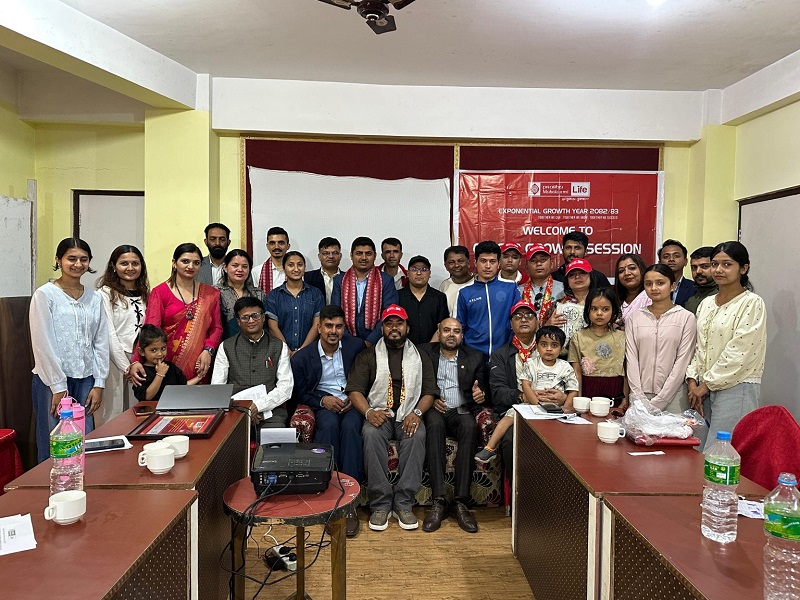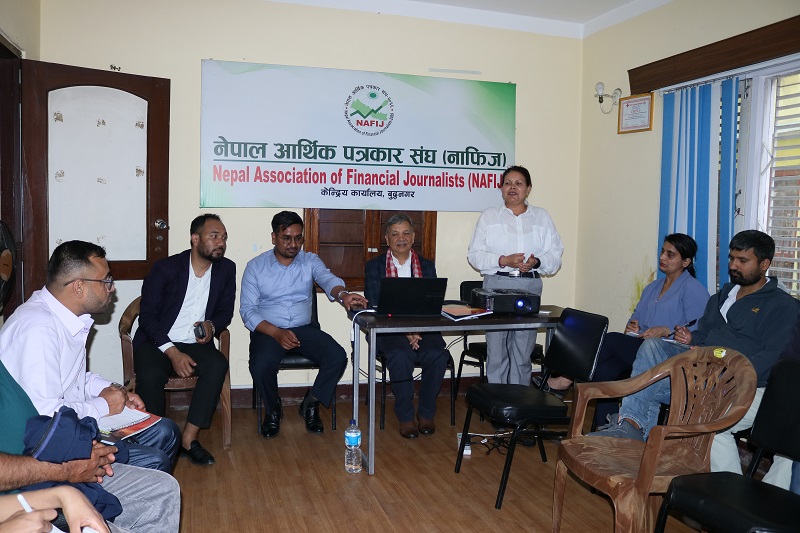
NAFIJ Conducts Budget Reporting and AML Training for Journalists


25th May 2026, Kathmandu
Tax expert Rup Khadka has strongly emphasized the absolute necessity of building a resilient tax ecosystem and establishing a mandatory digital billing framework to significantly upgrade the tax administration and public revenue management systems of Nepal.
NAFIJ Conducts Budget Reporting
Speaking comprehensively at an advanced media training program organized by the Nepal Economic Journalists Association ahead of the highly anticipated upcoming national budget announcement Khadka shed light on deep structural issues hindering the current taxation regime and presented a detailed list of urgent policy reforms designed to modernize the state treasury operations.
The specialized economic training program focused heavily on the interconnected themes of Budget and Taxation alongside Money Laundering.
During the sessions Khadka conducted comprehensive masterclasses on macro taxation principles while senior financial journalist Shridhar Khanal provided expert training modules regarding anti money laundering operations and hidden financial crimes.
The primary objective of the workshop was to enhance the analytical capacity of economic journalists so they can critically evaluate complex fiscal policies and national budget allocations.
The Urgent Need to Realign Excise Duties with Global Principles
A major point of criticism raised by Khadka during the seminar was the current unstructured implementation of excise duties across the country.
According to his analysis Nepal has historically imposed excise duties on thousands of consumer items completely bypassing internationally accepted taxation principles.
He strongly argued that excise taxes should structurally target specific socially harmful or environmentally damaging products such as alcohol tobacco and pollution related industrial goods rather than being applied indiscriminately across competitive business sectors.
Khadka explained to the participants that nearly 96 percent of total government revenue in Nepal is generated from just five major traditional tax categories which include Value Added Tax excise duty customs duty and other standard commodity based transaction taxes.
Because the national treasury relies so heavily on consumption taxes he stressed that journalists covering economic beats must develop a thorough understanding of international tax principles to analyze upcoming tax policy modifications effectively without spreading misconceptions.
Lowering Income Tax and Optimizing Customs Slabs for Competitiveness
Shifting the discussion toward direct taxation fields Khadka noted that corporate and personal income tax rates in Nepal remain exceptionally high when compared to neighboring countries within the South Asian Association for Regional Cooperation region.
He suggested that the government should seriously consider lowering these direct tax rates in the forthcoming budget to improve regional economic competitiveness encourage voluntary compliance and stimulate domestic investment.
Advertisement

He also targeted the excessive customs duties levied at various border entry points stating that inflated customs rates place a massive unfair financial burden directly on regular consumers while driving up inflation.
According to his recommendation reducing the total number of customs slabs and systematically lowering customs tariff rates would make the entire border taxation system far more efficient transparent and highly business friendly.
Transitioning to a Unified Value Added Tax Rate
Widely recognized as an international expert on Value Added Tax systems Khadka stated that this specific indirect tax remains one of the most organized stable and productive taxation models in the world. However he pointed out that Nepal has diluted the effectiveness of its own system by introducing too many selective exemptions and special interest tax benefits.
He strongly argued that Nepal must maintain a uniform Value Added Tax rate to ensure administrative simplicity and market equity. He added that only a tiny handful of countries globally operate under complicated multi rate Value Added Tax systems as they frequently lead to revenue leakage administrative confusion and endless legal disputes between businesses and tax offices.
The Roadmap for Nationwide Mandatory Digital Invoicing
To fix these systemic weaknesses Khadka emphasized that mandatory billing systems and advanced electronic invoicing mechanisms must be deployed nationwide without exceptions.
He pointed out that progressive economies around the world already require even small micro enterprises to issue digital invoices through verified electronic machines which automatically transmit transaction data to central revenue databases.
Implementing this infrastructure across Nepal would instantly improve financial transparency eliminate under invoicing and maximize tax compliance.
Adding to the financial integrity discourse senior economic journalist Shridhar Khanal highlighted the critical importance of tracking illicit financial flows.
He stated that economic journalists in Nepal must become far more alert analytical and technically capable of reporting on financial crimes and money laundering operations that threaten the formal economy.
Nepal Economic Journalists Association President Menuka Karki concluded the event by stating that the organization will continue conducting these vital capacity building training sessions for its media members in the future.
With the Government of Nepal scheduled to present the national budget on Jestha 15 these expert arguments regarding digital compliance and structural revenue overhaul are expected to dominate key policy priorities.
For More: NAFIJ Conducts Budget Reporting