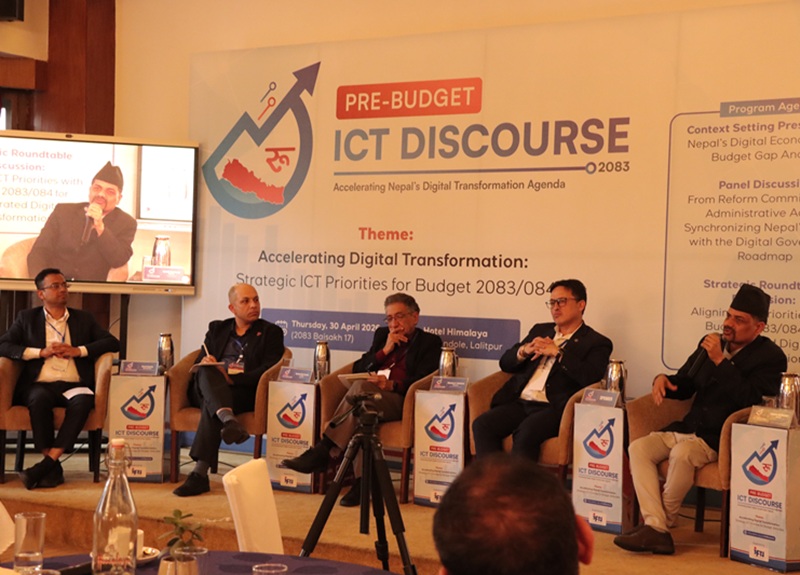
Pre-Budget ICT Discourse 2026: Policy Clarity and Budget Hike Critical for Digital Transformation

2nd May 2026, Kathmandu
In anticipation of the upcoming fiscal year 2026 budget, stakeholders in the Information and Communication Technology (ICT) sector have called for urgent policy reforms, increased budget allocation, and a simplified tax regime.
Pre-Budget ICT Discourse 2026
During the “Pre-Budget ICT Discourse 2026” organized by the ICT Foundation Nepal, experts emphasized that sustainable development is impossible without an effective public-private partnership.
The event brought together government officials, private sector leaders, tech experts, and academicians to draft a roadmap for Nepal’s digital future.

Key Highlights and Industry Demands
The discourse identified several bottlenecks hindering Nepal’s tech growth and proposed strategic solutions for the upcoming budget:
1. Policy Clarity and Legal Framework
Manohar Bhattarai, Chairman of the Internet Governance Institute, highlighted that while the digital economy holds immense potential, it is currently stifled by policy ambiguity and a lack of data security laws.
He advocated for a ‘Single Form’ and ‘One-Step System’ to simplify complex government service delivery. Adesh Khadka, Joint Secretary at the Ministry of Communication and IT, acknowledged that the lack of a clear definition for the “IT Industry” remains a major challenge in policy drafting.
2. Increasing Investment and Supporting Startups
Prof. Dr. Manish Pokharel from Kathmandu University criticized the government’s minimal spending on ICT, urging a significant hike in investment for education, research, and Artificial Intelligence (AI).
Similarly, Bhushan Giri of Arkbo Technologies noted that startup loans are insufficient and urged the government to prioritize the development of product-based IT industries to compete internationally.
3. Taxation and Infrastructure Hurdles
Representatives from the private sector expressed concerns over the “tax burden.” Keshav Nepal of WorldLink stated that excessive taxes and fines on ISPs have made operations difficult. Gaurav Raj Pandey, President of NAS-IT, identified high bandwidth taxes and weak infrastructure as the primary barriers to job creation within the tech sector.
4. Digital Payments and Fintech
ICT expert Anand Raj Khanal moderated a session on financial challenges, pointing out that cross-border payments remain a hurdle.
He stressed the need to integrate international services like PayPal and called for better synchronization between the government’s fiscal policy and the central bank’s monetary policy.
Advertisement

Insights from Key Speakers
Rajan Lamsal (President, ICT Foundation Nepal): Emphasized that collaboration between the government, private sector, and stakeholders is no longer optional but a necessity.
Gajendra Budhathoki (Editor-in-Chief, Taksar News): Pointed out the “data gap,” noting that while the ICT sector does billions in transactions, its formal contribution remains underrepresented in official government statistics.
Ganesh Shah (Former Minister): Linked digital transformation directly to good governance, stating that ICT should be viewed through a lens of globalization.
Dr. Amrita Sharma (ADB): Noted that the sector needs “actual budget, not just slogans,” highlighting that budget scarcity has been a chronic issue.
Strategic Recommendations for Budget 2026
The participants unanimously concluded that for Nepal to leap into the ICT sector, the government must address the following in the next budget:
Stable Tax Policies: Ensuring a predictable tax environment to attract foreign investment.
AI and Robotics Education: Integrating advanced tech into the school curriculum and providing tax exemptions for robotics kits.
Cybersecurity Framework: Implementing a national software standardization and audit framework to ensure quality and security.
Digital Literacy: Expanding ICT access from urban centers to rural villages to bridge the digital divide.
The Pre-Budget ICT Discourse 2026 served as a loud wake-up call for the government. While the potential for Nepal to become a regional tech hub is high, it requires moving beyond rhetoric.
Policy clarity, adequate funding, and a “facilitator” role for the government are essential to turn the vision of a Digital Nepal into reality.
For more: Pre-Budget ICT Discourse 2026