
EcoMethanol Signs MOU For Korea’s First Domestic Green Methanol Plant

27th August 2026, Kathmandu
EcoMethanol Signs Green Methanol Supply MOU with Wallenius Wilhelmsen and EUKOR
- Five-party agreement also involving Taebaek City and Hyundai Corporation
- Permits, site and basic design complete; construction to start in December
- 15,000 tons a year, KRW 120 billion in total investment
EcoMethanol Signs Korea’s First Domestic Green
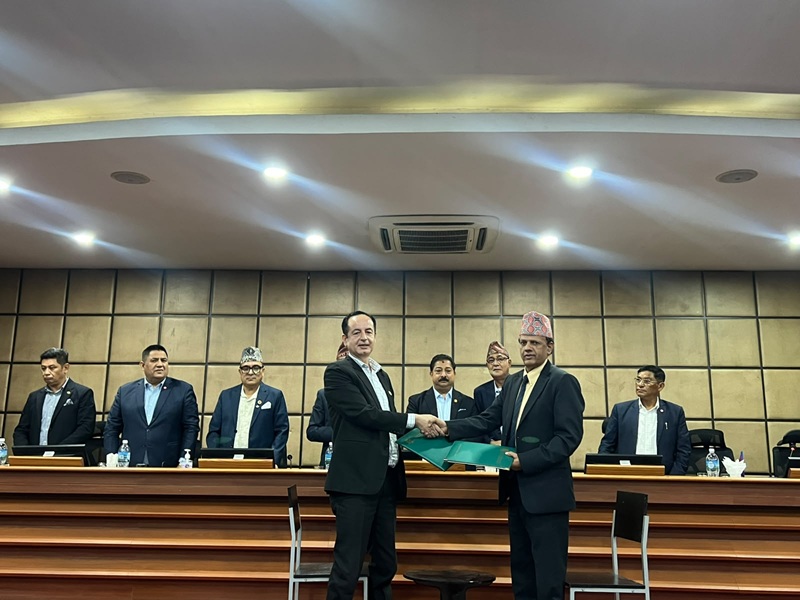
EcoMethanol Co., Ltd. signed a memorandum of understanding today on the supply of green methanol with Taebaek City, Hyundai Corporation, Wallenius Wilhelmsen Ocean AS of Norway, and EUKOR Car Carriers. The signing took place at EUKOR’s head office in Seoul.
EcoMethanol is the special purpose company set up by Plagen Co., Ltd., a Korean clean energy development and engineering firm, to build a green methanol plant in Taebaek, Gangwon State. John Kyung is the chief executive of both companies.
Under the MOU, Hyundai Corporation will buy the methanol produced in Taebaek and sell it on to the two carriers, which will burn it as fuel in their own fleets. Taebaek City takes part as an equity co-investor and will provide administrative and policy support. Production, trading and end use are tied together in a single chain, the first such arrangement in Korea.

Ready to break ground
The plant will produce 15,000 tons a year from forestry residues, using dual fluidized bed (DFB) gasification, a process already proven in commercial operation. Total investment is KRW 120 billion.
EcoMethanol holds Korea’s integrated environmental permit, has secured its site in the Dongjeom Industrial Complex and has completed basic design. Construction is due to start in December 2026 and commercial production in January 2029. The plant will employ 36 people locally.
Taebaek’s role as a production hub is written into both national and provincial plans. The Taebaek Jangseong Colliery Economic Revitalization Project cleared preliminary feasibility review in 2025 with a green methanol facility included in its scope, and Gangwon State lists a green methanol cluster in its mid- to long-term investment plan for former coal-mining regions. Dongjeom will be the first of these facilities to be built, because its industrial site is already developed.
The fuel is already in use, and all of it is imported
Carbon regulation in shipping is no longer a prospect. The EU Emissions Trading System now covers maritime transport, the FuelEU Maritime regulation on greenhouse gas intensity is in force, and the International Maritime Organization is moving toward adoption of its Net-Zero Framework.
Advertisement

Korean carriers are already buying green methanol. HMM’s methanol-fueled container ships HMM Green and HMM Forest took on 2,900 tons and 3,110 tons at Yangshan Port in Shanghai in March and May 2025. The car carrier Arctic Tern, operated by EUKOR, loaded about 2,800 tons in Shanghai in July 2026 before starting commercial service on the Asia-Europe route. All of that fuel was made in China.
Korea produces none of its own. Ulsan Port was the first port anywhere to bunker green methanol for a ship in 2023, but the fuel had been imported. Korea consumes roughly 2 million tons of methanol a year, most of it imported and made from fossil feedstock. The Taebaek plant would be the country’s first domestic source of clean marine fuel.
Closing the price gap
Green methanol costs more than fossil fuel because greenhouse gas emissions are not yet fully priced. That gap will narrow as international regulation takes hold. What is needed until then is a temporary mechanism to cover the difference.
Korea is working on one. An enforcement decree is being drafted for the Special Act on Support for the Establishment of Green Shipping Corridors, promulgated in March 2026, and a statutory basis for financial support is required, including a Carbon Contract for Difference scheme for green methanol. An amendment to the Gangwon State Special Act, intended to foster alternative industries in former coal-mining regions, is also being sought.
Kyung said the agreement had brought EcoMethanol together with carriers and partners of the first rank. “We will work with Taebaek City to make Taebaek a base for zero-carbon energy,” he said, “and to build a model for Korea’s clean shipping and energy industries.”
About EcoMethanol Co., Ltd.
EcoMethanol Co., Ltd. is developing a green methanol plant at the Dongjeom Industrial Complex in Taebaek, Gangwon State, Republic of Korea. The plant will convert forestry residues into 15,000 tons of green methanol a year by dual fluidized bed gasification. Commercial production is targeted for January 2029.
About Plagen Co., Ltd.
Plagen Co., Ltd. develops and engineers clean energy projects, specializing in biomass gasification for clean methanol production. It established EcoMethanol and leads the project.