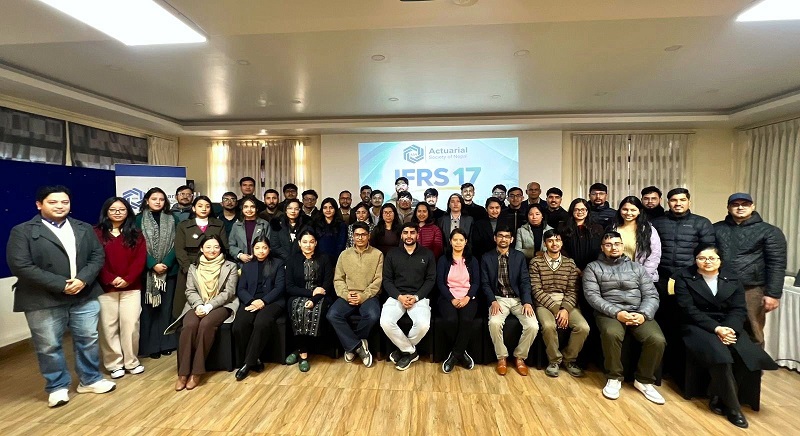
IFRS 17 Training Nepal Boosts Insurance Skills

21st January 2026, Kathmandu
The Actuarial Society of Nepal recently organized a specialized training program on IFRS 17, aiming to enhance the technical capabilities of professionals working in the insurance sector of the country. This introductory workshop, which took place in Kathmandu on Monday, January 19, 2026, provided participants with a comprehensive understanding of the new international accounting standards for insurance contracts that are currently being phased into the Nepali regulatory framework.
IFRS 17 Training Nepal
The program attracted 45 participants, including key employees from various life and non-life insurance companies, as well as auditors and other financial industry professionals. The session was led by Sajag Adhikari, an industry expert who offered detailed insights into the complex framework of IFRS 17 and its practical implementation challenges within the local market.
Understanding the Shift from IFRS 4 to IFRS 17
IFRS 17, which is known as NFRS 17 in the local context (Nepal Financial Reporting Standards), represents the most significant shift in insurance accounting in decades. It replaces the interim standard, IFRS 4, which allowed companies to use a variety of local accounting practices. The new standard introduces a uniform way to measure and report insurance contracts, ensuring that profit is recognized as the service is provided rather than when the premium is collected.
During the workshop, Sajag Adhikari emphasized that the adoption of these international standards in Nepal is expected to:
Increase Transparency: By revealing the true profitability and risk profiles of insurance portfolios.
Improve Comparability: Allowing investors to compare the performance of Nepali insurers with global counterparts.
Modernize Reporting: Moving away from historical cost accounting toward current value measurements.
Technical Insights and Practical Implementation
The training focused on the three primary measurement models under IFRS 17:
General Measurement Model (GMM): The default model for most long-term insurance contracts.
Advertisement


Premium Allocation Approach (PAA): A simplified model typically used for short-duration contracts (one year or less), such as most general insurance policies.
Variable Fee Approach (VFA): Designed for contracts with direct participation features, such as certain unit-linked life insurance products.
The session also delved into the “Contractual Service Margin” (CSM), a new balance sheet item representing the unearned profit that an entity will recognize as it provides services in the future. Experts noted that calculating the CSM requires intense collaboration between the IT, finance, and actuarial departments of an insurance company.
The Role of the Actuarial Society of Nepal
The Actuarial Society of Nepal (ASN) has been at the forefront of preparing the domestic industry for this transition. The event was managed by volunteers Sudhan Paudel and Shraddha Nepal, who ensured a smooth flow of technical exchange among the attendees. The society has pledged to continue these training initiatives, as the full implementation of NFRS 17 is expected to be a multi-year journey involving significant system upgrades and staff upskilling.
For the Nepali insurance community, such workshops are part of a continuous effort to strengthen actuarial expertise. As the regulator, the Nepal Insurance Authority, moves toward Risk-Based Capital (RBC) and international reporting standards, the demand for skilled actuaries and IFRS-literate accountants is at an all-time high.
Broader Implications for the Insurance Market
The implementation of IFRS 17 is seen as a strategic step to enhance the credibility of the insurance market of Nepal. By aligning with international best practices, the sector aims to foster greater investor confidence and attract foreign direct investment. Furthermore, the standard provides a clearer picture of the financial health of insurers, which is vital for long-term financial stability.
By equipping professionals with technical knowledge and practical insights, the IFRS 17 training in Nepal underscores the importance of continuous professional development. The workshop not only reinforced technical skills but also promoted a culture of knowledge exchange among practitioners who will be leading the transition in their respective organizations.
Conclusion
The IFRS 17 training program organized by the Actuarial Society of Nepal marks a significant milestone for the financial sector of the country. It reflects a proactive approach to adopting global standards, preparing professionals for more effective financial reporting and decision-making. As insurance companies in Nepal begin their parallel reporting phases, the insights gained from such sessions will be instrumental in navigating the complexities of the new accounting era.
For More: IFRS 17 Training Nepal