Kathmandu Wire Management Delay: ISPAN Requests 15-Day Extension, Ministry Issues Final Warning

1st August 2026, Kathmandu
ISPAN gets a final 15-day extension from the Communication Ministry to clean up Kathmandu’s tangled wires after completing 58% of Phase 1.
ISPAN Requests 15-Day Extension
Following its failure to manage unorganized and abandoned internet, telephone, and cable wires clustered across electricity poles in the Kathmandu Valley within the designated deadline, the Internet Service Providers Association of Nepal (ISPAN) has requested a final 15-day extension to complete the task.
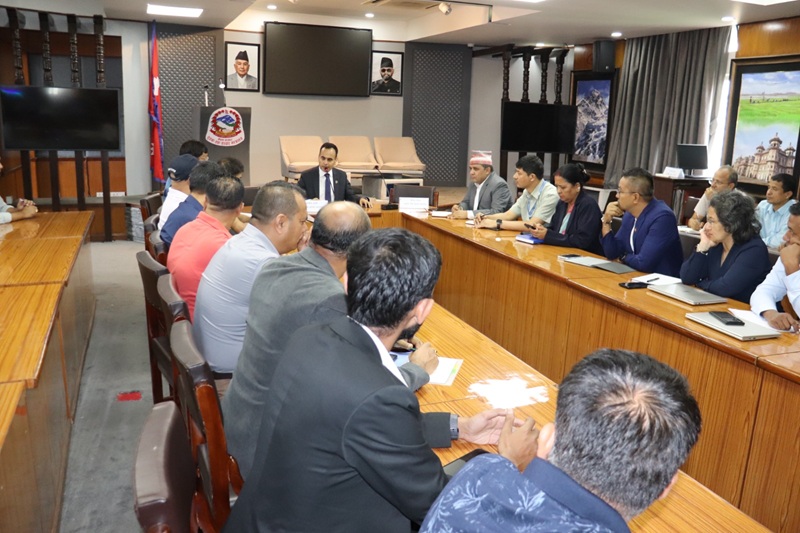
The request was presented during a high-level stakeholder review meeting hosted by the Ministry of Information and Communication (MoIC). The meeting brought together key representatives from the Ministry of Information and Communication, Ministry of Energy, Water Resources and Irrigation, Nepal Telecommunications Authority (NTA), Nepal Telecom (NTC), ISPAN, and other related authorities.

Communication Minister Expresses Dissatisfaction Over Delays
During the review, Minister for Information and Communication Dr. Bikram Timilsina expressed strong dissatisfaction over the failure to meet the agreed-upon timeline. While acknowledging the field challenges faced by service providers, Minister Timilsina emphasized that the government remains firm in resolving Kathmandu’s tangled-wire crisis.
“The government is committed to bringing the wire management project to a conclusive end. While minor delays happen, this process cannot be extended indefinitely. Wire management is both a legal and professional obligation for service providers.” Dr. Bikram Timilsina, Minister for Information and Communication
Minister Timilsina further stated that if providers had maintained their infrastructure systematically in the past, the current crisis would not have arisen. He directed officials to explore long-term solutions, including infrastructure sharing models among competing service providers to avoid duplicate overhead cabling.
NTA and ISPAN Held Accountable
Addressing the performance of both regulators and service providers, Minister Timilsina remarked that missing deadlines reflect a failure on multiple fronts:
Primary Failure: ISPAN’s execution capability.
Secondary Failure: Regulatory oversights by the Nepal Telecommunications Authority (NTA).
Ministry Oversight: Ultimate accountability resting on the Ministry itself.
While granting the final 15-day grace period, the Minister warned that no further extensions would be entertained without a clear, credible blueprint demonstrating guaranteed task completion.
Current Progress: 58% Completed Across Key Routes
According to ISPAN representatives, approximately 58% of the wire management work has been completed across the six initial routes designated in the Kathmandu Valley during Phase 1.
Phase 1 Priority Routes:
-
Tripureshwor – Kalimati – Kalanki
-
Jadibuti – Pepsicola
-
Tripureshwor – Lazimpat
Advertisement

-
Samakhushi – Town Planning – Gongabu
-
Kirtipur Area
-
Purano Baneshwor – Gaushala – Chabahil
Operational Challenges Faced by Service Providers
ISPAN highlighted several key hurdles hindering swift progress on the ground:
Inadequate Underground Infrastructure: Lack of sufficient underground ducts created by the Nepal Electricity Authority (NEA) during power line expansion.
Inter-Agency Coordination: Insufficient field support from the Nepal Electricity Authority and NTA.
Field Interference: Instances where local police halted workers, traffic police removed service ladders, and a persistent shortage of skilled technicians slowed operations.
To tackle these issues, ISPAN announced a strategic shift: rather than scattering the workforce across multiple locations, all available technicians will now be concentrated into single zones to fast-track route completions. Pilot underground cabling projects are also underway along routes such as Kalanki–Thankot and Chabahil–Baudha.
Background and Next Steps
The original deadline of Shrawan 15 (July 30) was established during a joint inter-agency meeting attended by Communication Minister Dr. Bikram Timilsina and Energy Minister Biraj Bhakta Shrestha.
Key decisions from that framework mandate:
NTA to lead and regulate enforcement.
Mandatory Cable Tagging: Service providers must attach identifiable tags to their respective cables.
Long-Term Structure: ISPAN’s proposal to establish a dedicated, independent infrastructure company for long-term cable management.
With the Ministry declaring this extension as the “final chance,” internet service providers are under intense pressure to clear the capital’s dangerous and unsightly cable clutter before the new deadline expires.
For more: ISPAN Requests 15-Day Extension