Bridging Education and Industry: How Nepal Can Turn Brain Drain into Choice

17th August 2026, Kathmandu
Stop the brain drain in Nepal. Experts at NAIMA Expo 2026 discuss One Window systems, industry-led curricula, and domestic job creation.
NAIMA Mobility Aligning Skills

Transforming “Brain Drain” to Opportunity: Why Nepal Needs a Bridge Between Education and Industry
Key Takeaways
Bridging the Gap: Stakeholders at the NAIMA Mobility Expo 2026 emphasized the urgent need to align education, skills, and industry to stop forced youth migration.
Policy Reform: Experts called for a “One Window System” to eliminate bureaucratic hurdles for entrepreneurs and startups.
Industry-Academia Collaboration: Universities and private sectors must collaborate on curricula, practical internships, and apprenticeships to match job market demands.
Shifting the Narrative: Leaders stressed that Nepal holds massive potential in automotive, IT, tourism, and manufacturing—shifting from Make in Nepal to Made in Nepal.
The Youth Migration Challenge in Nepal
For years, the mass departure of young Nepali talent has been viewed as an inevitable economic escape route. However, prominent policymakers, entrepreneurs, and academics are pushing back against this narrative.
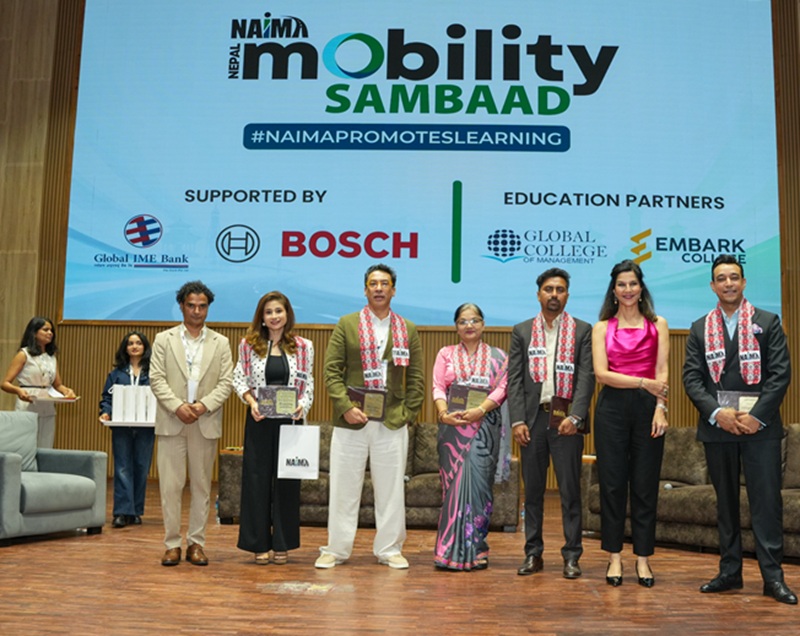
During a high-level panel discussion titled “Importing Talent and Exporting Labor: Bridging the Education, Skills, and Entrepreneurship Gap in Nepal”—held during the NAIMA Mobility Expo 2026 organized by the Nepal Automobiles Importers and Manufacturers Association (NAIMA)—experts concluded that leaving the country should be a matter of personal choice, not economic compulsion.
1. Eliminating Policy Hurdles Through a “One Window System”
Entrepreneur and Member of Parliament Bidushi Rana highlighted that while sectors like information technology, hospitality, automobiles, and manufacturing offer massive potential, complex government policies and a lack of early-stage opportunities drive youth abroad.
The Solution: Rana stressed the need for the government and private sector to create an enterprise-friendly environment.
Actionable Step: Implement a “One Window System” to streamline business registration, taxation, licensing, and financial access, ending the tedious cycle of navigating multiple government offices.
2. The Future of Manufacturing: From Make in Nepal to Made in Nepal
NAIMA Founder and Entrepreneur Sourabh Jyoti presented an optimistic roadmap for the next five to ten years, noting that Nepal’s automotive sector can transition from Make in Nepal to Made in Nepal.
Advertisement

Supply Chain Development: Achieving this requires expanding assembly plants alongside local component manufacturing and robust supply chains.
Reforming Academia: Jyoti pointed out the deep disconnect between academic institutions and private industries, advocating for industry-driven curricula. By restoring confidence and security in private investment, Nepal’s broader economy can accelerate rapidly.
3. Practical Skills: Aligning Universities with Industrial Realities
Addressing the gap from an educational standpoint, Thapathali Campus Associate Professor Lochan Kendra Devcotas noted that graduating students cannot immediately perform complex industrial tasks without practical alignment.
Collaboration Framework: Universities provide the theoretical foundation, but real-world competency requires active synergy among universities, industries, and the government.
Key Recommendations: Integrate industry needs into curriculum design, scale up student research funding, and institutionalize structured internships and apprenticeships.
4. Rewriting the Narrative: Creating Domestic Hope
Tribhuvan University Padma Kanya Campus Professor Bhagwati Sedhai cautioned against creating a defeatist narrative that “there are no opportunities in Nepal.”
Effective Implementation: While entrepreneurship and self-employment policies exist on paper, Sedhai noted that their practical execution remains weak.
Incentivizing the Private Sector: The government must actively encourage private enterprises to invest in domestic skill development programs.
Conclusion: Reversing the Trend
The consensus from the NAIMA Mobility Expo 2026 is clear: narrowing the distance between education and employment requires direct collaboration, hands-on training, and dynamic apprenticeships.
By building a robust domestic ecosystem, Nepal can not only curb the outflow of skilled professionals but also create an inviting environment for the Nepalese diaspora to return home.
For more: NAIMA Mobility Aligning Skills