Nepal’s First Road Tunnel: Nagdhunga Tunnel Road Prepares For Shrawan Launch

2nd July 2026, Kathmandu
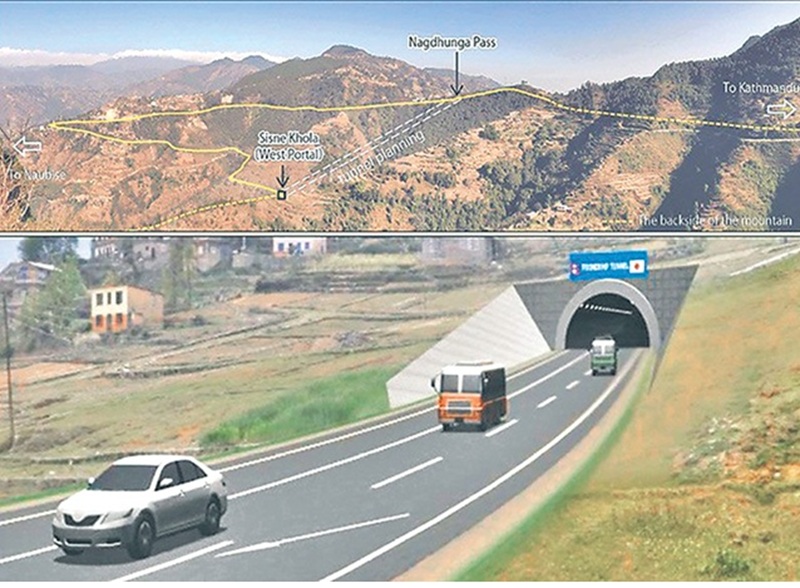
Nepal is on the verge of a historic infrastructure milestone. The country’s first modern commercial road tunnel, the Nagdhunga-Sisnekhola Tunnel Road, is in its final phase of preparation and is scheduled to begin full-scale operations this Shrawan (mid-July to August 2026).
Nepal’s First Road Tunnel
Ahead of the highly anticipated launch, project authorities completed functional testing for operational and maintenance vehicles inside the tunnel. These specialized vehicles are crucial for everyday management, including regular inspections, structural repairs, high-pressure cleaning, emergency rescue operations, and swift accident management.

Final Safety and System Testing Underway
With physical construction standing at over 99% completion, engineers are currently conducting comprehensive, integrated testing of the tunnel’s core operating systems.
To ensure safe passage for thousands of daily commuters, final calibrations are being wrapped up for:
Jet-Fan Ventilation & Climate Control: Engineered to keep carbon monoxide levels safe.
Advanced Fire Control & Suppression Systems: Built-in firefighting infrastructure ready for rapid response.
CCTV Monitoring & Traffic Management System: 24/7 continuous surveillance connected to a central control center.
Emergency Communication Systems: Direct lines of contact inside the passage.
Uninterrupted Power Supply (UPS): Backup systems to keep lights and life-safety electronics online.
Project Timeline, Funding, and Technical Specifications
The foundation stone for this mega-infrastructure project was officially laid on Kartik 4, 2076 (October 21, 2019) by the then Prime Minister KP Sharma Oli.
Despite facing operational delays caused by the COVID-19 pandemic, land acquisition hurdles, and local disruptions, the project has successfully crossed the finish line in approximately 79 months.
Advertisement

Key Project Details at a Glance
| Feature | Details |
| Total Project Cost | Approx. Rs 22 to 23 Arba |
| Primary Funding Partner | Japan International Cooperation Agency (JICA) via a concessional soft loan |
| Main Construction Contractor | Hazama Ando Corporation (Japan) |
| Main Tunnel Length | 2.68 Kilometers (2,688 meters), Two-lane layout |
| Emergency Tunnel Length | 2.55 Kilometers (2,557 meters) parallel evacuation route |
| Auxiliary Infrastructure | Specialized approach roads, a dedicated flyover overpass at Balambhu, and bridges |
| Operational Management | Awarded to Yusin-ART JV under a 5-year, Rs 1.1 billion contract |
Digital Toll Fees and Strict Regulations
To ensure smooth transit without causing a bottleneck at the entry points, the project has integrated state-of-the-art toll plazas on both the Kathmandu and Dhading sides. The central control center will employ 150 newly trained personnel working round-the-clock shifts.
Toll Payment Options
Motorists will have three swift payment methods to pay their toll fees:
Electronic Stickers (RFID) pasted on vehicle windshields for automatic gate opening.
N-Tags / Bank Payment Cards are integrated with major commercial banks.
QR Codes & Cash for occasional commuters.
Approved Vehicle Toll Rates (Sample Tier)
Cars, Vans, Pickups, & Light Vehicles: Rs 65 (Entering Kathmandu) / Rs 60 (Exiting Kathmandu).
Buses and Heavy Trucks: Tiered pricing up to Rs 600 based on cargo capacity.
Strict Prohibitions: According to the official Tunnel Road Operation Directive, two-wheelers (motorcycles/scooters), three-wheelers, non-motorized vehicles, and pedestrians are strictly prohibited. Furthermore, tankers carrying highly flammable materials (like petrol/diesel) or hazardous explosives are legally banned from entering. The maximum speed limit inside the tunnel is capped at 60 km/h.
Transformative Benefits for Nepal’s Economy
The Nagdhunga-Naubise section of the Tribhuvan Highway has long been notorious for its steep terrain, sharp hairpin turns, severe monsoon landslides, and grueling traffic jams that waste millions of rupees in fuel daily.
Once fully operational, the Nagdhunga Tunnel is expected to handle over 8,000 vehicles daily. It will dramatically slash travel times through the checkpoint from over 30 minutes down to a mere 7 minutes.
By bypassing the steepest bottleneck into the capital, the project will drastically lower vehicle operating costs, cut down national fuel consumption, optimize freight logistics, and offer passengers a significantly safer, smoother, and more predictable commute.
For more: Nepal’s First Road Tunnel