
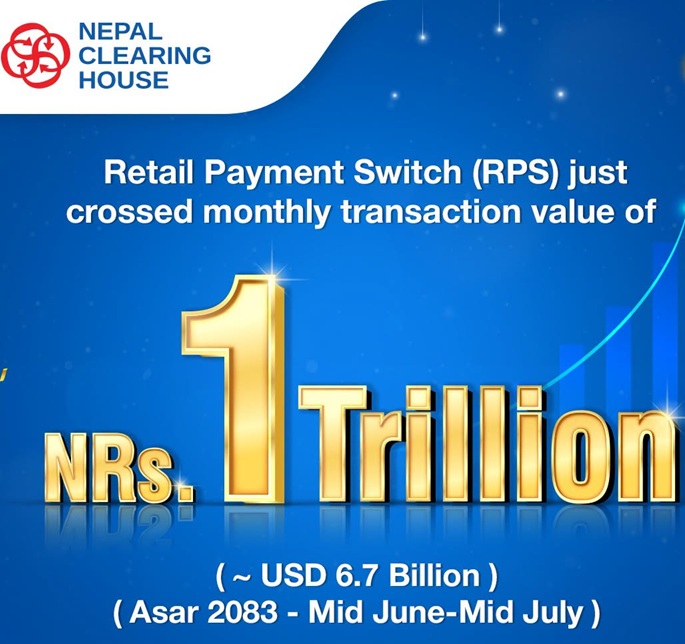
Nepal’s Retail Payment Switch Crosses NPR 1.2 Trillion in Monthly Volume

4th August 2026, Kathmandu
Nepal’s digital payment ecosystem has reached a landmark milestone as the Retail Payment Switch (RPS), operating under the National Payment Switch (NPS), processed more than NPR 1.2 trillion in transactions during the month of Ashadh 2083, reflecting the rapid growth of digital payments across the country and reinforcing Nepal’s position as one of the emerging real-time payment economies in the region.
Nepal’s Retail Payment Crosses
RPS processed a total of NPR 9.3 trillion equivalent of real-time transactions during the fiscal year 2025/26, which has crossed the transaction value of cheque transactions during the year.
This milestone marks a significant chapter in Nepal’s digital transformation, demonstrating increasing confidence of individuals, businesses, financial service providers, and the government in interoperable digital payments and underscores the growing role of shared payment infrastructure in supporting Nepal’s evolving digital economy.
The scale of this achievement reflects not only increasing transaction volumes but also the maturity of Nepal’s interoperable payment ecosystem and demonstrates the platform’s ability to handle transaction scale, maintaining the levels of security, resilience, and availability expected of critical national financial infrastructure.
Launched in November 2021, the RPS is one of the components of Nepal’s National Payment Switch, implemented and operated by NCHL under the regulatory oversight of Nepal Rastra Bank.
Designed as a shared national payment infrastructure, RPS enables secure, real-time and interoperable account-based payments across banks, financial institutions, payment service providers, payment system operators and government entities.
Advertisement

Today, RPS serves as a single transaction processing engine for a broad range of interoperable payment services that collectively support Nepal’s digital economy.
These include real-time account-to-account transfers, interoperable NEPALPAY QR payments, payments initiated through mobile banking and digital wallets using the National Payments Interface (NPI), online merchant payments, utility and bill payments through the Biller Gateway, Request-to-Pay services via NEPALPAY Request, Virtual Payment Address (VPA)-based transfers through NEPALPAY Instant, secure account tokenization, NFC-based account-to-account payments through NEPALPAY Tap, and multilateral net settlement integrated with the RTGS system.
By enabling these payment instruments, the NPS has eliminated the need for multiple isolated payment networks while fostering innovation across the financial ecosystem.
Around the world, interoperable real-time payment systems have emerged as strategic national infrastructure. India’s Unified Payments Interface (UPI), Brazil’s Pix, Thailand’s PromptPay, Singapore’s PayNow, Malaysia’s DuitNow and Indonesia’s BI-FAST have demonstrated how common payment infrastructure can accelerate digital commerce, improve financial inclusion and stimulate innovation.
Nepal’s National Payment Switch follows the same architectural principles by establishing a shared, interoperable platform capable of connecting banks, financial service providers, businesses, government agencies and fintech innovators through common standards and open APIs.
While Nepal’s economy is smaller than many of these countries, its commitment is to establish itself as one of the growing nations building modern digital public infrastructure to support long-term economic growth.
For more: Nepal’s Retail Payment Crosses