NIC Asia Global Money Week 2026 Nepal

26th March 2026, Kathmandu
The NIC Asia Global Money Week campaign has emerged as a cornerstone of financial advocacy in Nepal, demonstrating the bank’s commitment to building a financially inclusive society.
NIC Asia Global Money Week
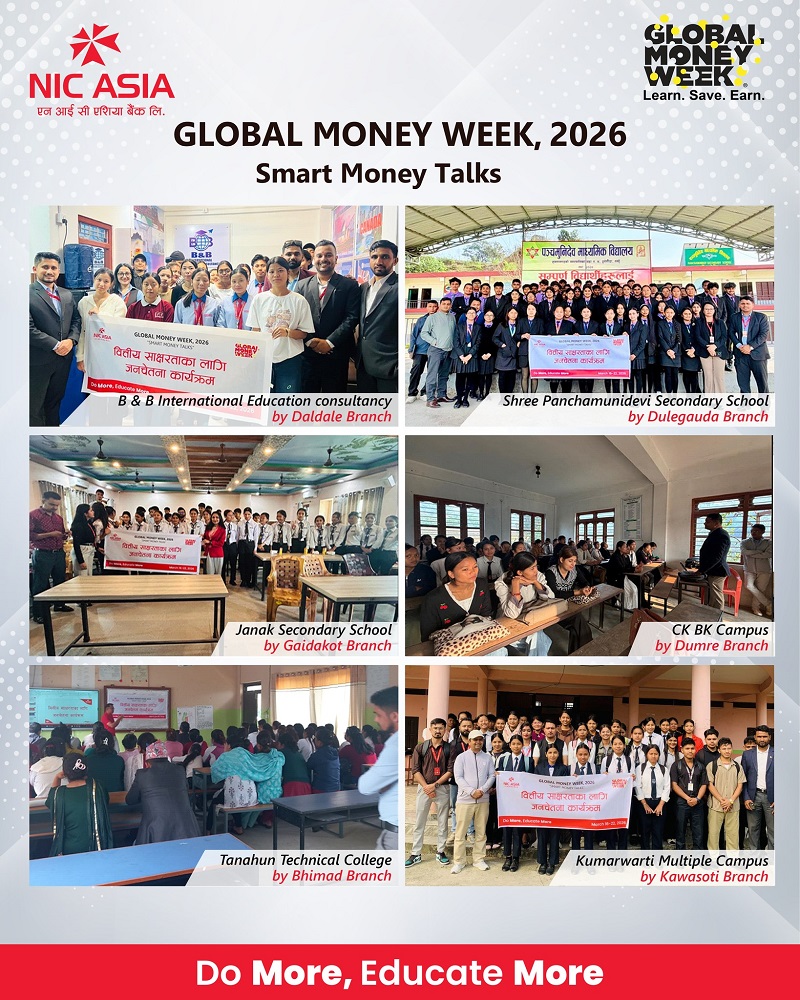
As a leading “A” class commercial bank, NIC Asia Bank took a proactive role in the 2026 edition of this global celebration, which ran from March 16 to March 22. Under the localized theme of “Protect your money, secure your future,” the bank mobilized its extensive network to reach thousands of young minds. By integrating traditional classroom learning with modern digital outreach, the NIC Asia Global Money initiatives provided a comprehensive roadmap for the next generation to navigate the complexities of the modern financial world.
Nationwide Financial Literacy Campaign
NIC Asia Bank’s participation in Global Money Week 2026 was characterized by its unprecedented scale and geographical reach. Recognizing that financial illiteracy is a significant barrier to economic empowerment, the bank executed a synchronized campaign across all seven provinces of Nepal. This effort was closely aligned with the national coordination framework led by the Nepal Rastra Bank (NRB), ensuring that the messaging was consistent with the central bank’s long-term financial literacy roadmap.
The bank successfully organized over 67 dedicated financial literacy sessions in a single week. These programs were not confined to urban centers like Kathmandu or Pokhara but extended to remote districts, ensuring that the NIC Asia Global Money message reached underserved communities. By the end of the campaign, more than 4,100 students and young professionals had received direct training, marking one of the largest single-bank contributions to the global movement in Nepal.
Strategic Focus on Youth and Students
The heart of the NIC Asia Global Money Week programs lay in its focus on the youth. Research suggests that financial habits formed during adolescence dictate lifelong economic stability. To capitalize on this, the bank collaborated with numerous secondary schools and colleges to host interactive workshops.
Key Educational Pillars:
Basic Financial Concepts: Simplifying the roles of banks, the importance of the formal economy, and how the “Interest” mechanism works for both savings and loans.
Money Management Skills: Teaching students the “50/30/20” rule of budgeting—allocating funds for needs, wants, and future savings.
Psychology of Spending: Developing positive financial attitudes by helping students distinguish between “inflationary desires” and “essential requirements.”
Future Planning: Introducing the concept of compound interest and how early investments in various financial instruments can lead to long-term wealth.
The Role of Nepal Rastra Bank and Regulatory Alignment
The execution of the NIC Asia Global Money Week initiatives was meticulously guided by the directives of the Nepal Rastra Bank. As the regulatory authority, the NRB has prioritized financial literacy as a tool for poverty reduction and financial stability. NIC Asia Bank’s active participation served as a practical implementation of the central bank’s “Financial Literacy Framework 2022-2027.”
This collaboration ensured that the information provided to students regarding deposit insurance, consumer rights, and grievance redressal mechanisms was accurate and up-to-date. By fostering a direct link between the regulator’s vision and the bank’s execution, the campaign provided a transparent view of the Nepalese banking ecosystem to its future participants.
Digital Awareness and Omni-Channel Outreach
In an era where the youth are increasingly online, the NIC Asia Global Money campaign transcended physical boundaries through a robust digital strategy. The bank utilized its market-leading social media presence to disseminate “snackable” financial tips and instructional videos.
Advertisement


Digital Literacy Highlights:
Safe Digital Banking: Educating users on how to protect their mobile banking credentials and the dangers of sharing OTPs (One-Time Passwords).
Cyber Hygiene: Informing the youth about “phishing” and “vishing” scams that specifically target inexperienced digital users.
QR Culture: Promoting the use of digital payments to reduce the circulation of physical cash and improve the transparency of personal transactions.
Social Media Engagement: Using infographics and short-form videos to explain complex topics like “Remittance” and “Forex” in simple Nepali and English.
Quantifiable Impact of the Campaign
The impact of the NIC Asia Global Money Week 2026 initiative is visible through both quantitative metrics and qualitative behavioral shifts. By engaging over 4,100 participants directly, the bank has created a “multiplier effect” where students share their newfound knowledge with their families.
The initiative has been instrumental in:
Promoting the “One Student, One Bank Account” Vision: Encouraging young individuals to start their financial journey with formal savings accounts.
Enhancing Financial Confidence: Reducing the intimidation factor often associated with visiting a bank or interacting with financial professionals.
Building a Risk-Aware Generation: Equipping youth with the critical thinking skills needed to avoid high-risk informal lending schemes and fraudulent “get-rich-quick” programs.
Importance of Financial Literacy for Nepal’s Future
For a developing economy like Nepal, the NIC Asia Global Money campaign is more than just a corporate social responsibility (CSR) activity; it is an economic necessity. Financial literacy is directly linked to higher rates of entrepreneurship and lower rates of debt default. When youth understand how to leverage credit for productive purposes rather than consumption, the entire national economy benefits. By investing in these programs, NIC Asia Bank is essentially investing in the quality of its future client base, ensuring a more resilient and sophisticated financial market.
Conclusion
NIC Asia Global Money Week 2026 has set a high standard for financial education in Nepal. Through its disciplined execution of nationwide programs and its innovative use of digital platforms, NIC Asia Bank has demonstrated that the banking sector can be a powerful force for educational change. As these thousands of empowered students move into the workforce, the financial wisdom gained during this week will serve as a permanent asset, contributing to the personal prosperity of citizens and the collective economic strength of Nepal.
For More: NIC Asia Global Money Week