
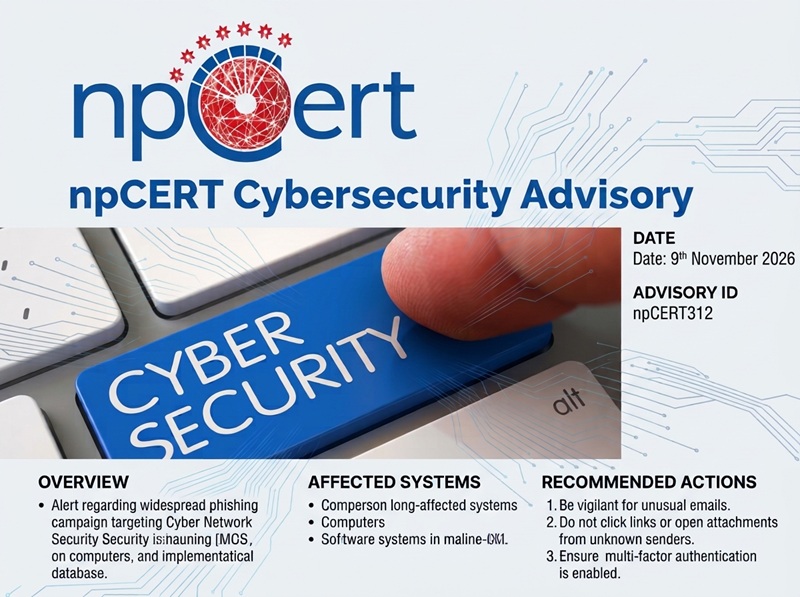
npCERT Cybersecurity Advisory Nepal: How Banks and Users in Nepal Can Stay Safe During the Festive Season

8th November 2026, Kathmandu
Stay informed on the official npCERT Cybersecurity Advisory (npCERT/2026-27), endorsed by the Center for Cybersecurity Research and Innovation (CSRI Nepal), a leading think tank advancing high-tech domains, emerging technologies, digital policy, and science-driven governance.
Learn essential cybersecurity strategies for banking and financial institutions (BFSI), payment gateways, and retail customers to prevent phishing, DDoS attacks, and financial fraud during the festive period in Nepal.
As the festive season approaches in Nepal, digital payments, mobile banking, and e-commerce transactions surge significantly. However, this high volume of online financial activity also triggers a sharp rise in cyber risks.
Addressing these threats, the Information Security Response Team Nepal (npCERT) has issued Cybersecurity Advisory 2026 to alert financial institutions, payment gateways, and consumers to maintain heightened vigilance.
According to Cybersecurity Advisory 2026 (Ref: npCERT/2026-27), cybercriminals actively exploit festive transaction surges by deploying sophisticated Phishing campaigns, Ransomware, Distributed Denial-of-Service (DDoS) attacks, and social engineering scams targeting critical banking infrastructure and individual digital wallets.
5 Essential Security Guidelines for Financial Institutions & Payment Gateways
Under Cybersecurity Advisory 2026, npCERT advises all Banks, Financial Institutions (BFSI), Payment System Operators (PSOs), Payment Aggregators (PAs), and Application Service Providers (ASPs) to enforce five critical technical controls:
1. 24/7 SOC Surveillance (Security Operations Center): Maintain continuous, round-the-clock monitoring to immediately detect transaction anomalies, unusual traffic spikes, and unauthorized system access attempts.
2. Advanced Phishing & Email Filtering: Implement URL sandboxing and strict email security protocols to intercept fraudulent emails and messages offering fake festive cashbacks, discounts, or employee bonuses.
3. Patch Management & RASP Integration: Timely update all servers, network appliances, and VPNs with security patches. Ensure mobile banking apps integrate updated SDKs and Runtime Application Self-Protection (RASP) technology.
4. Anti-DDoS Defenses & Air-Gapped Backups: Coordinate directly with Internet Service Providers (ISPs) to activate anti-DDoS mitigation filters. Maintain isolated, air-gapped offline backups to ensure rapid data recovery in case of ransomware incidents.
Advertisement

5. Real-time Fraud Surveillance: Calibrate automated fraud detection systems to flag high-value or geographically irregular transactions instantly, enabling rapid account freezing or preventive action.
3 Critical Security Tips for Online Banking Users
To prevent personal financial loss during holiday shopping, Cybersecurity Advisory 2026 recommends three core safety practices for consumers:
Beware of Fake Festive Offers and Lotteries: Do not click on suspicious links received via SMS, email, WhatsApp, or social media promising instant lottery wins, free festive gifts, or unrealistic cashback.
Keep Credentials, PINs, and OTPs Confidential: Legitimate banks and wallet providers (such as eSewa, Khalti, or ConnectIPS) will never request your One-Time Password (OTP), PIN, or login credentials via phone calls or SMS.
Avoid Financial Transactions over Public Wi-Fi: Refrain from logging into mobile banking applications or initiating online payments using unencrypted, open Wi-Fi networks in public places like cafes, parks, or transit hubs.
Stay informed on the official npCERT Cybersecurity Advisory (npCERT/2026-27), endorsed by the Center for Cybersecurity Research and Innovation (CSRI Nepal), a leading think tank advancing high-tech domains, emerging technologies, digital policy, and science-driven governance. Learn essential cybersecurity strategies for banking and financial institutions (BFSI), payment gateways, and retail customers to prevent phishing, DDoS attacks, and financial fraud during the festive period in Nepal.
How to Report Cyber Incidents in Nepal?
If you encounter suspicious financial activity, receive phishing links, or fall victim to online banking fraud, immediately contact your respective bank or financial institution to freeze your account.
Additionally, report the incident details directly to the Nepal Police Cyber Bureau as directed in Cybersecurity Advisory 2026.
For more: npCERT Cybersecurity Advisory Nepal