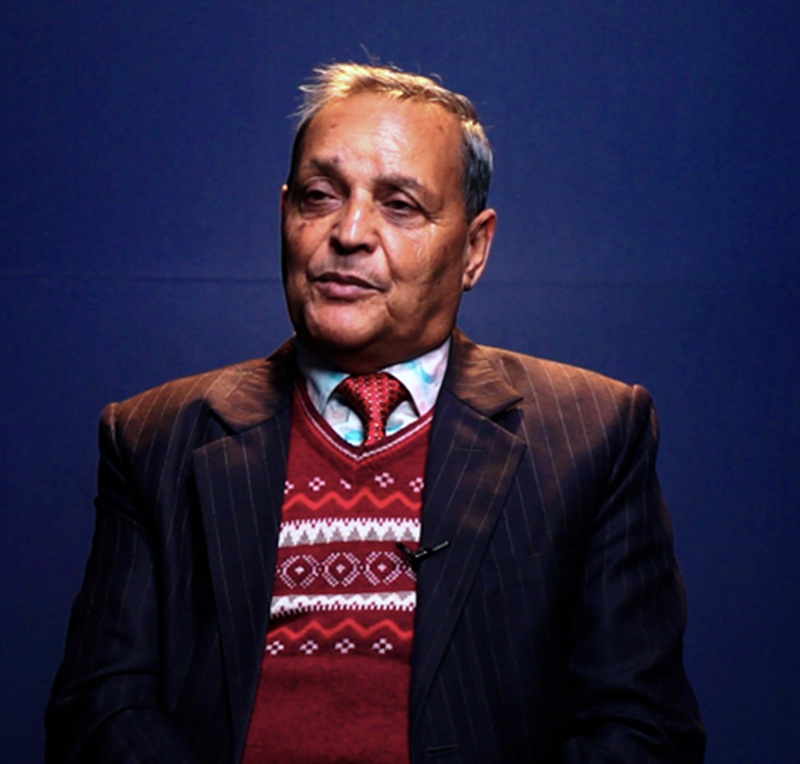
Separating Politics From Health Education: Educationist Dr. Ram Prasad Dahal’s Blueprint for a Successful Government

15th April 2026, Kathmandu
In a period of significant political transition and national planning, renowned educationist Professor Dr. Ram Prasad Dahal has issued a stern advisory to the current administration.
Separating Politics From Health Education
His central thesis, “Health and education must remain independent of politics for government success,” serves as a blueprint for structural reform in the Nepalese public sector.
Speaking on the intersection of academic excellence and governance, Dr. Dahal emphasized that the true measure of a successful state lies in its ability to shield its intellectual and welfare sectors from the turbulence of partisan interests.

The Academic Imperative: Beyond Partisan Interests
Dr. Dahal argues that education should be treated as a sacred domain focused on academic excellence, intellectual development, and scholarly debate.
In an era of rapid global change, the curriculum and educational infrastructure must adapt to international standards rather than local political shifts.
“The current government must distance education from politics. We need to foster an environment where academic elevation and intellectual discourse are the priorities. Only such a system can truly build a progressive society,” Dr. Dahal remarked.
He pointed out that the current trend of political expansion into universities and schools has stifled innovation. For education to flourish, it must be recognized as a standalone pillar of society, operating on the principles of meritocracy and academic freedom.
A Constitutional and Merit-Based Approach
One of the most critical points raised by Dr. Dahal is the need for merit-based appointments. He suggested that if constitutional provisions regarding education are inconsistent with modern needs, they must be amended to prioritize competence over connections.
Meritocracy: Appointments of teachers, professors, and administrators should be based strictly on qualifications and expertise.
Capacity Building: The state must create incentives for those who demonstrate exceptional capability in their fields.
The ‘Temple of Learning’: Dr. Dahal envisions educational institutions as “temples” that remain untouched by strikes, lockdowns, or political maneuvering.
The Global Standard: Free Education and Health
Drawing comparisons with developed nations, Dr. Dahal strongly advocated for free school-level education in Nepal. He noted that several successful countries have proven that making health and education accessible without financial barriers is the fastest way to alleviate poverty and ensure social equity.
He urged the government to adopt a vision that produces “skilled, idealistic, and character-driven teachers.” Without high-quality teachers who are respected and well-supported, the goal of free and quality education remains an empty promise.
Advertisement

Political Stability: The ‘Five-Year Mantra’
Addressing the current political landscape, where the government holds nearly a two-thirds majority, Dr. Dahal emphasized the opportunity for unprecedented stability. He warned against internal ego-driven conflicts that have historically plagued Nepalese politics.
“The government has the trust of the people and a sufficient mandate. Now is the time to be stable. They must not engage in internal bickering or power struggles. They must free themselves from ‘ego’ and develop a mindset of being public servants,” he asserted.
He suggested that the leadership should adopt a “five-year mantra”—a commitment to remain unified and focused on the national interest for the full duration of their term, rather than seeking short-term political gains.
Logistical Efficiency: Learning from the Election
Dr. Dahal highlighted a recurring failure in the education sector: the delay in distributing textbooks to remote and mountainous regions. He used a powerful analogy from the recent general elections to illustrate his point.
During the elections, millions of ballot papers reached the most inaccessible corners of Nepal within days. Dr. Dahal questioned why the same logistical efficiency is not applied to education.
The Challenge: Every year, students in remote areas begin their sessions without books.
The Solution: The entire administrative machinery—from the central government to local levels should be mobilized with the same urgency as an election to ensure that books reach every child on time.
Dual Strategy: Short-term Relief and Long-term Vision
For the government to be truly successful, Dr. Dahal proposed a dual-track strategy:
Short-term Strategy: This involves providing immediate relief to the public, improving service delivery in hospitals, and ensuring basic amenities are met without delay.
Long-term Strategy: This requires a 10-to-20-year roadmap. It involves investing in Artificial Intelligence (AI), infrastructure, and an education system that will yield results for the next generation.
Conclusion: A Vision for a Prosperous Nepal
Dr. Dahal concluded on an optimistic note, stating that Nepal’s natural beauty and potential are unparalleled.
He believes that if all ministries and departments work with collective intelligence and a clear vision, the country can achieve prosperity in a relatively short period.
The government, as the “guardian of the nation,” must lead by example, treating the health and education of its citizens as a non-negotiable duty, free from the stains of political interference.