Human-Centric AI in Nepal: UNDP Launches Regional Report to Drive Inclusive Innovation

5th February 2026, Kathmandu
As the global artificial intelligence (AI) market hurtles toward a projected $4.8 trillion valuation by 2033, Nepal stands at a critical crossroads.
Human-Centric AI in Nepal
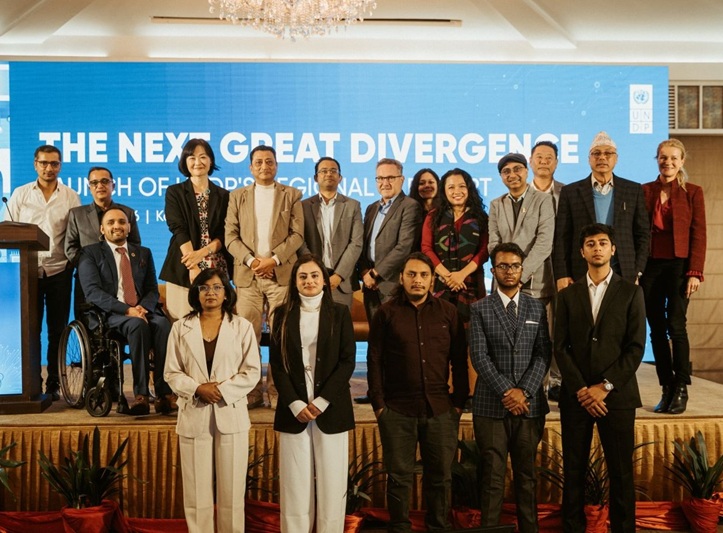
In a landmark event held this February in Kathmandu, Kyoko Yokosuka, the UNDP Nepal Resident Representative, officially launched the regional report: “The Next Great Divergence: Why AI may widen inequality between countries.”
The report serves as both a warning and a roadmap for the Nepalese government, tech industry, and civil society. While AI offers a “productivity-driven growth dividend” that could add 2% to annual GDP growth, it also risks leaving behind those who are not digitally prepared.

The “Next Great Divergence”: A Historical Warning
The “First Great Divergence” was sparked by the Industrial Revolution, which created a massive wealth gap between nations that lasted for centuries. Today, we face a digital equivalent.
“Technological revolutions rarely benefit everyone equally at the start,” Yokosuka noted during her speech. “They flow first and fastest to those who are most prepared.”
For Nepal, the challenge is to ensure that AI becomes a tool for convergence narrowing the gap between urban hubs like Kathmandu and rural provinces rather than widening it.
Strategic Pillars for Nepal’s AI Future
The UNDP report outlines three essential messages to ensure AI benefits all Nepalese citizens:
1. Putting People First
AI is only as fair as the data it is fed. If marginalized groups such as women farmers in Karnali or elderly populations in remote villages are missing from the data, the AI “does not see them.”
The Goal: Moving beyond English and standard Nepali. AI must work in local languages like Maithili and Tamang.
Action: UNDP is currently partnering with the National AI Center to curate data sets in under-resourced indigenous languages.
Advertisement

2. Responsible Innovation and Governance
Governance shouldn’t stifle innovation, but it must manage risk. Nepal has already laid a strong foundation with the National AI Policy 2025 and the establishment of the National AI Center under the Ministry of Communication and Information Technology.
The Basics: Success depends on reliable electricity, high-speed internet, and robust data-protection laws.
Transparency: Citizens must have a “right to recourse” when AI systems fail or make biased decisions.
3. Building Future-Ready Systems
Nepal must move beyond small-scale pilot projects to institutionalized, nationally anchored systems.
Talent Pipeline: The government aims to train 5,000 AI professionals within the next five years.
Resilience: AI solutions must be sustainable and built by local talent who understand the unique geography and socio-economic context of the country.
Innovation in Action: 2026 and Beyond
The launch event showcased six innovative ideas from Nepalese entrepreneurs tackling real-world development challenges. From AI-enabled public service chatbots that reduce administrative bottlenecks to predictive analytics for agriculture in the Terai, the potential is immense.
As Nepal strengthens its digital foundations, the focus remains clear: human development must remain at the center of every technological choice.
Key Facts: AI in Nepal (2025-2026)
| Feature | Status/Detail |
| National AI Policy | Released in 2025 |
| Lead Agency | National AI Center (MoCIT) |
| Infrastructure Goal | AI Excellence Centers in all 7 provinces |
| Digital Reach | 153+ Charging Stations (supporting EV-AI integration) |
| Key Risk | Data exclusion of rural/indigenous communities |
A CAN Federation delegation, led by Senior Vice President Chiranjibi Adhikari alongside Prof. Dr. Sudan Jha and Dikchya Raut, submitted critical feedback on the National AI Policy to MoCIT. Their recommendations focus on refining the regulatory framework to ensure the Nepalese tech ecosystem fosters inclusive innovation and ethical AI governance.
For more: Human-Centric AI in Nepal