Nepal India Economic Cooperation Must Become More Result-Oriented

22nd February 2026, Kathmandu
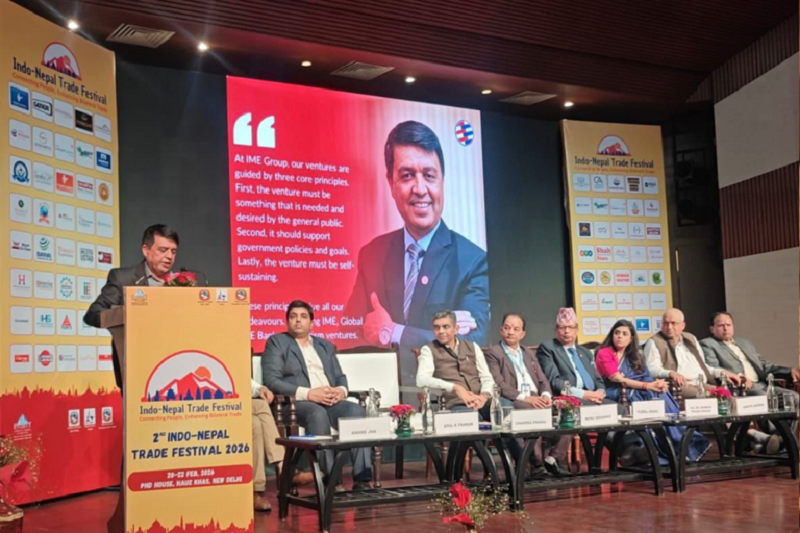
The bilateral relationship between Nepal and India has reached a significant milestone as leaders from both nations gathered in New Delhi for the Second Indo-Nepal Trade Festival 2026. Speaking at the prestigious event on February 21, 2026, Chandra Prasad Dhakal, the President of the Federation of Nepalese Chambers of Commerce and Industry (FNCCI), delivered a compelling call to action. He argued that while the historical and cultural ties between the two neighbors are unparalleled, the current framework for Nepal India Economic Cooperation must be modernized to become more practical, streamlined, and result-driven. As the global economy grapples with shifting supply chains and the rapid pace of digitalization, Dhakal emphasized that the future of this partnership lies in structural reforms, the harmonization of standards, and the elimination of non-tariff barriers that have historically hindered the flow of goods and services across the 1,850-kilometer open border.
Nepal India Economic Cooperation
The core of Dhakal’s address centered on the need for administrative efficiency at the border. Despite the geographical proximity, exporters in both nations often face delays due to mismatched customs procedures and divergent quality standards for agricultural and industrial products. To address this, the FNCCI President proposed a comprehensive digital trade integration plan. This would involve the synchronization of the Electronic Cargo Tracking System (ECTS) and the implementation of a single-window interface that allows for the real-time sharing of customs data between the Department of Customs in Nepal and the Central Board of Indirect Taxes and Customs in India. By reducing the physical paperwork and the time spent at Integrated Check Posts (ICPs) like Birgunj-Raxaul and Bhairahawa-Sunauli, both countries can significantly lower the cost of doing business, making Nepali exports more competitive in the vast Indian market.
A pivotal theme of Nepal India Economic Cooperation in 2026 is the energy sector. Dhakal highlighted that Nepal is no longer just a potential energy producer but is actively contributing to the regional green energy transition. With the recent inauguration of the New Butwal-Gorakhpur 400 kV cross-border transmission line, the capacity for electricity trade has expanded significantly. Nepal’s hydropower potential, estimated at over 42,000 MW of economically viable capacity, offers a reliable source of clean energy for India’s power-hungry northern states. Dhakal urged both governments to finalize more long-term power purchase agreements (PPAs) that extend beyond the current medium-term frameworks. This would provide the necessary bankability for large-scale projects like the Upper Karnali and West Seti, attracting more Foreign Direct Investment (FDI) from Indian corporate giants into Nepal’s water resources.
The influence of India’s latest federal budget on Nepal was another key point of discussion at the New Delhi festival. Dhakal noted that India’s massive capital expenditure on border infrastructure and digital connectivity provides a unique tailwind for Nepal’s economy. The expansion of the Indian railway network toward the Nepal border—including the progress on the Raxaul-Kathmandu broad gauge line—is expected to revolutionize cross-border logistics. Furthermore, India’s focus on promoting Small and Medium Enterprises (SMEs) aligns perfectly with Nepal’s industrial base. Dhakal called for a specialized technology transfer mechanism where Indian startups and manufacturing firms can partner with Nepali entrepreneurs, particularly in the fields of agro-processing, pharmaceuticals, and light electronics. This would help Nepal diversify its export basket, which is currently heavily reliant on a few primary commodities.
Advertisement

Tourism remains a low-hanging fruit for enhanced cooperation. With the operation of the Gautam Buddha International Airport in Bhairahawa and the Pokhara International Airport, Nepal is better positioned to receive the growing number of Indian outbound travelers. Dhakal invited Indian hospitality groups to invest in luxury resorts, wellness centers, and cable car projects along the Buddhist Circuit and the various hill stations. He emphasized that spiritual tourism, which links destinations like Pashupatinath in Kathmandu to Kashi Vishwanath in Varanasi, can be a major driver of economic growth. By creating joint tourism packages and simplifying the movement of private Indian vehicles into Nepal, both nations can tap into a multi-billion dollar industry that generates immediate employment for the youth.
The presence of high-ranking ministers from both countries at the event, including India’s Minister of Communications Jyotiraditya Scindia and Nepal’s Industry Minister Anil Kumar Sinha, underscored the political will to support these economic initiatives. The ministers acknowledged that the 1950 Treaty of Peace and Friendship and the subsequent Trade and Transit treaties provide the legal bedrock, but the operational success depends on the private sector. Dhakal concluded by stating that Nepal is currently undertaking a series of legal reforms to improve its Ease of Doing Business ranking, including the amendment of the Foreign Investment and Technology Transfer Act (FITTA). These changes are intended to provide Indian investors with the same level of protection and transparency they would find in any global financial hub.
In conclusion, the roadmap for Nepal India Economic Cooperation as outlined at the Trade Festival 2026 is one of optimism backed by practical solutions. By focusing on digital integration, energy security, and SME empowerment, the two nations can move beyond traditional trade and toward a deep economic partnership. As Chandra Prasad Dhakal aptly summarized, the goal is to transform the unique “Roti-Beti” relationship into a “Roti-Beti-Investment” relationship that serves as a model for regional cooperation in South Asia. The successful implementation of these reforms will not only boost the GDP of both nations but will also ensure that the benefits of economic growth reach the millions of people living in the border regions.
For More: Nepal India Economic Cooperation