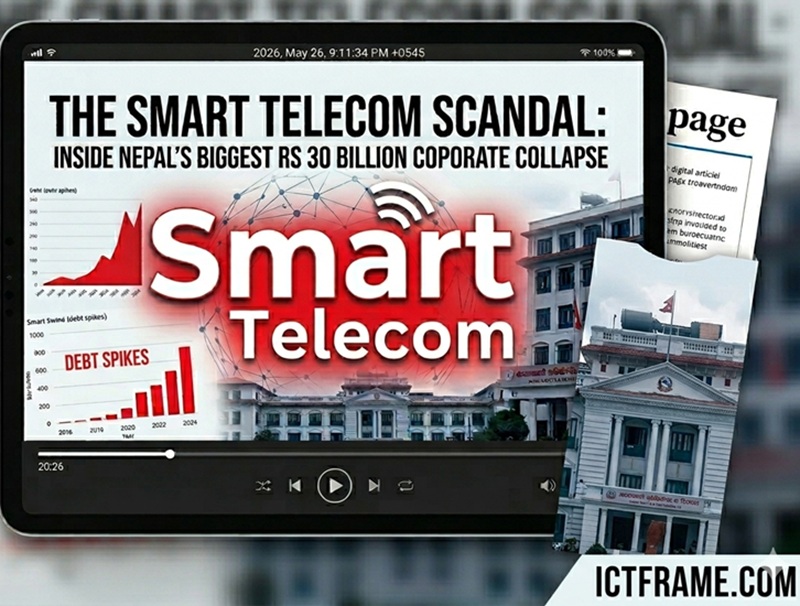
Smart Telecom Scandal Nepal: Who is Accountable for the Rs 30 Arba Loss?

26th May 2026, Kathmandu
The ongoing fallout surrounding Smart Telecom Private Limited (SmartCell) has ignited a fierce debate regarding corporate accountability, regulatory oversight, and political patronage in Nepal’s telecommunications sector.
Smart Telecom Scandal Nepal
Once positioned as a promising third player to break the market duopoly, the company’s collapse has turned into one of the country’s largest telecom-related financial scandals, leaving the state facing an estimated loss of Rs 30 billion (arba) in unpaid dues.
When a private enterprise fails on this scale, a critical question remains: Who should carry the burden—the company, the former promoters, the commercial banks, or the Nepalese taxpayer?

The Scale of the Crisis: Breaking Down the Rs 30 Arba Default
According to investigative reports by tech news outlet TechPana, Smart Telecom’s financial liabilities accumulated over years of regulatory evasion. The company defaulted on multiple statutory fronts, failing to clear:
-
License Renewal Fees
-
Frequency Charges
-
Royalties
-
Administrative Fines and Accrued Interest
Following chronic non-payment, the Nepal Telecommunications Authority (NTA) automatically revoked Smart Telecom’s operating permit in Baishakh 2080 (April 2023) under the Telecommunications Act, which dictates that failure to clear renewal fees results in an automatic expiry of operations.
While the license cancellation halted mobile services for over 2 million subscribers, it triggered an even bigger crisis: a massive black hole of bad debt and a complex legal battle over surviving infrastructure assets.
A Political Tug-of-War: The History of Policy Concessions
The Smart Telecom case is no longer just a corporate insolvency matter; it has escalated into a highly politicized scandal. Investigative timelines show that the company repeatedly leveraged political connections across multiple administrations led by KP Sharma Oli, Sher Bahadur Deuba, and Pushpa Kamal Dahal “Prachanda” to secure unprecedented extensions.
The Timeline of Concessions:
Initial Revocation & Reinstatement (2019–2020): The NTA originally moved to revoke Smart Telecom’s license in July 2019 when arrears stood at Rs 2.32 billion.
Advertisement

However, in January 2020, the Cabinet led by then-Prime Minister KP Sharma Oli annulled the regulator’s decision, granting the company a highly favorable facility to pay its dues in five annual installments.
Repeated Deadline Extensions: Despite failing to pay even the first installment, the company received at least four consecutive deadline extensions from the government between 2020 and 2022.
The 2023 Final Collapse: Subsequent administrations under Deuba and Prachanda faced the mounting pressure of these deferred liabilities. By the time the license expired automatically in 2023, the dues had snowballed from Rs 2.32 billion to nearly Rs 30 billion.
The Core Controversy: Who Pays for the Loss?
The controversy has exposed severe legal ambiguities at the intersection of the Telecommunications Act, the Bank and Financial Institutions Act (BAFIA), and the Secured Transactions Act. A deep conflict of interest has emerged among three main entities:
1. The State and the Regulator (NTA)
Under the Telecommunication Service Provider Asset Management Regulations, the NTA maintains that once an operator’s license is revoked, its entire infrastructure, towers, and core network systems automatically revert to government ownership to cover sovereign dues.
2. Commercial Banks and Asset Liquidation
Smart Telecom had secured billions in loans from domestic commercial banks, placing its physical assets and telecom infrastructure as collateral.
Banks argue that under BAFIA, their legal right to auction the mortgaged properties to recover public deposit loans takes precedence over government claims.
This clash led to high-profile legal interventions and arrests within the banking and corporate sector regarding asset management and auctioning processes to private entities like Ncell.
3. The Nepalese Taxpayer
If the former promoters walk away without personal liability, and if the auctioned assets fail to match the combined weight of banking loans and state royalties, the ultimate financial vacuum is filled by public money.
The Public Sentiment: For ordinary citizens, the Smart Telecom saga has become a symbol of corporate impunity. It raises serious concerns about whether systemic loopholes allow influential business figures and political intermediaries to evade multi-billion rupee obligations while shifting the financial risk onto state coffers and public banking institutions.
As regulatory bodies, law enforcement, and judicial blocks continue to untangle the asset liquidation process, the Smart Telecom scandal stands as a landmark case study.
Moving forward, it underscores the urgent need for structural reforms, stringent financial auditing, and absolute transparency within Nepal’s telecom governance.
For more: Smart Telecom Scandal Nepal