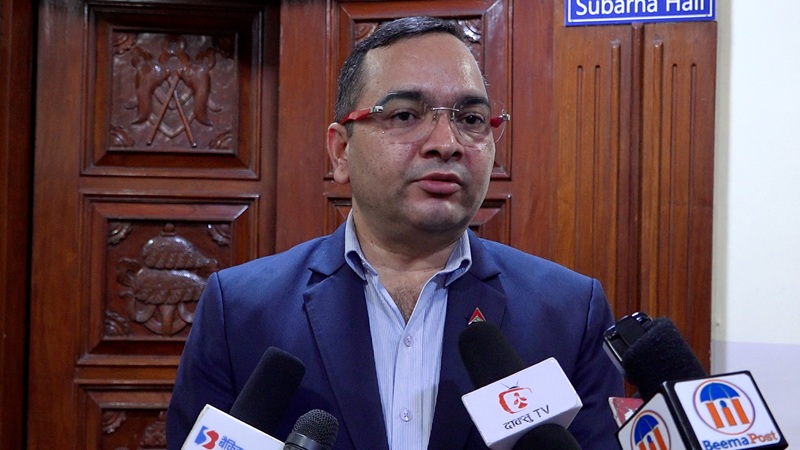
Govt Committed to Private Sector Growth: Nabil Bank CEO Manoj Gyawali

5th August 2026, Kathmandu
In a major development for Nepal’s economic landscape, Finance Minister Dr. Swarnim Wagle has reaffirmed the government’s strong commitment to work closely with the private sector to revitalize national economic activity.
Govt Committed Private Sector Growth
The assurance came during a high-level consultation with Chief Executive Officers (CEOs) of Class ‘A’ commercial banks.
Speaking to media representatives after the meeting, Manoj Gyawali, Chief Executive Officer of Nabil Bank, stated that open dialogue between the government and financial leaders is critical for restoring business confidence and driving sustainable growth.

Key Takeaways from the High-Level Meeting
Record Liquidity Pool: Commercial banks currently hold Rs 1.4-1.5 trillion in excess liquidity, with total deposit reserves at Rs 8.2 trillion.
Sluggish Credit Growth: Despite low interest rates and abundant cash reserves, private-sector credit demand remains below expectations.
Focus on Productive Sectors: Priority is being shifted toward import substitution, export promotion, job creation, and balancing external trade accounts.
Open Door Policy: The government has invited private sector stakeholders to identify legal, policy, and administrative barriers for immediate reform.
Unlocking Rs 1.5 Trillion in Excess Liquidity: The Primary Challenge
Nepal’s commercial banking sector is currently facing a unique structural paradox: while total deposits stand at an unprecedented NPR 8.2 trillion, financial institutions are sitting on NPR 1.4 to 1.5 trillion in excess liquidity.
According to Nabil Bank CEO Manoj Gyawali, the main challenge facing policymakers and financial institutions today is not the availability of funds, but channeling this surplus cash into productive, high-yielding projects.
“With around Rs 8.2 trillion sitting in public deposits, the banking sector possesses immense financial muscle. State capital expenditure alone cannot pull the economy forward—we must channel private investment, banking capital, and Foreign Direct Investment (FDI) together.”
Advertisement
— Manoj Gyawali, CEO, Nabil Bank

Key Strategic Pillars discussed with Finance Ministry
During the session with commercial bank heads, discussions centered around core economic priorities aimed at boosting national productivity:
Removing Barriers to Private Sector Investment
Before meeting banking leaders, Finance Minister Dr. Swarnim Wagle engaged in consultation rounds with manufacturing industry leaders. The insights gathered from production industries formed the basis for discussions with commercial bankers.
Gyawali emphasized that the government sent an unambiguous message: it is prepared to resolve policy and regulatory bottlenecks. The Finance Ministry has asked private sector representatives and banking executives to submit specific proposals regarding:
-
Administrative delays in project approvals.
-
Policy inconsistencies hindering long-term credit expansion.
-
Legal obstacles restricting domestic and foreign direct investments.
Building Trust Through Continuous Policy Consultation
Commending the government’s proactive approach, Gyawali noted that executive-level engagement—led by the Prime Minister and Finance Minister with builders, industrial groups, and commercial leaders—signals a positive shift toward consultative governance.
Continued engagement with financial stakeholders builds policy predictability and investor trust, creating a foundation for economic recovery.
For more: Govt Committed Private Sector Growth