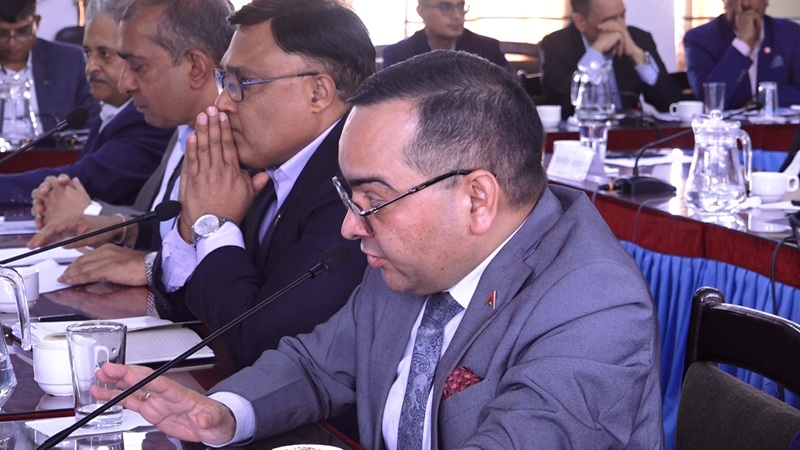
Nabil Bank CEO Manoj Gyawali Warns of Banking Crisis Over Delayed Contractor Payments

6th July 2026, Kathmandu
The Nepalese banking sector is facing imminent pressure, with Non-Performing Loans (NPL) at risk of surging due to the government’s failure to clear outstanding dues to construction contractors.
Gyawali Warns Banking Crisis
Speaking at the House of Representatives’ Finance Committee meeting on Sunday during a discussion on the upcoming monetary policy, Manoj Gyawali, Chief Executive Officer (CEO) of Nabil Bank, warned that the banking system will face severe consequences if issues in the construction sector are not addressed immediately.

High Financial Stakes in the Construction Sector
According to Gyawali, banks and financial institutions (BFIs) in Nepal have a massive credit exposure of around NPR 500 billion in the construction sector.
Because the government has failed to make timely payments for completed development projects, Nepalese construction contractors are plunging into a severe liquidity crunch. This financial distress has directly hampered their ability to service their bank loans regularly.
“Contractors have completed their work but haven’t received their payments,” Gyawali stated. “This has created a situation where they cannot repay their loans on time, which could severely impact the credit quality of banks and spike NPLs.”
Proposed Solutions to Mitigate Banking Risks
To ease the financial strain on both the construction industry and the banking system, Gyawali urged the government to adopt proactive measures, including:
Accelerating Payment Clearances: Instantly clearing the long-overdue bills of contractors for completed projects.
Advertisement

Contract Transfers: Introducing alternative arrangements, such as transferring stagnant contracts to capable entities to keep projects moving.
Implementing these steps would provide immediate relief to Nepalese construction businesses, streamline loan management for banks, and reduce the overall systemic risk in the financial market.
The Ripple Effect on Government Revenue
Gyawali also highlighted how the downturn in the banking sector could directly hurt state coffers. The banking industry stands as one of the largest taxpayers in Nepal, contributing NPR 37 billion to NPR 38 billion annually in corporate income tax. This accounts for roughly 13% of the country’s total income tax collection.
However, recent policy shifts coupled with the ongoing crisis in the construction sector have squeezed bank profitability.
“If banks face shrinking profits or losses, it directly hits the government’s revenue collection,” Gyawali warned. He emphasized that resolving the payment crisis in the construction sector must be a top priority for the government to protect its own revenue streams.
Call for Facilitation via Monetary Policy
The Nabil Bank CEO concluded by urging both the central bank, through its upcoming Monetary Policy, and relevant government bodies to introduce facilitative measures for construction contractors.
Timely payment mechanisms or strategic restructuring alternatives are critical to preventing further financial instability in the Nepalese banking sector.
For more: Gyawali Warns Banking Crisis