Honda Nepal VR-Based Simulators are Enhancing Local Road Safety in Nepal

22nd April 2026, Kathmandu
As the automotive landscape in Nepal shifts toward smarter vehicles and increased road safety awareness, global leaders like Honda are leveraging cutting-edge technology to redefine the driving experience.
Honda Nepal VR-Based Simulators

While many associate Honda with durable engines and reliable SUVs, the secret to its “human-centered” engineering lies in a virtual world: VR-based driving simulators.
For a country like Nepal—where diverse topographies and challenging traffic conditions demand high-precision safety features—Honda’s simulator-led research offers a glimpse into a safer, more efficient digital future.

Reproducing Reality: The Power of Simulation
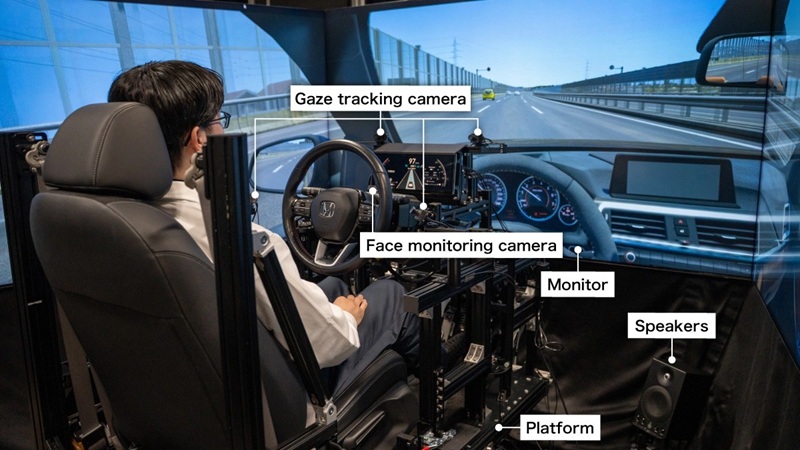
Honda uses driving simulators to replicate the exact feeling of being behind the wheel. These simulators aren’t just for entertainment; they are essential tools for Functional Verification.
In traditional car development, testing actual cars is weather-dependent and time-consuming. In contrast, Honda’s simulators allow engineers to:
Test Dangerous Scenarios Safely: High-risk situations, such as sudden braking or highway cut-ins, can be tested without risking lives.
Ensure Consistency: Simulators allow for testing complex traffic environments under the exact same conditions every time, which is nearly impossible in real-world traffic.
Speed Up Development: By identifying and addressing issues in a virtual environment, Honda achieves faster development at lower costs.
Focus on ADAS and Automated Driving (AD)
One of the most critical applications of these simulators is the development of Advanced Driver Assistance Systems (ADAS). In Nepal, where features like lane-keep assist and collision mitigation are becoming more popular, Honda’s research ensures these systems are “human-friendly.”
Advertisement

Honda utilizes two primary types of simulators for this:
Vision-Focused Simulators: These use a massive screen (5.5m radius) and actual car bodies to encourage natural driving behavior. They are used to test how drivers react when a system shuts down or how they respond to notifications.
Feeling-Focused Simulators: These reproduce the physical forces (acceleration, deceleration, and G-forces) that a driver’s body feels. This is crucial for developing Automated Driving Level 3, where the system takes over during traffic congestion.
The “Human-Centered” Approach: Understanding the Driver
What sets Honda apart is its commitment to understanding human behavior. Beyond testing the car’s parts, Honda uses simulators to measure:
Gaze Tracking: Where is the driver looking?
Physical Responses: Measuring heart rate, hand sweating, and reaction times to alerts.
“Waigaya” Culture: Honda’s unique culture of open discussion (Waigaya) allows engineers to use small, maneuverable simulators to test new ideas rapidly in office settings.
Why This Matters for Honda Nepal
As Honda Nepal continues to introduce vehicles equipped with sophisticated technology, the knowledge gained from these simulators directly impacts the local market.
By studying human characteristics through observation and analysis, Honda creates value that appeals to the “Three Realities Principle,” being realistic, knowing the actual situation, and going to the actual place.
Whether it is navigating the busy streets of Kathmandu or the winding highways of the Himalayas, the safety features developed in these high-tech domes ensure that Nepalese drivers are protected by systems tested for the most extreme “what-if” scenarios.
For more: Honda Nepal VR-Based Simulators