Navigating Nepal’s Gig Economy: NPC and Industry Leaders Call for Coherent Ride-Hailing Framework

21st June 2026, Kathmandu
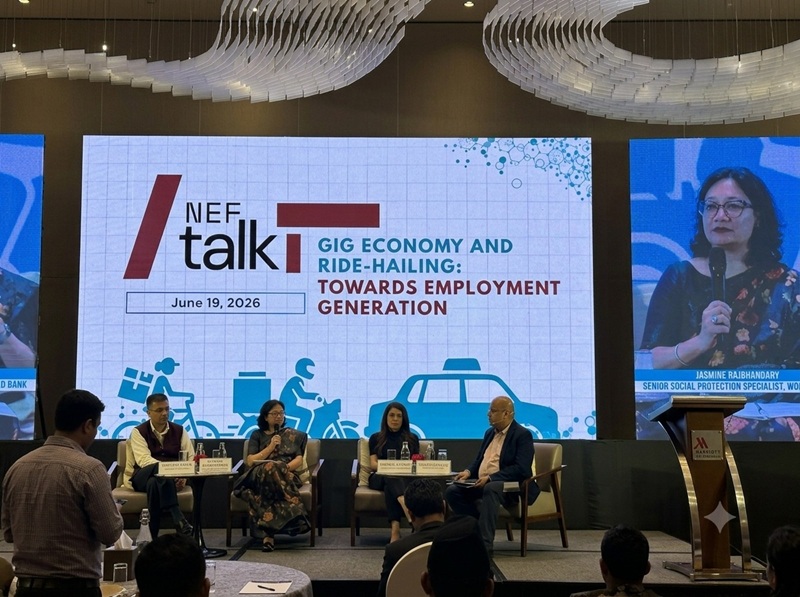
Nepal Economic Forum (NEF) convened its signature event, the NEFtalk, today on the topic ‘Gig Economy and Ride Hailing: Towards Employment Generation,’ bringing together senior policymakers, business leaders, economists, and development practitioners to discuss the policy framework for ride-hailing and the broader gig economy.
Nepal’s Gig Economy NPC Industry Leaders
The discussions emphasized how ride-hailing and the broader platform economy could serve as a meaningful bridge between where the economy is today and an inclusive, employment-generating future.
Nepal’s gig economy is expanding rapidly, with ride-hailing emerging as one of its most visible sectors. By improving urban mobility, supporting SMEs, strengthening tourism, and creating flexible earning opportunities for youth, these platforms are becoming integral to Nepal’s digital and economic infrastructure. The sector also offers one of the most practical pathways to formalization.
The potential is significant, but the key challenge now is to build a balanced and enabling policy environment that allows the sector to grow sustainably while ensuring the safety, protection, and inclusion of the workers who power it.
This means moving beyond ad hoc regulation and towards a coherent national framework that recognizes the gig economy as a legitimate and growing part of Nepal’s economic landscape.
If Nepal can get this right, ride-hailing and the broader platform economy could serve as a meaningful bridge between where the economy is today and the inclusive, employment-generating future it is working toward. Understanding the importance of this sector, NEF conducted this event to discuss the current status of the gig economy and its future.
Addressing the audience, National Planning Commission (NPC) Member Pukar Malla provided views from the government on the discussion around the increasingly important role of the gig economy in Nepal, especially in terms of the country’s future.
He noted that “Nepal must avoid a false choice between innovation and regulation.” On the regulatory framework, he spoke on six policy principles that he will take forward.
These include clarity regarding the national framework on ride hailing, harmonization across subnational and national levels, proportionate worker protection and inclusion in the social security fund, skill certification for riders, labor formalization through digital platforms, and evidence-based government regulation. He also stated that “When there is clarity, it becomes easier to implement [laws and policies].” He also emphasized the importance of stakeholders using the policy window strategically to offer suggestions to the NPC in its further policy planning.
Advertisement

NEF Executive Board Member Rojesh Shrestha delivered the anchor presentation based on the prepared policy brief, which explained how ride-hailing services contribute to tourism, building the SME ecosystem, and creating employment opportunities.He stated, “This is not simply a transportation story now, but increasingly becoming an economic development story.” He also provided suggestions for the government to work towards an enabling environment for the gig economy.
This was followed by remarks from Rajesh Maskey, Chairperson of eDriveNepal, who provided perspectives on the evolution of the ride-hailing business, its contribution to the economy, and the necessary areas for government intervention to regulate this rapidly growing business.
Maskey further described Nepal as a potential leader in e-mobility in South Asia, while also supporting livelihoods across the country. He emphasized further specificity and clarity needed in the law, while ensuring the importance of healthy competition in the gig economy and ride-hailing sector.
NEF Chair Sujeev Shakya then moderated a panel discussion with Aanchal Kunwar, Managing Director of Daraz Nepal, an online e-commerce marketplace; Jasmine Rajbhandary, Senior Protection Specialist at the World Bank Group; and lawyer Semanta Dahal, also Chair at Purak Asia.
Aanchal Kunwar shared her experience as the Managing Director of e-commerce company Daraz Nepal, and the importance of accommodating regulations by the government. She stated, “Any e-business actually makes it much easier [for the government] to monitor and implement whatever changes that they’re trying to make, whether it be from a tax perspective, or from a regulatory perspective.”
Jasmine Rajbhandary emphasized the importance of social protection for gig workers, the rural-urban implications of the gig economy, and the importance of creating feasible and safe opportunities for women in the gig economy. She also emphasized the multiplier effect of the gig economy, stating that “[Ride-hailing] is not [just] a sector, it really is an opportunity as well for so many sectors to grow.” Rajbhandary further spoke of the safety and financial risks which gig-workers face and the importance of managing such risks effectively whilst also leveraging the opportunities of the gig economy. Moreover, she highlighted the importance of keeping gig workers central to the discussion, questioning, “Who are these young people and what does [the gig economy] mean for them and their families? What kind of job quality do they have?”
Semanta Dahal, on the other hand, spoke of the opaque legal context surrounding ride-hailing in Nepal and the importance of a coherent framework. He noted that “[Currently there is] a patchwork of fragmented legal regulations that different provinces have drafted and regulations that the federal government is trying to come up with.” He suggested key policy priorities, including amendments to the labor act to protect gig workers, clarifying fare regulation approaches, distinguishing between digital platforms and software providers to prevent overregulation, and reassessing mandatory local ownership provisions that may hinder growth despite intentions of promoting technology transfer.
Closing the event, NEF Chair Sujeev Shakya reaffirmed NEF’s commitment to working with the relevant stakeholders in the private sector and the government to further support the gig economy in Nepal through research and dialogue.

About Nepal Economic Forum
Nepal Economic Forum (NEF) is an independent, non-partisan platform that brings together policymakers, private sector leaders, civil society, and development partners to advance evidence-based dialogue on Nepal’s economic development. NEF organises high-level forums, publishes research, and facilitates constructive engagement to support inclusive and sustainable economic growth in Nepal.
For more: Nepal’s Gig Economy NPC Industry Leaders