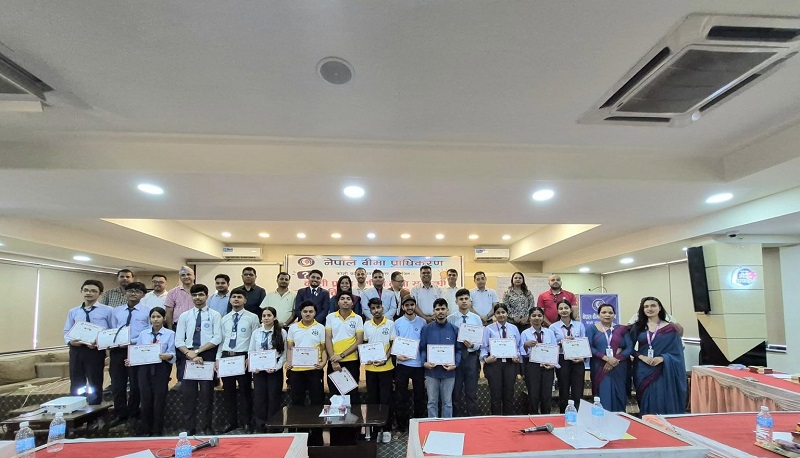
Nepal Insurance Authority Hosts Koshi Province Inter School Quiz Competition to Boost Insurance Awareness Among Youth

14th June 2026, Kathmandu
The Koshi Province Office of the Nepal Insurance Authority has successfully organized a comprehensive provincial level inter school quiz competition focused entirely on insurance awareness and corporate risk models.
NIA Hosts Quiz Competition
The competitive educational event took place within the main auditorium hall of the Morang Chamber of Commerce and Industry located in Biratnagar. By gathering bright young minds for this regional tournament, the regulatory group sought to spark analytical thinking regarding insurance systems, highlight the long term value of household financial safety nets, and encourage early asset preservation habits among the upcoming generation of consumers.

Strategic Execution Framework and Core Evaluation Performance Criteria
The academic tournament attracted active participation from six prominent secondary schools situated across the administrative territories of the province.
The custom question catalog covered basic insurance laws, international indemnity guidelines, local agricultural financial support rules, and general economic principles.
The organizational parameters and leadership structure behind the provincial academic tournament included:
- Executive Session Leadership: The entire youth development program was officially chaired by Preeti Dev, the regional chief of the Koshi Province Office for the regulatory body.
- Professional Moderation Controls: The quick fire rounds and technical points tallying were conducted by designated quiz master Manoj Tiwari.
- Core Academic Objectives: The tournament focused heavily on building a practical understanding of commercial risk underwriting, household saving tools, and modern claim adjustment phases.
- Future Educational Expansion: The authority confirmed its plans to set up similar regional knowledge testing forums across multiple public and private academic circles later this year.
The structured rounds allowed the student groups to showcase their problem solving skills, proving that young minds can easily master complex banking and risk calculations when given the right tools.
Detailed Institutional Rankings and Academic Cash Award Allocations
The final rounds featured highly competitive matching, with three main secondary institutions securing top positions through their superior knowledge of financial literacy concepts.
Advertisement

The winning groups received formal participation certificates alongside cash prizes to support their ongoing academic studies.
The finalized institution rankings and prize structures cleared by the selection panel include:
- First Position Championship Team: The representative group from Maryland Secondary School, which included students Harsh Singh, Suraj Paswan, and Sambhav Bhattarai, won the top crown and secured a cash prize of twenty thousand Nepalese rupees.
- Second Position Runner Up Group: The student squad from Shikshadeep Boarding School, consisting of Keshav Jha, Bishesh Poudel, and Alisa Sapkota, secured the second spot and earned fifteen thousand Nepalese rupees.
- Third Position Honorable Team: The competitors from Shree Pokhariya Secondary School, represented by Krish Khatiwada, Anukul Acharya, and Prajwal Acharya, completed the podium in third place and received ten thousand Nepalese rupees.
- Recognized General Participants: Elite teams representing Birat Campus, City Secondary School, and Siddhartha Shishu Sadan Secondary School completed the final brackets and received official institutional participation certificates.
The administrative staff noted that the high scores achieved by the top teams reflect the growing focus on finance and banking topics within regional school curriculums.
The Long Term Impact of Youth Focused Financial Advocacy on Local Economies
During her closing speech, regional president Preeti Dev highlighted the major role secondary students play as community ambassadors for modern asset protection.
Educating young minds creates an immediate trickle down effect, helping families understand the benefits of securing insurance policies for their farms, businesses, and homes.
The long term economic benefits of running continuous school level financial literacy programs include:
- Faster Adoption of Micro Insurance: Inspiring regular families to purchase low cost healthcare and crop insurance plans to protect their livelihoods from natural disasters.
- Better Personal Financial Habits: Teaching youth the importance of household budgeting, calculated risk taking, and setting up dedicated emergency funds early in life.
- Safer Small Business Investments: Building a new generation of entrepreneurs who know how to use commercial insurance policies to protect their startups from unexpected market losses.
- Closer Ties Between Regulators and Schools: Creating regular opportunities for corporate finance experts, school boards, and state planners to design practical educational materials together.
By converting complex financial regulations into engaging, accessible school activities, the Nepal Insurance Authority continues to strengthen the country financial sector from the ground up, ensuring a more stable and prosperous future for communities throughout Koshi Province.
For More: NIA Hosts Quiz Competition