Prime Bank To Invest Rs. 300 Million In Arun Khola-2 Hydropower Project

30th June 2026, Kathmandu
Prime Bank Limited has signed a financing agreement to invest in the 2 MW Arun Khola-2 Hydropower Project, which is being developed by Himalayan Engineering & Energy.
Prime Bank Arun Khola
This corporate debt commitment underlines the continuing trend of commercial banks in Nepal channeling their excess credit liquidity into renewable energy systems. Commercial financial institutions are legally required to fulfill specific priority sector lending targets, making clean infrastructure consortia highly attractive for deploying long-term capital reserves.
Developing small-scale clean energy production facilities helps decentralized regional infrastructure networks meet increasing industrial power demands.
By supplying dedicated project financing lines, domestic commercial banking units play a massive role in expanding national energy security.
The construction of this facility ensures that more eco-friendly power flows directly into rural transmission loops, supporting small-scale industrial development across adjacent municipal areas.

Official Executive Representation and Corporate Signing Logistics
The formal financial transaction was closed during an administrative gathering attended by the senior executive steering teams of both entities.
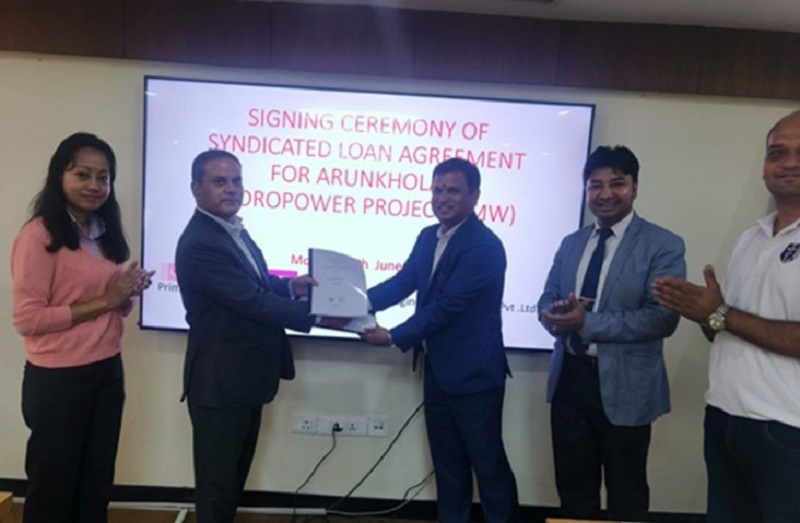
The investment agreement was signed on Monday by Narayan Prasad Shrestha, Deputy General Manager of Prime Bank, and Om Prasad Bhattarai, Chairman of the project developer.
This direct joint confirmation locks down the complete capital allocation pipeline and authorizes the disbursement phases to begin according to structural build schedules.
The developer, Himalayan Engineering & Energy Private Limited, has already finalized the preliminary hydrological studies, completed environmental impact screenings, and secured the necessary grid connection permissions from the state power authority.
Having the funding paperwork managed by top-level financial managers ensures that subsequent corporate governance standards and construction milestone audits will proceed in full alignment with national banking compliance frameworks.
Comprehensive Financial Breakdown and Debt to Equity Architecture
The complete monetary blueprint for the infrastructure build requires a balanced mix of private capital and institutional credit facilities. Under the agreement, the project’s estimated total cost is Rs 486.4 million.
Prime Bank will provide approximately Rs 300 million in debt financing, while the remaining investment will be arranged by the promoter companies through equity.
This clear division ensures that the developers maintain substantial skin in the game while minimizing initial corporate financial strains.
Advertisement

The structural capital deployment follows a standard conservative framework to guarantee project safety. The project will be financed with a 61.66 percent debt and 38.34 percent equity structure.
Maintaining an equity buffer above thirty-five percent protects the primary lending institution from unexpected construction cost overruns or supply chain delays.
This sound capitalization approach guarantees that the infrastructure asset possesses robust financial health long before entering its commercial operations phase.
Anticipated Annual Grid Generation Output and Seasonal Variance Plans
The mechanical and electrical systems of the plant are specifically calibrated to maximize seasonal river flows. According to the developer, the hydropower plant is expected to generate approximately 13.18 GWh of electricity annually, including 4.864 GWh during the dry season and 8.319 GWh during the monsoon season.
River running infrastructure inherently faces variations in fluid velocity, making separate seasonal calculation models necessary for predicting true corporate financial yields.
Securing a high generation output during the dry winter months is especially valuable for the national power infrastructure, as lower water levels frequently force the state to rely on expensive external energy imports.
The projected monsoon output of over eight gigawatt hours will feed ample energy into local manufacturing corridors during peak summer industrial cycles. The complete output will transit through a dedicated high voltage transmission line directly into the nearest central substation.
Target Completion Timeline and Strategic Contributions to the National Grid
The construction engineering teams have introduced a highly aggressive development schedule to bring the generation units online without facing extended delays.
The company aims to complete construction within 15 months from the date of the financing agreement. Achieving commercial operations within this short timeframe requires rapid mobilization of civil excavation crews, structural concrete pouring, and immediate procurement of heavy turbine units.
Once operational, the project is expected to add clean energy to Nepal’s national grid and contribute to strengthening the country’s electricity supply.
Replacing dirty fossil fuel generators with reliable, small-scale run-of-the-river plants directly supports the national strategic plan to build a carbon-neutral economy.
Prime Bank Limited continues to review secondary renewable energy portfolios, positioning its corporate credit books to support sustainable infrastructure development while maximizing long-term value for its public shareholders.
For More: Prime Bank Arun Khola